

Magnetic Block Challenges for Rainy Days: 30-Minute Building Ideas
NOVEMBER 21, 2025
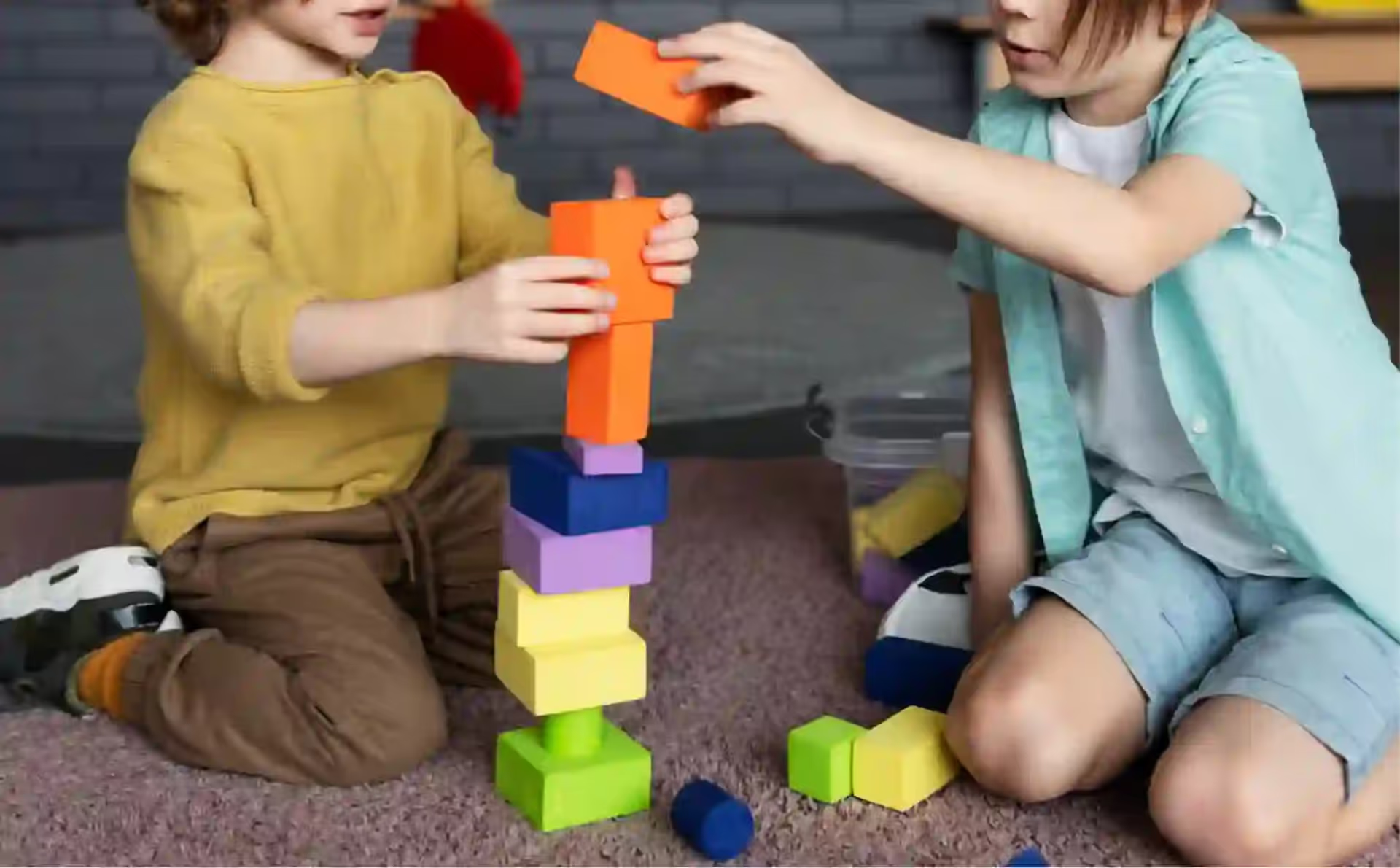
Picture this: Four children sit around a pile of colorful magnetic blocks, their hands hovering in anticipation. They want to build the tallest, most ambitious tower possible. But there's one rule—no talking. Not a single word, whisper, or sound. Just hands, eyes, and blocks.
At first, confusion flickers across their faces. How will they coordinate? Who starts? What if someone builds the wrong way? Then something remarkable happens. Eyes meet. One child slowly reaches for a square tile and places it deliberately on the floor. Another child nods almost imperceptibly and adds a triangle. A third child gestures toward the base, miming "wider foundation." Without a single spoken word, they begin building—not just a tower, but a synchronized collaboration that requires deeper communication than talking ever did.
This is the collaborative architecture game—a deceptively simple challenge that removes the most common communication tool (language) and forces children to rely on observation, empathy, spatial awareness, and creative problem-solving. What emerges isn't just a structure of magnetic tiles but a masterclass in nonverbal teamwork that strengthens skills children will use throughout their lives.
The beauty of this silent tower challenge lies in its elegant simplicity. You need only magnetic building blocks, willing participants, and the discipline to remain quiet. Yet within those constraints, children develop executive function skills like impulse control and planning, social-emotional competencies including empathy and emotional regulation, spatial reasoning essential for STEM learning, and leadership dynamics as they learn when to lead and when to follow.
This article explores why removing verbal communication paradoxically enhances collaboration, how to structure this game for maximum developmental benefit, what skills emerge from silent building challenges, and how parents, educators, and therapists can adapt this activity for different ages, settings, and learning objectives.
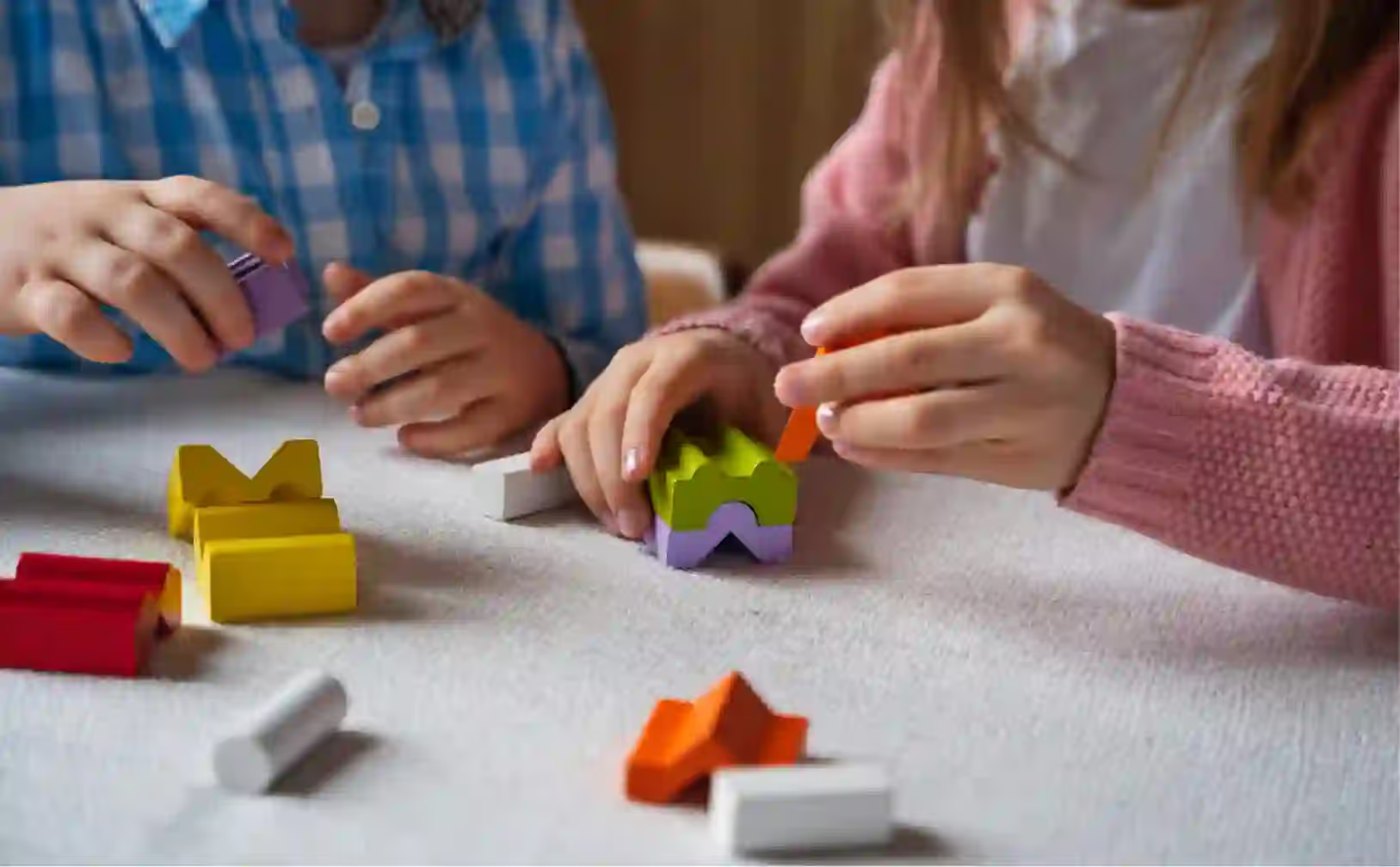
Humans communicate constantly without words. Before infants speak, they coordinate with caregivers through eye contact, gestures, and emotional expressions. Even as adults, research suggests that 55-93% of communication effectiveness comes from nonverbal cues—facial expressions, body language, tone, and timing—rather than words themselves.
Yet most children's collaborative activities emphasize verbal communication. Group projects require discussion, negotiation, and verbal idea-sharing. While these skills matter enormously, something valuable gets lost when we rely exclusively on words: the capacity to read subtle cues, synchronize without explicit coordination, and trust nonverbal understanding.
Cooperative inhibition describes the ability to suppress individual impulses in favor of group goals. When building silently, children can't blurt out instructions or dominate verbally. They must inhibit the urge to speak while simultaneously staying engaged with the group task. This dual demand—suppressing one behavior while executing another—exercises cognitive control in ways that strengthen executive function. According to research on child development from the Harvard Center on the Developing Child, executive function skills including working memory, flexible thinking, and self-control are fundamental to success in school and life. Activities requiring cooperative inhibition provide natural, engaging practice in these critical capacities.
Joint attention—the shared focus of two or more people on the same object or event—becomes explicit and necessary in silent collaboration. When children can't say "look at this" or "hand me that," they must establish joint attention through eye contact, pointing, or positioning their bodies toward objects. This practice strengthens their ability to recognize where others are focusing attention and to direct others' attention without words—skills essential for all social interaction.
Kinesthetic synchrony emerges when collaborators physically coordinate their movements in time and space. Watch children building silently and you'll notice they begin moving in rhythm—one reaches while another waits, hands alternate adding pieces, bodies lean and shift in patterns mirroring each other. This physical synchronization creates what researchers call "embodied cooperation," where understanding flows through movement rather than language. Studies in developmental psychology show that movement synchrony increases prosocial behavior, empathy, and cooperation between children. When bodies move together harmoniously, minds follow. Silent building challenges naturally produce this synchrony because participants must carefully observe each other's physical actions and time their own movements accordingly.
Gesture-based coordination forces children to communicate intentions through deliberate signals. A pointed finger indicates "build there." An open palm facing outward means "wait." A slow, exaggerated placement demonstrates "do it like this." These gestures carry meaning but require interpretation—the receiver must decode what the gesture signifies and respond appropriately. This interpretation process builds theory of mind, the capacity to understand that others have mental states different from one's own. The Collaborative for Academic, Social, and Emotional Learning (CASEL) emphasizes that social awareness—including the ability to take others' perspectives and recognize social cues—is a core competency for emotional intelligence. Silent collaboration activities directly target this competency by making social cue interpretation essential rather than optional.
Attentional intensity increases when verbal distractions are removed. Talking while building divides attention between conversation content and construction task. Silence eliminates that split, allowing fuller focus on the building itself—observing stability, judging proportions, noticing partner actions, and planning next moves. This undivided attention supports deeper engagement and more sophisticated spatial reasoning.
Empathetic observation becomes necessary when you can't ask "what are you trying to do?" Instead, you must watch carefully, interpret intent from actions, and respond to what you perceive rather than what you're told. This cultivates empathy—not just emotional empathy (feeling what others feel) but cognitive empathy (understanding what others think and intend).
Research published in developmental science journals demonstrates that activities requiring perspective-taking and intent-interpretation strengthen children's empathetic capacities. Silent collaboration provides natural repeated practice in exactly these skills.
The simple act of building cooperatively without speaking targets multiple developmental domains simultaneously, making it remarkably efficient for skill-building.
Executive Function Development
Impulse control gets intensive practice. Children naturally want to grab pieces, start building immediately, or tell others what to do. The no-talking rule requires constant self-monitoring and impulse suppression—recognizing the urge to speak and deliberately not speaking. This is precisely the kind of exercise that strengthens inhibitory control, one of the three core executive functions.
Working memory is engaged as children must remember what they're building toward (the goal of height), track what's already been built, plan next steps, and remember partners' previous actions to predict future moves—all without verbal reminders or discussion to offload that memory burden.
Cognitive flexibility develops when initial plans don't work. When a tower wobbles or falls without the ability to verbally negotiate a new strategy, children must flexibly shift approaches, incorporate others' ideas communicated nonverbally, and adjust their own mental models of what the structure should become.
Planning and organization emerge through necessity. Without discussion, effective building requires that someone establishes a pattern or system that others can recognize and follow. Children take turns planning through example—building in ways that demonstrate intended patterns—and others must recognize and continue those patterns.
Spatial Reasoning and Engineering Thinking
Three-dimensional visualization strengthens as children build upward. They must mentally rotate pieces, predict how weight will distribute, judge whether structures will balance, and understand geometric relationships—all while observing how physical reality confirms or contradicts their mental models.
Structural stability concepts are discovered through experimentation. Without verbal instruction about "wide bases" or "weight distribution," children must learn these principles through trial and error, observation of what works and what collapses, and imitation of successful strategies partners demonstrate.
Early engineering intuition develops as children encounter and solve real architectural challenges: how to build taller without toppling, how to reinforce weak points, how to transition between different structural elements, and how to achieve vertical height within physical constraints. These are authentic engineering problems experienced hands-on.
According to educational research compiled by Edutopia, hands-on collaborative STEM activities that involve authentic problem-solving produce deeper learning than passive instruction. The silent tower challenge embodies this principle perfectly—genuine problems requiring creative solutions with immediate feedback from physical reality.
Social-Emotional Learning
Nonverbal cue decoding becomes the primary communication mode. Children must interpret facial expressions (is my partner frustrated or concentrating?), body language (are they reaching eagerly or hesitantly?), eye contact patterns (are they looking at me for confirmation or at the structure planning next moves?), and gestural signals (what does that hand wave mean?).
This intensive practice in reading nonverbal communication translates beyond the game. The same observation skills help children recognize when teachers are impatient, when friends are sad despite claiming "I'm fine," or when situations feel unsafe even if words suggest otherwise.
Emotional regulation is required when frustration mounts. Towers fall, partners make unexpected choices, and desired pieces get used differently than intended—all common triggers for frustration or conflict. Without words to vent, negotiate, or argue, children must regulate emotions internally, find calm amid disappointment, and persist through setbacks without the release valve of verbal expression.
This constraint paradoxically builds regulation capacity. When you can't express frustration verbally, you must manage it internally or through constructive action. Over time, this builds the neural pathways supporting self-soothing and emotional control.
Collaboration without competition shifts the dynamic. When you can't argue about whose idea is better or verbally claim credit, the work becomes genuinely shared. Success belongs to the group collectively. This experience of "we-ness" rather than "me-versus-you" builds collaborative identity and reduces the competitive dynamics that can undermine group work.
Trust development occurs through successful nonverbal coordination. When your wordless signal is correctly understood and acted upon, trust grows. When you correctly interpret another's intent and respond appropriately, mutual understanding deepens. These trust-building moments accumulate across the activity, strengthening social bonds.
Research from Zero to Three, an organization focused on early childhood development, emphasizes that trust and secure relationships form the foundation for all learning. Activities that build trust between children create the relational safety necessary for taking learning risks in other domains.
Leadership and Followership Dynamics
Emergent leadership appears when certain children take initiative demonstrating building strategies, establishing patterns others follow, or gently redirecting when structures go off-track. This leadership isn't assigned or verbal—it emerges from action and is validated when others follow.
Children who rarely speak up in verbal group work sometimes become leaders in silent collaboration because the skills required shift from verbal articulateness to spatial-kinesthetic intelligence and clear nonverbal demonstration.
Followership as a skill gets equal practice. Recognizing when others have good ideas, choosing to support rather than redirect, and harmonizing with emerging patterns rather than insisting on your own vision are valuable capacities often underdeveloped because leadership gets more attention.
Silent building makes followership visible and valuable. Children learn that reading others' intentions accurately, building on others' ideas, and providing stable support are contributions equal to initiating new directions.
Turn-taking without negotiation must happen organically. With no verbal claiming of turns, children develop sensitivity to timing—waiting for the right moment, recognizing when others are actively building versus pausing, and finding rhythm in alternating contributions. This builds the social grace of knowing when to step forward and when to step back.
STEM Integration and Creative Exploration
Physics concepts emerge experientially. Children discover that taller structures are less stable, that triangular supports create strength, that weight must distribute evenly, and that materials have properties affecting construction. These aren't taught—they're discovered through building, failure, adjustment, and success.
Mathematical thinking includes counting (how many pieces high?), geometric recognition (which shapes fit where?), symmetry appreciation (balanced structures look and perform differently), and spatial measurement (judging distances and proportions). All occur naturally within the building challenge without feeling like math lessons.
Design thinking process unfolds organically: empathize (understand partners' intentions), define (tacitly agree on goals), ideate (try different approaches), prototype (build), and test (see if it stands). This design cycle repeats rapidly throughout the activity, building fluency with iterative problem-solving.
The National Association for the Education of Young Children emphasizes that young children learn best through play-based activities that integrate multiple domains rather than isolated skill drills. Silent tower building embodies this integrated learning perfectly.
Proper setup ensures the activity runs smoothly and achieves its developmental objectives.
Recommended ages: This activity works beautifully for children 4-10 years old, with modifications for different developmental levels. Preschoolers (4-5) benefit from shorter sessions and more explicit initial demonstration. School-age children (6-10) can handle longer sessions, more complex rules, and sophisticated variations.
Materials needed: One set of magnetic building blocks with at least 40-60 pieces per team. Having adequate pieces prevents frustration from resource scarcity. Blocks should be standard geometric shapes (squares, triangles, rectangles, hexagons) rather than specialized pieces requiring specific knowledge. Optional: timer for timed challenges, though untimed building often produces better focus.
Group size: Teams of 2-4 children work best. Pairs create the simplest dynamic with clear responsibility for coordination. Trios introduce interesting complexity as children must split attention between two partners. Quartets test collaboration limits and work well for older children with stronger executive function skills.
Space requirements: Each team needs a stable flat surface roughly 3x3 feet—enough room for building without constraint but contained enough that all team members can easily reach and see the structure. Floor space works perfectly; tables work if stable and sufficiently large.
Preparation steps:
Sort magnetic blocks ensuring no damaged pieces with exposed or loose magnets. Safety must always come first, particularly with young children. The Consumer Product Safety Commission magnet safety guidance provides important information about proper magnet toy use and the serious risks of magnet ingestion if pieces break.
Divide blocks into equal sets for each team, creating fair starting conditions. Count pieces so each team has identical resources. Alternatively, provide communal piles that all teams access, introducing strategic decisions about resource allocation.
Clear the building area of distractions. The focus required for nonverbal collaboration means environmental management matters—minimize background noise, eliminate visual clutter, and create space where children can see each other clearly.
Demonstrate the no-talking rule clearly. Be explicit that "no talking" includes whispering, sound effects, singing, humming, or any vocal noise. However, gestures, facial expressions, and body language are all permitted and encouraged.
Rule establishment: Before starting, ensure all participants understand:
No verbal communication of any kind once building begins. Nonverbal signals (pointing, gesturing, eye contact, nodding) are allowed and encouraged. Everyone must contribute—no passive observers allowed. The goal is building the tallest stable structure possible. "Stable" means it stands unsupported for at least 10 seconds after completion. Teams work independently without looking at other teams' strategies (if multiple teams play simultaneously). A designated timekeeper or facilitator can speak to give time warnings or answer urgent questions, but builders remain silent.
Creating proper mindset: Before imposing silence, briefly discuss why this challenge is valuable: "When we can't talk, we have to pay extra attention to each other. We'll discover new ways to communicate and learn to work together differently. It might feel frustrating at first—that's normal! The challenge is figuring out how to understand each other without words."
This framing helps children view the constraint as a fascinating challenge rather than an arbitrary restriction, increasing engagement and reducing resistance.
The activity unfolds in distinct phases, each serving specific developmental purposes.
Phase 1: Silent Planning (30-60 seconds)
Teams gather around their materials in complete silence. During this planning phase, children can look at the blocks, make eye contact with partners, gesture about ideas, and begin coordinating without touching pieces yet.
This pause before action serves crucial functions. It forces children to think before acting rather than impulsively building. It creates space for nonverbal negotiation about strategy—do we build a wide pyramid or a narrow tower? It establishes communication patterns that will continue during building. And it builds anticipation and focus.
Facilitators should observe carefully during planning. You'll see fascinating dynamics emerge—some children naturally take planning leadership through confident gestures, others observe and nod, and creative tensions appear when children have conflicting visions communicated through competing gestures.
Phase 2: Active Building (5-15 minutes)
Signal the start (a gentle bell, timer beep, or hand signal). Teams begin building in silence, working toward their tallest stable structure.
During building, facilitators should:
Maintain the silence rule firmly but kindly. If children speak, gently shake your head or put a finger to your lips. If verbal outbursts become frequent, pause everyone and re-establish the rule with a fresh start. Observe collaboration patterns noting who initiates, who follows, how conflicts get resolved nonverbally, and what communication strategies emerge. Resist intervening unless safety concerns arise. Let children struggle productively through challenges—the struggle is where learning happens. Take photos or videos if appropriate, documenting the building process for later discussion.
Children will experience several predictable phases during building. Initial hesitancy as they adjust to the constraint and figure out how to start. Growing coordination as patterns and rhythms establish. Possible setbacks when structures fall, requiring nonverbal conflict resolution and decision-making about whether to rebuild or modify approaches. Final push toward height where risk-taking and careful placement balance precariously.
Phase 3: Completion and Documentation
When the time limit expires or teams indicate they're finished, structures should stand unsupported for 10-15 seconds proving stability. Measure heights objectively—counting blocks high, using a ruler, or comparing structures side-by-side.
Take photos documenting final structures before moving to the debrief phase. These images become valuable prompts for reflection and can be saved showing progress if the activity becomes recurring.
Celebrate the achievement before any analysis. Applaud the completed towers and the successful silent collaboration. Acknowledge the difficulty and the triumph.
Phase 4: Debrief and Reflection (5-10 minutes)
Now silence ends and verbal discussion begins. This is where much of the learning gets consolidated through metacognitive reflection.
Facilitation questions:
Encourage children to share their observations about the process rather than just the product. The tower height matters less than the insights gained about communication, collaboration, and problem-solving.
Phase 5: Optional Second Round
If time and interest allow, a second silent building round with the same teams produces dramatically different results. Children apply learning from the first attempt, demonstrate improved nonverbal coordination, build faster and more efficiently, and achieve greater heights through refined collaboration.
The improvement between rounds provides powerful evidence that the skill-building is real and immediate. Children see their own growth across just 20-30 minutes.
While the no-talking rule is absolute, skilled facilitators can teach children effective nonverbal collaboration strategies that enhance the activity.
The verbal reflection following silent building is where conscious learning happens. Children articulate what they experienced, recognize skills they used, and connect the activity to broader life applications.
Metacognitive awareness develops when children think about their own thinking. Questions like "How did you decide what to build next?" or "What was your strategy for working with your partner?" prompt reflection on cognitive processes that were automatic during building. According to educational psychology research, metacognition—awareness and understanding of one's own thought processes—is a strong predictor of academic success. Activities that prompt metacognitive reflection build this capacity.
Emotional vocabulary expands when children name feelings that arose during the challenge. "I felt frustrated when the tower fell" identifies an emotion. "I felt excited when I realized my partner understood my idea" articulates a more complex emotional experience involving social connection. Facilitators can help children develop nuanced emotional vocabulary: "It sounds like you felt disappointed at first but then felt determined to try again. That's resilience—bouncing back from setbacks."
Perspective-taking conversations emerge from questions like "Why do you think your partner chose that piece?" or "What was your partner trying to communicate with that gesture?" These questions prompt children to step into others' mental states, exercising theory of mind.
Comparative analysis between silent and verbal collaboration helps children recognize benefits of each mode:
This nuanced understanding that different communication modes serve different purposes builds flexible thinking about collaboration itself.
Transfer questions connect the activity to other contexts:
These questions help children see that skills practiced in the game have real-world applications, increasing motivation and retention.
Is the no-talking rule frustrating for kids?
Initially, yes—many children find it challenging and slightly frustrating, which is actually part of the learning. That frustration teaches impulse control and emotional regulation. However, most children quickly adapt and even report enjoying the focused, peaceful quality of silent building. Framing it as an interesting challenge rather than a restriction reduces resistance. If frustration becomes overwhelming for a particular child, allow them to step back and observe rather than forcing participation, or modify the rules to allow nonverbal sounds while still prohibiting words.
How long should the game last?
For younger children (4-6), keep building time to 5-8 minutes. Attention spans are developing, and shorter sessions maintain engagement without exhaustion. For school-age children (7-10), 10-15 minutes of building works well. Some groups can sustain focus for 20 minutes if deeply engaged. Read the room—if energy and focus are high, let it continue; if children seem done, end it there. The debrief should be 5-10 minutes regardless of age, as this is where much learning consolidates.
Does this work for neurodiverse learners?
Yes, often remarkably well. Children with ADHD sometimes find that removing verbal distraction helps them focus more intensely on the task. Children on the autism spectrum may appreciate the clear structure and reduced demand for verbal social interaction, though some might find the ambiguity of nonverbal communication challenging—providing explicit gesture coaching beforehand can help. Children with language delays or who speak English as a second language often excel in nonverbal collaboration, as it levels the playing field. However, every child is unique—observe individual responses and modify as needed.
What if a child feels overwhelmed by the silence?
Some children find silence uncomfortable or anxiety-provoking. If this occurs, validate their feelings first: "Silence can feel strange sometimes. That's okay." Then offer accommodations: they can observe instead of actively building, you can play quiet instrumental music in the background creating gentle sound, or you can modify rules to allow nonverbal sounds (humming, tapping) as long as no words are spoken. For children with auditory processing differences, complete silence might actually be helpful by reducing sensory input—context matters.
Can this activity help children who struggle with peer interactions?
Yes, particularly for children who have difficulty with verbal social exchanges. The structured activity provides clear goals, reduces verbal demands that can trigger social anxiety, and creates a controlled context for practicing cooperation with immediate feedback about what works. The nonverbal nature removes some pressure while still building social connection. However, for children with significant social challenges, having an adult or older child as a partner might be more comfortable than peer pairing initially.
How often should we repeat this activity?
Benefits accumulate with repetition. Weekly or bi-weekly sessions allow children to build on previous learning, develop more sophisticated nonverbal communication strategies, and deepen collaborative skills. If done too frequently (daily), novelty and challenge diminish. If too rare (monthly), skills don't consolidate as effectively. Finding a rhythm where it feels familiar but still engaging is ideal.
The collaborative architecture game—building the tallest tower without talking—transforms a simple childhood activity into a sophisticated exercise in nonverbal communication, emotional intelligence, executive function, and cooperative problem-solving.
In a world saturated with words, screens, and constant verbal interaction, this silent challenge offers children something rare and valuable: the opportunity to communicate through observation, movement, and presence rather than language. The skills they practice—reading subtle cues, coordinating without explicit instruction, regulating emotions without verbal release, and trusting partners through actions rather than promises—extend far beyond the game itself.
These are the skills that help children recognize when teachers are losing patience before explicitly stating it, understand when friends need support despite claiming "I'm fine," collaborate effectively in sports or performances requiring nonverbal synchrony, and navigate social situations where explicit verbal communication is impossible or inappropriate.
The beauty of this activity lies in its elegant simplicity. No expensive curriculum, no elaborate planning, no specialized training required. Just magnetic blocks, willing participants, and the discipline to remain quiet while building together.
The invitation is simple: tonight, gather magnetic blocks, invite your children or students, explain the challenge, and then don't say a word. Just watch what happens. Watch how children naturally invent communication systems. Watch how they navigate frustration when towers topple. Watch how satisfaction blooms when they successfully coordinate without words. Watch how focus deepens when verbal chatter is removed.
Then, after the towers stand tall (or don't), have the conversation. Ask what they noticed, what surprised them, what they learned about themselves and each other. You might be surprised by the depth of insight children offer about communication, teamwork, and the ways we understand each other beyond words.
Cooperation doesn't always require conversation. Sometimes the most profound collaboration happens in silence, where actions speak louder than words ever could, and where building together creates bonds stronger than any tower of magnetic blocks.
So try it. Build without talking. See what emerges when words fade away and only presence, attention, and shared purpose remain. You might discover that silence, far from being empty, is actually full—of observation, understanding, and a different kind of communication that children need to practice just as much as speaking itself.
NOVEMBER 21, 2025
NOVEMBER 21, 2025
NOVEMBER 20, 2025
NOVEMBER 20, 2025
NOVEMBER 20, 2025