

Birthday Party Games With Magnetic Tiles: Group Activities That Work
NOVEMBER 21, 2025
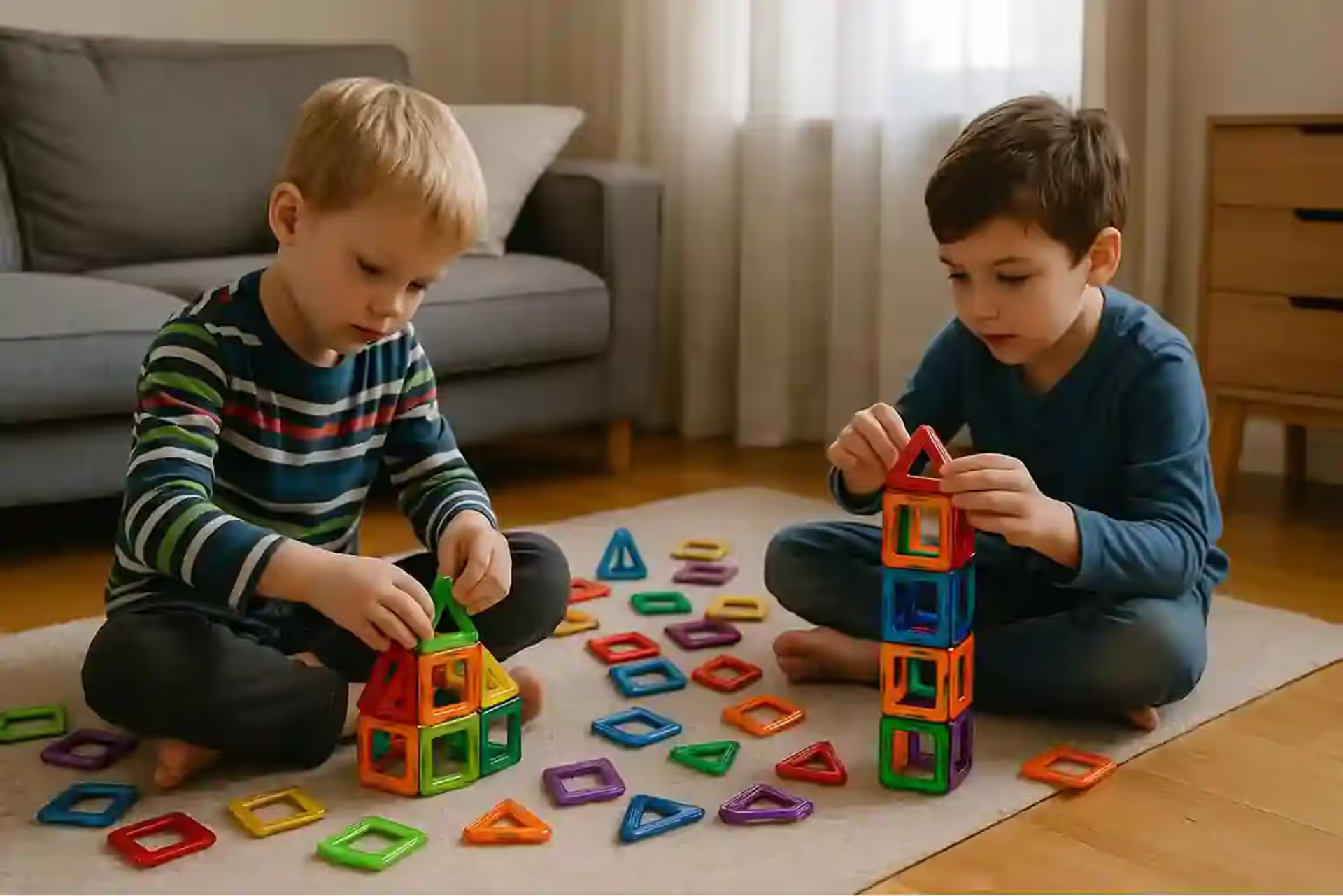
Rain hammers the windows. Your kids have already watched two shows, eaten three snacks, and asked "what can we do?" seventeen times. The magnetic blocks sit in their bin, full of potential but lacking direction. You need specific, engaging challenges that actually work—not vague suggestions to "build something cool." These 30-minute magnetic block challenges transform rainy afternoon chaos into focused creativity, each one tested for that sweet spot between too easy (boring) and too hard (meltdown).
Each challenge here includes exact parameters, time limits, and difficulty variations for different ages. No Pinterest-perfect builds that require 200 pieces and an engineering degree. These are real activities for real families with mixed-age kids, limited pieces, and parents who need that 30 minutes to actually accomplish something else. Let's turn those magnetic tiles into rainy day salvation.
Setup Time: 2 minutes
Build Time: 20 minutes
Test Time: 8 minutes
Pieces Needed: 40-60 tiles
Ages: 4+
Build the tallest tower possible that can survive the "earthquake test"—sliding a book under one corner of the building surface. Start with a hardcover book on a smooth floor. Kids build directly on the book cover. After 20 minutes of building, slowly slide another book under one corner of the base book, creating an angle. The tower that stays standing at the steepest angle wins.
This challenge teaches structural engineering principles without saying those words. Kids discover that wide bases beat tall skinny towers, that triangular supports prevent collapse, and that symmetry matters for balance. The sliding book creates drama and anticipation—will it stand or fall? For younger kids, use a magazine for gentler angles. Older kids can add a second phase: the tower must also hold a toy car on top during the earthquake.
Variation for multiple kids: Each child builds on their own book, creating an earthquake competition. Or work together on one mega-tower with assigned roles—one child does the base, another the middle, another the top. The collaborative version often creates more elaborate structures as kids combine their strengths.
Success tips for this challenge include using square tiles for the base since they're more stable than triangles, connecting pieces at multiple points rather than just edges, keeping the center of gravity low, and testing gentle tilts during building to check stability. If frustration builds, introduce the "rebuild rule"—after a collapse, builders get 60 seconds to grab fallen pieces and reinforce before the next earthquake. This prevents total destruction despair while maintaining challenge.
Setup Time: 3 minutes
Build Time: 22 minutes
Race Time: 5 minutes
Pieces Needed: 50-70 tiles plus marbles
Ages: 5+
Create a marble run using magnetic tiles that takes exactly 10 seconds for a marble to travel from start to finish. Not 8 seconds, not 12—as close to 10 as possible. This specificity transforms random building into precision engineering. Kids must balance speed sections with slow zones, creating chicanes, loops, and obstacles that control marble velocity.
Start the run at least 12 inches off the ground (stack of books works) and end in a container on the floor. The height requirement ensures enough energy for interesting paths while the container ending prevents marble chaos. Use a phone timer for accuracy. After each test run, builders get 90 seconds to adjust their track—add a curve to slow things down or straighten a section for speed.
The genius of this challenge lies in its iterative nature. First attempts usually finish in 3-4 seconds—way too fast. Kids learn that longer doesn't always mean slower if the path is steep. They discover that rough surfaces (tiles placed ridge-side up) create friction. The time limit prevents endless tinkering while the specific target (10 seconds) maintains focus. Understanding basic physics concepts through hands-on experimentation makes abstract principles concrete and memorable for young learners.
Setup Time: 5 minutes
Build Time: 20 minutes
Testing Time: 5 minutes
Pieces Needed: 40-50 tiles in at least 3 colors
Ages: 6+
Build a bridge between two equal-height surfaces (books, boxes) that follows a specific color pattern. Draw the pattern from a deck of cards—red card means warm colors (red, orange, yellow), black means cool colors (blue, green, purple). Draw 5 cards and that's your required pattern. The bridge must incorporate this color sequence at least 3 times while spanning a minimum 8-inch gap and supporting 5 toy cars.
This challenge brilliantly combines structural engineering with pattern recognition. Kids can't just build the strongest bridge—they must integrate aesthetic requirements that often conflict with structural ideals. Maybe the perfect support piece is the wrong color. This constraint forces creative problem-solving: can you hide structural pieces behind decorative ones? Can the pattern run diagonally?
For younger kids, simplify to alternating colors. For older kids, add requirements like "pattern must be visible from above AND from the side" or "use exactly 7 pieces of each color." The testing phase adds drama—place cars one at a time, building suspense with each addition. Different age groups benefit from adjusted complexity levels. Four to five year olds work best with two alternating colors, a four-inch gap, and two toy car weight requirements. Six to seven year olds handle three-color sequences, six-inch gaps, and four cars. Eight to nine year olds manage five-color patterns, eight-inch spans, and six cars. Children ten and older tackle pattern plus symmetry requirements, ten-plus inch gaps, and real objects like books for weight testing.
Setup Time: 2 minutes
Build Time: 15 minutes building + 10 minutes storytelling
Pieces Needed: 30-40 tiles plus toy animals
Ages: 3+
Draw an animal card (or pick a toy animal randomly from a bag). Build that animal's habitat in exactly 15 minutes. The habitat must include: shelter from rain, a food storage area, a play zone, and a sleeping spot. After building, spend 10 minutes telling the story of a day in the animal's life using the habitat.
This challenge works brilliantly for mixed ages. Younger kids focus on basic enclosures while older ones add elaborate features. A 4-year-old might build a simple bear cave while their 8-year-old sibling creates a multi-level bear habitat with a fish-catching platform and honey storage. The storytelling component validates all building levels—simple structures can have elaborate stories. Resources on imaginative play development confirm that narrative building supports cognitive development across multiple domains simultaneously.
Keep a timer visible to maintain urgency. When time expires, building stops immediately—no "just one more piece!" This hard stop prevents perfectionism paralysis and teaches time management. The story phase allows builders to explain features that might not be visually obvious, giving verbal kids a chance to shine even if their building skills lag.
Using visual timers helps kids see time remaining without constant parental reminders. Playing building music that stops when time's up creates urgency without nagging. For competitive kids, offer 30-second "power-up" bonuses for specific achievements like using all one color or building above a certain height. The hard stop when time expires teaches a valuable lesson: perfection is the enemy of done. Kids learn to prioritize essential features over endless tweaking.
Setup Time: 3 minutes
Build Time: 25 minutes
Pieces Needed: 60-80 tiles (must have pairs of each type)
Ages: 7+
Place a strip of tape down the middle of your building surface. Whatever gets built on the left must be exactly mirrored on the right. Start with a random selection of 5 tiles placed on the left side. Builders must create the mirror image on the right, then expand both sides simultaneously, maintaining perfect symmetry. The goal: create the most elaborate symmetrical structure possible in 25 minutes.
This challenge exercises spatial reasoning in ways that hurt adult brains. Kids must constantly translate left to right, managing not just placement but orientation. A triangle pointing left needs its twin pointing right. A blue tile backed by red needs red backed by blue on the opposite side. The constraint forces deliberate building—no random placement allowed. Research on spatial reasoning development shows that symmetry exercises strengthen mathematical thinking and geometric understanding essential for advanced STEM learning.
For solo builders, this becomes a meditation in precision. For partners, assign one to each side—they must communicate constantly to maintain symmetry. Watch for the moment kids realize they can build perpendicular to the tape line, creating structures that bridge both sides while maintaining mirror properties. This "aha!" moment usually comes around minute 15.
Setup Time: 1 minute
Build Time: 20 minutes setup + 5 minutes reset
Run Time: 30 seconds to 2 minutes
Pieces Needed: All available tiles
Ages: 5+
Create the longest possible domino chain reaction using magnetic tiles standing on edge. But here's the twist: the chain must include at least 3 "special features"—a split where one tile knocks down two paths, a bridge where tiles pass under without stopping, and a "launcher" where a falling tile sends another tile sliding to continue the chain elsewhere.
The magnetic properties add complexity regular dominoes lack. Tiles might stick together when they shouldn't or repel at crucial moments. Kids learn to use these properties strategically—placing tiles at specific angles where magnetism helps rather than hinders. The special features requirement prevents simple straight lines, forcing creative engineering.
Build in sections to prevent total collapse despair. Use books or boxes to create "firebreaks" during construction—if section A falls during setup, section B remains safe. Remove firebreaks for the final run. Film the chain reaction—kids love analyzing slow-motion replays to see exactly what worked and what needs adjustment for round two. Understanding cause and effect relationships through chain reactions develops logical thinking and sequential reasoning skills.
Setup Time: 1 minute
Build Time: 15 minutes
Pieces Needed: 25-30 tiles
Ages: 6+
Build the tallest structure possible using only one hand. The other hand must stay behind your back the entire time. No using your body, the table edge, or any other surface to steady pieces—pure one-handed construction. This simple constraint transforms easy building into a focus-intensive challenge.
Watch kids discover that magnetic properties become crucial when you can't steady pieces manually. They learn to use the table's magnetic attraction, to build in sequences that self-support, and to move slowly to prevent cascade failures. The challenge naturally slows down speed builders and helps impulsive kids develop patience.
For mixed ages, implement handicaps: older kids use non-dominant hand, younger kids can use their elbow for emergency steadying, adults must wear an oven mitt. These modifications level the playing field while maintaining challenge for everyone.
These quick challenges work perfectly for short attention spans or as warm-ups before longer activities. They require minimal setup and use fewer pieces, making them ideal for impromptu rainy day entertainment when parents need just a brief distraction. The verbal description challenge particularly develops communication skills as builders must translate visual information into precise language.
Setup Time: 2 minutes
Build Time: 25 minutes
Pieces Needed: 40-50 tiles
Ages: 8+
Build a platform that extends as far as possible from a table edge without falling. The platform must hold a specific object (choose based on available tiles—maybe a small toy or eraser) at its furthest point. Only magnetic tiles can touch the table; no tape, no additional supports. Pure cantilever engineering.
This challenge reveals physics principles without lectures. Kids discover that weight behind the fulcrum point (table edge) allows extension beyond it. They learn about counterbalancing, structural triangulation, and weight distribution. The specific object requirement prevents cheating with super-light platforms that couldn't hold anything useful.
Measure extension from the table edge to the farthest tile edge, not the object placement. This encourages builders to maximize their reach. For group challenges, each team uses identical object weights. For solo builders, try increasingly heavy objects to find the platform's limit. Exploration of balance and stability concepts through hands-on experimentation creates deeper understanding than passive observation ever could.
Setup Time: 3 minutes
Build Time: 20 minutes building + 5 minutes story
Pieces Needed: 30-40 tiles
Ages: 5+
Roll story dice (or use regular dice with assigned meanings: 1=dragon, 2=castle, 3=treasure, etc.). Build a structure that incorporates all rolled elements. If you rolled dragon, castle, and treasure, your structure must clearly represent all three. After building, tell a 2-minute story explaining how these elements connect in your creation.
This challenge bridges literal and abstract thinking. Younger kids might build separate items—a dragon here, castle there. Older kids create integrated designs where the dragon IS the castle, made of treasure. The story component validates all interpretation levels. That jumbled pile of tiles becomes a "dragon's stomach full of treasure castle pieces" with the right narrative.
For non-readers, use picture cards or toy figures as prompts. For advanced builders, add constraint dice: one die for required colors, another for minimum height, a third for special features. The increasing complexity keeps the challenge fresh across multiple rainy days. Understanding how storytelling supports learning helps parents recognize that narrative building develops literacy skills alongside spatial reasoning.
This rotation prevents challenge fatigue while building skills progressively. Starting with simpler challenges builds confidence before tackling complex ones. By week three, kids have developed techniques making earlier challenges seem easier, encouraging them to add their own complexity variations. The schedule provides structure without rigidity—swap days or challenges based on energy levels and interest.
Setup Time: 2 minutes
Build Time: 20 minutes building + 5 minutes testing
Pieces Needed: 50-60 tiles plus small ball
Ages: 6+
Build a maze that takes exactly 30 seconds to solve when rolling a small ball through it. Not a marble run where gravity does the work—a flat maze where players must tilt the entire structure to guide the ball. Include at least 3 dead ends and 2 "trap zones" where the ball can get stuck if you're not careful.
The tilting requirement adds kinesthetic challenge to the building puzzle. Kids must consider wall heights (too low and the ball escapes, too high and you can't see), corridor widths (tight enough to be challenging but wide enough for the ball to actually pass), and structural integrity (the whole maze must stay together when tilted).
Test runs during building are allowed but count against the 20-minute limit. This forces decision-making: keep building blind or use precious time testing? After time expires, each player gets three attempts to navigate the maze. Closest to 30 seconds wins. This specific target prevents both rushed solutions and overcautious crawling.
Once children master basic challenges, introduce complexity layers that maintain engagement. The Earthquake Tower becomes the "Multi-Story Earthquake" requiring three distinct levels with different functions—garage, living space, rooftop garden—all surviving progressive earthquakes. The Marble Run evolves into "The Marble Obstacle Course" where balls must navigate around stationary objects placed randomly throughout the run.
Combine challenges for ultimate difficulty. Build a Color Pattern Bridge that also functions as a Marble Run. Create an Animal Habitat that must survive the Earthquake Test. These hybrid challenges push problem-solving to new levels, requiring kids to balance competing requirements simultaneously. Parents often discover these combined challenges engage kids for 45-60 minutes rather than the standard 30.
Time-based modifications add urgency and excitement. "Speed Challenges" reduce building time by half while maintaining all requirements. "Slow-Mo Challenges" double the time but add additional constraints like using non-dominant hand or building while sitting on the floor. These variations keep familiar challenges fresh across multiple rainy days.
These challenges work because they hit the psychological sweet spot called "flow state"—that absorption where time disappears and frustration yields to focus. The specific requirements provide enough structure to prevent decision paralysis while leaving room for creative solutions. The time limits create healthy urgency without overwhelming pressure. Understanding flow state psychology helps parents recognize when activities successfully engage children versus merely occupy them.
The iterative nature of challenges like the Marble Run teaches growth mindset principles naturally. First attempts fail, but the 90-second adjustment period explicitly builds in revision time. Kids internalize that failure isn't final—it's information for improvement. This lesson transfers far beyond magnetic tiles into academic challenges and social situations requiring persistence.
Mixed-age success stems from multiple solution pathways. The Animal Habitat challenge works for three-year-olds building basic shelters and ten-year-olds engineering elaborate multi-level environments. Both achieve success on their level without either feeling too challenged or under-stimulated. This flexibility makes these challenges suitable for families with children spanning significant age ranges.
The key to successful rainy day challenges isn't perfection—it's engagement. If kids modify rules mid-challenge, that's creative problem-solving. If they abandon one challenge for another, they're learning their preferences. If the 30-minute challenge becomes 45 minutes of focused play, you've won regardless of arbitrary time limits.
Keep challenge cards in a jar for random selection, preventing decision paralysis. Let kids add their own challenge ideas—ownership increases engagement. Document builds with photos, creating a rainy day gallery that shows progress over time. These images become inspiration for future builds and evidence of growing skills.
Some challenges will flop—too hard, too easy, or just not interesting to your specific kids. That's data, not failure. Note what works and adapt. Maybe your kids prefer collaborative challenges over competitive ones, or story-based builds over engineering problems. The goal isn't completing every challenge perfectly but finding the ones that transform rainy day imprisonment into creative opportunity.
Children with sensory processing differences may need challenge modifications. Reduce visual overwhelm by limiting color variety in pattern challenges. Increase physical support for kids with motor planning difficulties by allowing assistive devices or adult help for initial setup. Extend time limits for children who process information more slowly, or eliminate time pressure entirely for kids who find it anxiety-inducing.
Children with autism often excel at pattern-based challenges like the Mirror Match or Color Bridge, appreciating the clear rules and concrete outcomes. The Animal Habitat storytelling component supports social-emotional learning for kids who struggle with narrative development. One-Handed Wonder builds focus and impulse control beneficial for children with ADHD.
Visual schedules showing challenge steps help children with executive function challenges understand expectations. Breaking challenges into smaller sub-tasks with individual completion points provides scaffolding for kids who struggle with sustained attention. Success markers at 5, 10, and 15-minute intervals maintain motivation for children who need more frequent reinforcement.
Heavy rain sounds create natural white noise that aids focus for some children but distracts others. Position building areas away from windows for easily distracted builders. Embrace the rain soundtrack for kids who find ambient sound soothing—the rhythmic percussion enhances concentration.
Thunderstorm days call for collaborative challenges rather than competitive ones. The Earthquake Tower becomes a storm shelter test—can your structure protect toy figures from simulated wind and rain? Animal Habitat stories naturally incorporate weather themes, allowing kids to process storm anxiety through play. Avoid challenges requiring intense focus during severe weather when children may feel genuinely unsafe.
Extended rainy periods spanning multiple days benefit from the challenge rotation schedule. Repeating challenges becomes boring, but the structured progression maintains novelty. By day three of rain, kids appreciate revisiting early challenges with new techniques learned from advanced ones. This recursive learning demonstrates skill development in tangible ways.
These challenges deliberately avoid screen integration despite our device-saturated world. The hands-on manipulation, spatial problem-solving, and social interaction provide developmental benefits screens cannot replicate. Magnetic blocks require zero charging, survive being dropped, and never need software updates—crucial advantages during rainy days when power outages are possible.
However, technology can enhance rather than replace block play. Filming the Domino Chain Reaction for slow-motion analysis uses technology as a tool rather than entertainment. Timing challenges precisely with phone stopwatches teaches kids to use devices purposefully. Taking progress photos for the rainy day gallery documents learning over time. The key is using technology to amplify block play rather than competing with it.
Apps offering building challenges can supplement physical ones during exceptionally long rainy periods. However, the tactile feedback, spatial relationships, and trial-and-error learning from physical building remain irreplaceable. Balance screen time against the documented benefits of hands-on play that research consistently demonstrates.
Successful challenges inspire natural extensions that stretch original concepts. The Earthquake Tower evolves into the "Disaster-Proof City" where multiple buildings must survive coordinated earthquakes. The Marble Run becomes "The Marble Olympics" with multiple event courses scored on speed, creativity, and trick completeness. Animal Habitat expands into "The Zoo Project" requiring six connected habitats with shared features.
These extensions work beautifully across multiple rainy days, creating project continuity that builds investment. Children who spend three sessions perfecting their marble run courses develop deeper understanding than those building random structures daily. The progression from simple to complex mirrors real engineering and architectural processes, validating children's work as legitimate design practice.
Parent-child collaborative extensions allow skill-sharing both directions. Parents contribute engineering insights making structures stronger, while kids contribute creative vision making projects more interesting. This mutual learning models lifelong education principles—everyone always has something to learn and something to teach.
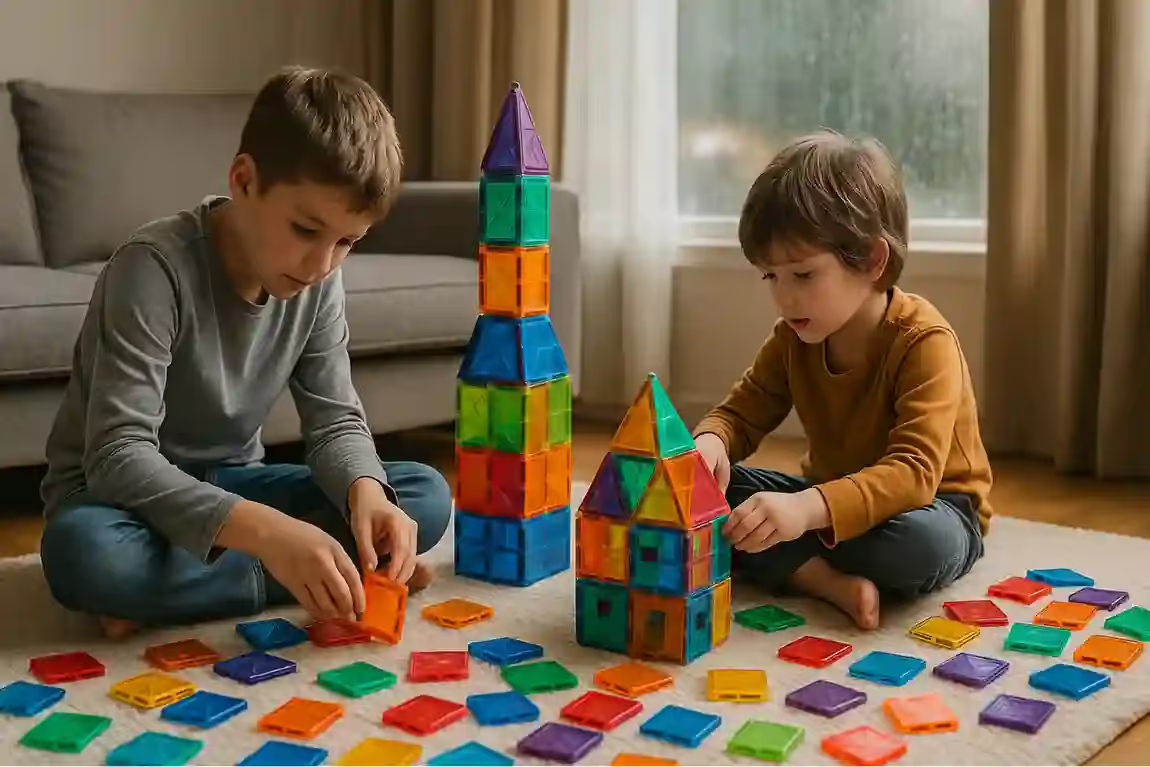
These 30-minute challenges transform magnetic blocks from scattered pieces into focused activities that actually hold attention. No more vague "go build something" suggestions that lead to five minutes of half-hearted stacking. Each challenge provides structure while leaving room for creativity, competition without tears, and learning disguised as play.
The time limits aren't arbitrary—they're salvation. Thirty minutes maintains focus without exhaustion, allows multiple challenges per afternoon, and gives parents realistic breaks. These aren't Pinterest-perfect activities requiring supervision and constant intervention. Set the challenge, start the timer, and actually drink that coffee while it's still warm.
Next rainy day, don't dread the indoor imprisonment. Grab the magnetic blocks, pick a challenge, set the timer, and watch chaos transform into creativity. The rain outside becomes background music to focused building, problem-solving, and those precious moments when kids are so engaged they forget to ask for screens. That's not just successful parenting—that's rainy day victory.
Understanding indoor play importance helps parents recognize that rainy days aren't lost opportunities but different opportunities. The focused engagement these challenges provide may actually exceed the developmental benefits of outdoor free play in certain cognitive domains. Structure and freedom balance perfectly when challenges provide clear goals while allowing infinite solution pathways.
These challenges prove that magnetic blocks justify their cost through extended engagement across developmental stages. The three-year-old building simple habitats becomes the ten-year-old engineering elaborate cantilever platforms using the same tiles. The investment pays dividends through years of rainy day salvation, making those magnetic tiles among the most cost-effective toys families can purchase.
Creating a challenge journal transforms one-time activities into longitudinal learning documentation. Photograph each completed challenge with a note card showing the child's name, date, challenge name, and any special achievements. Over months and years, these photos reveal dramatic skill progression invisible in day-to-day observations. The wobbly four-piece tower from January becomes the elaborate twelve-story structure by December, providing tangible evidence of spatial reasoning development.
Encourage children to annotate their own progress. Young children can dictate observations while parents transcribe: "This was hard because the pieces kept falling" or "I figured out triangles make it stronger." Older children write their own reflections, developing metacognitive awareness about their problem-solving processes. These annotations become precious records of thinking development alongside building skill growth.
Display particularly impressive builds for extended periods, validating children's efforts as worthy of preservation rather than immediate deconstruction. Designate a specific shelf or table area as the "gallery space" where challenge winners or personal bests remain intact for days or weeks. This extended visibility reinforces that their work has value beyond the building moment, teaching children that creative efforts deserve respect and appreciation.
Create challenge certificates for completed activities, particularly for children who respond well to concrete recognition. Simple templates noting "Master Builder: Completed Earthquake Tower Challenge" or "Engineering Achievement: 10-Second Marble Run Success" provide tangible validation. Some families implement a "challenge wall" where certificates accumulate, creating a visual representation of rainy day accomplishments that motivates continued engagement.
While these challenges primarily provide entertainment, they offer authentic assessment opportunities revealing cognitive development patterns. The Mirror Match Challenge assesses spatial reasoning and symmetry understanding more authentically than any worksheet could. The Color Pattern Bridge reveals pattern recognition and planning skills. The Animal Habitat storytelling component demonstrates narrative capability and imaginative thinking.
Parents who observe carefully during challenges gain insights impossible to obtain through formal testing. Does your child plan before building or dive in impulsively? Do they persist through initial failures or abandon difficult tasks? Can they adapt strategies when approaches fail? These observations inform educational support needs and reveal cognitive strengths applicable far beyond block play.
The iterative nature of challenges like the Marble Run explicitly teaches scientific method thinking. Children form hypotheses about what will work, test them, observe results, and modify approaches based on evidence. This systematic experimentation develops research skills foundational to scientific literacy. Parents might explicitly label these steps during play: "You made a prediction about the speed. Now you're testing it. What did you observe? How will you adjust your design?" This language scaffolds scientific thinking transferable to academic contexts.
Collaborative challenges reveal social-emotional skills and communication capabilities. Does your child share ideas willingly or dominate planning? Can they compromise when visions conflict? Do they celebrate partners' contributions or focus solely on their own? These social competencies predict success in group academic projects and workplace collaboration later in life. Challenges creating friction points offer coaching opportunities for developing negotiation and cooperation skills.
While positioned as rainy day activities, these challenges work equally well during extreme heat, cold snaps, or illness recovery periods requiring indoor confinement. Summer challenges might incorporate ice cubes—build an Animal Habitat that protects toy figures from "melting ice floods." Winter challenges add cotton ball "snow" requiring structures with sloped roofs preventing accumulation. Seasonal adaptations maintain novelty while leveraging familiar challenge frameworks.
Holiday-themed variations extend challenge applications throughout the year. Valentine's Day Color Pattern Bridges use only pink, red, and white tiles arranged in heart patterns. Halloween Earthquake Towers must survive while holding candy at the top. Thanksgiving Animal Habitats focus on turkeys with specific food storage requirements. These themed variations teach children that creativity frameworks adapt to different contexts, not just different building materials.
The challenges also adapt beautifully to transitional periods requiring quiet indoor activity. The hour before dinner when everyone feels cranky benefits from the focused distraction challenges provide. Long car trips using lap trays transform boring travel time into building opportunities with adjusted challenge parameters. Doctor's office waiting rooms become bearable when armed with a small magnetic tile set and quick 10-minute challenges that fit on waiting room chairs.
Consider organizing neighborhood "challenge swaps" where families rotate hosting building challenge sessions. Each family shares their favorite challenge variations and technique discoveries. Children benefit from peer modeling—seeing how other builders approach problems sparks new strategies. Parents gain activity ideas while children gain social building experiences unavailable during solo play.
Create friendly competitions between houses on long rainy weekends. FaceTime or video call connections allow children in different locations to build simultaneously, comparing results at the end. This virtual connection maintains social relationships during weather keeping friends apart while adding competition motivation that enhances engagement. The combination of collaboration (working with household members) and competition (against other families) creates dynamic tension driving sustained effort.
Document and share challenge innovations through photo sharing or social media, crediting child creators of new variations. This recognition validates children's creativity while contributing to larger building communities. Some families discover their challenge variations adopted by others, creating proud moments demonstrating their ideas have value beyond immediate family contexts.
Despite careful design, some children will experience frustration during certain challenges. The key lies in distinguishing productive struggle from destructive frustration. Productive struggle features attempted solutions, verbal problem-solving, and sustained engagement despite setbacks. Destructive frustration manifests as refusal to try, emotional dysregulation, or aggressive behavior toward materials.
When productive struggle appears, resist immediate rescue. Ask guiding questions: "What happened when you tried that?" "What might happen if you moved this piece here?" "I notice this section stayed standing—what's different about how you built it?" These questions scaffold thinking without removing challenge. The struggle itself builds resilience and problem-solving confidence applicable across life domains.
Destructive frustration requires intervention before negative associations form. Offer a "pause button"—walk away for five minutes, have a snack, then return with fresh perspective. Modify challenge parameters: extend time limits, reduce complexity requirements, or shift from competitive to collaborative formats. Some children simply aren't ready for certain challenges; waiting six months and trying again often produces completely different results as developmental capabilities mature.
Frame failures as data collection rather than personal inadequacy. "This attempt showed us the base needs more support. That's useful information!" This language models growth mindset thinking where setbacks inform progress rather than defining capability. Children who internalize this perspective approach academic and social challenges with greater resilience and optimism.
Families implementing these challenges regularly report unexpected benefits extending beyond rainy day entertainment. Children develop "building vocabulary" allowing precise communication about spatial relationships and structural principles. Siblings who previously struggled finding common play activities discover magnetic blocks as neutral ground where varied skill levels contribute equally. Parent-child relationships strengthen through shared challenges creating teamwork memories distinct from typical caregiving interactions.
The skills developed through consistent challenge engagement appear in surprising contexts. Teachers report stronger geometry understanding and spatial reasoning in students with extensive building experience. Problem-solving approaches learned through iterative challenge attempts transfer to math word problems and science experiments. The persistence developed fighting through Earthquake Tower collapses surfaces during difficult homework assignments.
Perhaps most valuably, these challenges teach children that boredom is solvable through creativity rather than passive entertainment consumption. Kids who initially respond to rainy days with screen requests gradually start suggesting building challenges instead. This shift represents profound learning—entertainment isn't something provided by others but created through personal agency and imagination. That lesson, more than any specific building skill, justifies every magnetic tile investment and rainy day challenge attempt.
NOVEMBER 21, 2025
NOVEMBER 20, 2025
NOVEMBER 20, 2025
NOVEMBER 20, 2025
NOVEMBER 20, 2025