

Magnetic Blocks That Work With LEGO: Hybrid Building Systems Guide
NOVEMBER 21, 2025
You're standing in the toy aisle or scrolling through an online store, trying to make a decision that feels surprisingly weighty. In one hand (metaphorically), there's a set of colorful magnetic building blocks—simple, tactile, endlessly reconfigurable. In the other, there's a STEM robot kit promising to teach coding, engineering, and problem-solving through structured projects.
Both claim to be educational. Both cost a significant chunk of your budget. And both seem to promise that your child will somehow emerge smarter, more creative, and better prepared for a technology-driven future.
But here's the question that actually matters: which one builds skills faster? Not "better" in some abstract sense, but genuinely accelerates the development of spatial reasoning, problem-solving, fine motor control, creative thinking, and early engineering concepts in ways you'll actually notice?
The answer, as with most things in child development, is refreshingly complex. It depends on your child's age, their learning style, what specific skills you're targeting, and how much structure versus freedom serves their current developmental stage. Some children race ahead with open-ended magnetic exploration. Others thrive when robotics projects provide clear goals and immediate feedback.
This isn't just theoretical parenting philosophy. The choice between construction-based play and programming-based learning represents fundamentally different approaches to cognitive development, each with research-backed advantages at different stages. Understanding these differences helps you invest in tools that actually accelerate learning rather than just occupy time.
This article breaks down exactly how magnetic blocks and STEM robot kits compare across skill development domains, learning speeds, age appropriateness, and long-term educational value. You'll discover when each tool shines, which accelerates specific skills faster, and how to sequence both for maximum developmental benefit.

Before comparing developmental impacts, let's clarify what these tools actually involve and how children interact with them.
Magnetic Blocks: Open-Ended Construction Play
Magnetic building blocks—typically flat geometric tiles with embedded magnets along edges—represent pure construction play. Children connect squares, triangles, hexagons, and other shapes, building two-dimensional patterns or three-dimensional structures limited only by piece count and imagination.
The interaction is immediate and intuitive. Pieces snap together satisfyingly when edges align. Structures stand or fall based on balance and geometry. No instructions, no correct solutions, no external validation beyond whether the creation does what the child intended.
This open-endedness defines the experience. A child might build a house, then without breaking stride transform it into a rocket, then into an abstract sculpture. The same pieces serve infinite purposes. The play is self-directed—children set their own goals, define their own success criteria, and iterate based on internal motivation rather than external requirements.
Key characteristics include:
Tactile feedback providing immediate sensory information about connections and stability. Visual appeal through colorful translucent materials and geometric patterns. Low barrier to entry requiring no reading, no instructions, and minimal adult facilitation. Mistake-friendly design where "failures" (collapsed structures) provide instant learning without frustration since rebuilding is quick. Social flexibility working equally well for solitary play or collaboration.
According to developmental research from Zero to Three, open-ended play materials that allow children to explore cause-and-effect relationships, experiment with physical properties, and create without prescribed outcomes support crucial early learning across multiple domains.
STEM Robot Kits: Structured Engineering and Coding Challenges
STEM robot kits occupy a different category entirely. These typically include physical components (motors, sensors, wheels, structural pieces) plus software interfaces for programming robot behaviors. Children follow instructions to build a functional robot, then write code making it move, respond to sensors, or complete specific tasks.
The interaction is inherently more structured. Most kits provide step-by-step building instructions. Coding interfaces—whether visual block-based programming or text-based languages—require learning specific command structures. Goals are often predetermined: make the robot navigate a maze, detect objects, follow lines, or perform programmed sequences.
Success isn't subjective. The robot either functions as intended or doesn't. Code either executes correctly or produces errors requiring debugging. This concrete feedback appeals to some children while frustrating others, depending on temperament and developmental readiness.
Key characteristics include:
Sequential instruction following requiring sustained attention and procedural memory. Computational logic introduction teaching if-then thinking, loops, variables, and algorithmic problem-solving. Troubleshooting demands as children must identify why robots don't behave as expected and systematically fix problems. Delayed gratification since completing builds and achieving functioning code takes significantly longer than magnetic block creation. Technology integration familiarizing children with interfaces, programming concepts, and digital literacy.
Educational frameworks supporting robotics education, documented by the National Science Teaching Association, emphasize that hands-on engineering challenges combined with computational thinking develop problem-solving skills, persistence, and systematic thinking that transfer to other academic domains.
The fundamental difference is freedom versus structure. Magnetic blocks say "create anything." Robot kits say "build this specific thing, make it work, then modify if you want." Both approaches have developmental value, but they exercise different cognitive muscles at different speeds.
Parents asking "what builds skills faster?" usually mean "where will I see developmental progress most quickly?" The answer depends on what you're measuring and when you're starting.
A three-year-old with magnetic blocks can show measurable progress in spatial reasoning, fine motor control, and creative problem-solving within days or weeks of regular play. You'll observe increasingly complex structures, better structural stability, and more sophisticated design thinking relatively quickly.
The same three-year-old with a robot kit will likely experience frustration rather than progress. The cognitive demands—following multi-step instructions, understanding cause-effect across the gap between code and robot action, troubleshooting when things don't work—exceed typical three-year-old capacities. There's no progress to measure because the tool doesn't match developmental reality.
This isn't a flaw in robot kits—it's a feature. They're designed for older children whose cognitive development has reached stages where abstract thinking, delayed gratification, and systematic problem-solving are accessible.
Intrinsic motivation drives learning speed. Children learn fastest when activities match their interests and hit the sweet spot of being challenging but achievable. According to research on child development from the Harvard Center on the Developing Child, learning is most effective when children are engaged, motivated, and operating within their "zone of proximal development"—the space between what they can do independently and what they can do with guidance.
Magnetic blocks hit this zone for younger children because success is immediate and intrinsically satisfying. The first time a toddler connects two tiles and they click together magnetically, that's a dopamine-releasing success moment. The first tower they build that stands—however wobbly—produces pride. These frequent small successes motivate continued play, and continued play accelerates skill development.
Robot kits require more patience before success moments arrive. Building the robot itself might take 30-90 minutes of careful assembly. Writing code that makes it move correctly might take another 20-30 minutes of trial and error. For children whose executive function and frustration tolerance can handle this delayed gratification, the eventual "it works!" moment is incredibly powerful. For those not developmentally ready, the waiting period between effort and reward feels eternal, motivation collapses, and learning stalls.
Magnetic blocks feature gentle, continuous learning curves. Progress happens incrementally. Day one: connecting two pieces. Day three: building a simple tower. Week two: creating walls and enclosures. Month two: designing complex multi-level structures with aesthetic considerations. Month six: understanding architectural principles through experience, teaching others, and showing genuine engineering thinking.
The gentleness of this curve means children rarely hit walls that stop progress. They're always working slightly above their current level, experiencing enough challenge to learn without enough frustration to quit.
Robot kits feature steeper, step-function learning curves. There's significant upfront investment—learning the interface, understanding basic programming concepts, mastering assembly techniques. During this initial phase, progress feels slow. Then suddenly, something clicks. The child understands how loops work, or how sensors trigger actions, and capability jumps noticeably. Progress happens in plateaus and leaps rather than steady climbs.
For children who persevere through early plateaus, robot kits can accelerate specific skills (particularly computational thinking) faster than any other tool once comprehension breaks through. But getting to that breakthrough requires patience and support many young children lack.
Ages 2-5: Magnetic blocks build skills dramatically faster simply because robot kits aren't developmentally accessible. A four-year-old playing regularly with magnetic tiles will show rapid gains in spatial reasoning, fine motor control, creative confidence, and early engineering thinking. The same four-year-old with most robot kits will show little progress and potential frustration.
Ages 6-8: This is the transition zone. Magnetic blocks continue building spatial and creative skills effectively, but growth rate slows as children master available challenges. Robot kits become accessible and, for the right children, can accelerate logical thinking, problem-solving persistence, and technology fluency faster than blocks can at this stage. However, individual variation is enormous—some six-year-olds thrive with basic coding robots while others still benefit more from open-ended construction.
Ages 9-12: Robot kits generally accelerate relevant skills faster for children in this range, particularly if foundational spatial and creative thinking were established earlier through block play or similar activities. The complexity available in age-appropriate robotics—sensors, variables, complex programming challenges—provides cognitive workout magnetic blocks alone can't match at this developmental level.
The developmental sequence matters enormously. Children who spent ages 4-7 with rich block play often progress faster with robot kits at ages 8-10 because spatial reasoning and creative problem-solving transfer. Children who jump directly to robot kits at age 6 without prior construction play experience sometimes struggle more because they're simultaneously learning spatial thinking AND computational logic rather than building on established spatial foundations.
Knowing which tool accelerates learning at which age helps you invest appropriately and sequence experiences for maximum benefit.
Ages 2-4: Magnetic Blocks Exclusively
Robot kits aren't appropriate for this age range except perhaps as curious objects to examine physically. The cognitive demands are too high, fine motor requirements too precise, and frustration tolerance too limited.
Magnetic blocks, however, are ideal. Toddlers and preschoolers use them to:
Develop spatial intelligence through stacking, balancing, and three-dimensional creation. Build fine motor skills through precise tile alignment and manipulation. Practice executive function through goal-setting ("I'm making a house"), planning (gathering needed pieces), and self-monitoring (adjusting when structures don't work). Experience early physics principles (gravity, balance, stability) through direct experimentation. Express creativity with no "wrong" outcomes to inhibit exploration.
Learning velocity is high because every play session produces visible progress. A two-year-old who starts with random tile clicking evolves to deliberate towers within weeks. A three-year-old who begins with simple stacking creates enclosed structures within months. A four-year-old who starts with basic shapes designs elaborate, stable architecture within a year.
Recommendations: Invest in quality magnetic blocks. Create regular play opportunities. Avoid pressure or instruction—let exploration guide learning. This foundation accelerates all future spatial learning including geometry, engineering, and even programming concepts that require visualizing abstract structures.
Ages 4-7: Blocks Dominate; Introductory Coding Optional
This age range represents magnetic blocks' sweet spot. Children have the motor control, attention span, and imaginative capacity to use blocks in increasingly sophisticated ways while still benefiting from open-ended exploration.
Magnetic blocks continue developing:
Advanced spatial reasoning as children build complex symmetrical structures, multi-level designs, and functional objects (vehicles, buildings with specific purposes). Creative storytelling as constructions become props or representations in imaginative play. Collaborative skills as children build together, negotiate shared projects, and combine ideas. Problem-solving through architectural challenges—how to build taller, stronger, or more elaborate structures.
Visual coding robots become appropriate for some children in this range, particularly ages 6-7. Simple programmable toys with buttons or tablet interfaces that use visual command blocks can introduce computational thinking concepts without requiring reading or abstract symbol manipulation.
However, these should supplement rather than replace construction play. The coding experience works best when brief (10-20 minutes) and focused on exploration rather than complex projects. Many children this age will try coding toys briefly but gravitate back to blocks—that's developmentally appropriate and should be supported rather than redirected.
Learning velocity: Blocks continue producing steady skill gains. Coding toys, if introduced, show slow initial progress as children familiarize themselves with interfaces and concepts. This is the beginning of a learning arc that accelerates later, not the phase of maximum velocity.
Recommendations: Magnetic blocks should be primary play materials. If interested, introduce simple coding toys as occasional supplements. Avoid pushing robotics—developmental readiness varies wildly in this range. Watch for signs of genuine interest versus adult-driven pressure.
Ages 7-10: Robot Kits Accelerate Analytical Skills
This is where robot kits hit their stride. Children have the cognitive capacity for abstract thinking, the executive function for multi-step projects, the reading ability for instructions, and the frustration tolerance for debugging.
STEM robot kits now develop:
Computational logic through visual programming languages (Scratch-style block coding) or simple text-based languages. Engineering principles through building functional mechanisms involving motors, sensors, and structural integrity. Systematic problem-solving through debugging processes requiring hypothesis-testing. Persistence and growth mindset as children work through challenges taking hours or days to resolve. Technology fluency preparing them for increasingly digital learning environments.
Magnetic blocks remain valuable but in modified ways. Rather than pure construction, they might be used for:
Rapid prototyping of ideas before building with more complex materials. Stress-relief and creative breaks from structured learning. Teaching younger siblings (which reinforces the older child's spatial understanding). Collaborative building challenges that are more sophisticated than younger ages attempted.
Learning velocity shifts. For children ready and interested in robotics, skill acquisition in computational thinking and systematic engineering can be quite rapid once initial concepts are grasped. Progress becomes visible as children move from following instructions to modifying code to creating original programs. However, this accelerated learning requires genuine readiness—forced too early, it produces frustration without progress.
Recommendations: Introduce age-appropriate robot kits for children showing interest and readiness. Maintain access to blocks for creative outlet and spatial play. Don't abandon open-ended construction entirely—the creativity and self-direction it fosters complement the structured thinking robotics develops. Consider the child's learning style—some thrive with structure and love robotics immediately; others need more time with exploratory play before engaging with programming.
Ages 10+: Robotics and Engineering Projects Dominate
By double-digit ages, children ready for advanced learning benefit more from robot kits and similar structured STEM tools than from magnetic blocks alone, though blocks still have applications.
Advanced robot kits and related tools develop:
Complex programming including variables, functions, arrays, and more sophisticated logic structures. Integration of multiple sensors and outputs creating responsive, intelligent robot behaviors. Engineering design processes from problem identification through testing and refinement. Team collaboration on larger projects requiring role division and communication. Competition preparation for events like FIRST LEGO League where engineering meets programming meets presentation skills.
Magnetic blocks, if used, serve supporting roles:
Prototyping enclosures or structures for electronic projects. Art and stress relief. Mentoring younger children. Occasional creative play when seeking mental breaks from demanding academic work.
Learning velocity: For engaged students, progress in programming and engineering can be quite rapid, particularly if they're working on self-directed projects or participating in robotics competitions. Skills developed here directly prepare for high school computer science, physics, and engineering courses.
Recommendations: Invest in quality robotics platforms appropriate for the child's skill level. Encourage participation in robotics clubs, competitions, or online communities. Recognize that open-ended spatial play, while less central, still offers value for relaxation and creative thinking. Consider transitioning from consumer robot kits to more advanced platforms like Arduino, Raspberry Pi, or competition robotics systems.
Understanding how these tools function in actual learning environments clarifies their practical benefits and limitations.
Preschool Open Build Station
A pre-K classroom maintains a magnetic block area with approximately 200 pieces accessible during free choice time. Children aged 3-5 use it independently or collaboratively for 15-45 minutes at a stretch.
Observable skills developing:
Turn-taking and sharing as children negotiate piece access. Spatial planning as children visualize then execute builds. Fine motor refinement through precise placement. Creative expression as each child's personality reflects in their constructions. Language development as children describe what they're building and narrate play. Early geometry recognition as teachers casually name shapes during play.
Learning velocity: Noticeable progress occurs weekly. Teachers document increasing structural complexity, better collaboration, and more sophisticated designs throughout the school year.
Why robot kits wouldn't work here: The cognitive demands, required reading, adult facilitation needs, and potential for frustration make them inappropriate for this age group and setting. Blocks provide the right developmental fit, accelerating relevant skills without pushing beyond readiness.
Elementary Robotics Club
A school runs an after-school robotics club for 3rd-5th graders (ages 8-10). Students work in teams building and programming robots to complete challenge courses—navigate mazes, move objects, respond to sensor input.
Observable skills developing:
Computational thinking as students write increasingly sophisticated code. Engineering design process from problem definition through iterative refinement. Team collaboration with role differentiation (programmers, builders, testers). Resilience as students debug code and rebuild mechanisms repeatedly. Technology fluency as students become comfortable with programming interfaces.
Learning velocity: Progress feels slow initially as students master basics, then accelerates noticeably as concepts click. By season's end, students accomplish challenges that seemed impossibly complex initially.
Why magnetic blocks wouldn't work here: While students might enjoy building with blocks, the club's objectives (computational thinking, engineering systematization, technology skills) require the structured complexity robot kits provide. Blocks alone couldn't achieve the same learning velocity for these specific skills at this age.
Family "Design & Code" Nights
A family with children ages 6 and 9 alternates between magnetic building competitions and robot programming challenges as weekend activities.
Observable family benefits:
Cross-age collaboration as the older child teaches the younger during both activities. Diverse skill exercise as creative building and systematic programming engage different cognitive modes. Stress-free learning environment where play remains genuinely playful. Shared accomplishment building family bonds around learning rather than entertainment consumption.
The younger child excels during building competitions, experiencing confidence and competence. The older child thrives during programming challenges, showcasing more advanced skills. Both activities matter—the variety prevents burnout while developing complementary capacities.
Learning velocity: Both children show continuous progress appropriate to age, and the variety seems to enhance engagement compared to families focusing exclusively on one activity type.
Therapy-Based Repetition Builds
An occupational therapist uses magnetic blocks with children developing fine motor skills, spatial awareness, and attention regulation. The therapist designs specific progressive challenges: build a 5-block tower, replicate a simple pattern, construct a stable bridge, create symmetrical designs.
Observable therapeutic benefits:
Fine motor improvement measurable through precision and speed. Attention span extension as engaging activity supports sustained focus. Spatial awareness growth documented through increasingly complex successful constructions. Self-regulation as children manage frustration when builds fall.
Learning velocity: Therapeutic progress typically moves slowly but the immediate feedback and intrinsic satisfaction magnetic blocks provide often accelerate gains compared to traditional therapy materials.
Why robot kits rarely work therapeutically: The complexity, abstraction, and delayed gratification make them less effective for addressing most fine motor, attention, or spatial therapy goals with younger or struggling children.
Practical considerations including budget, longevity, and upkeep affect the real-world value proposition of each toy type.
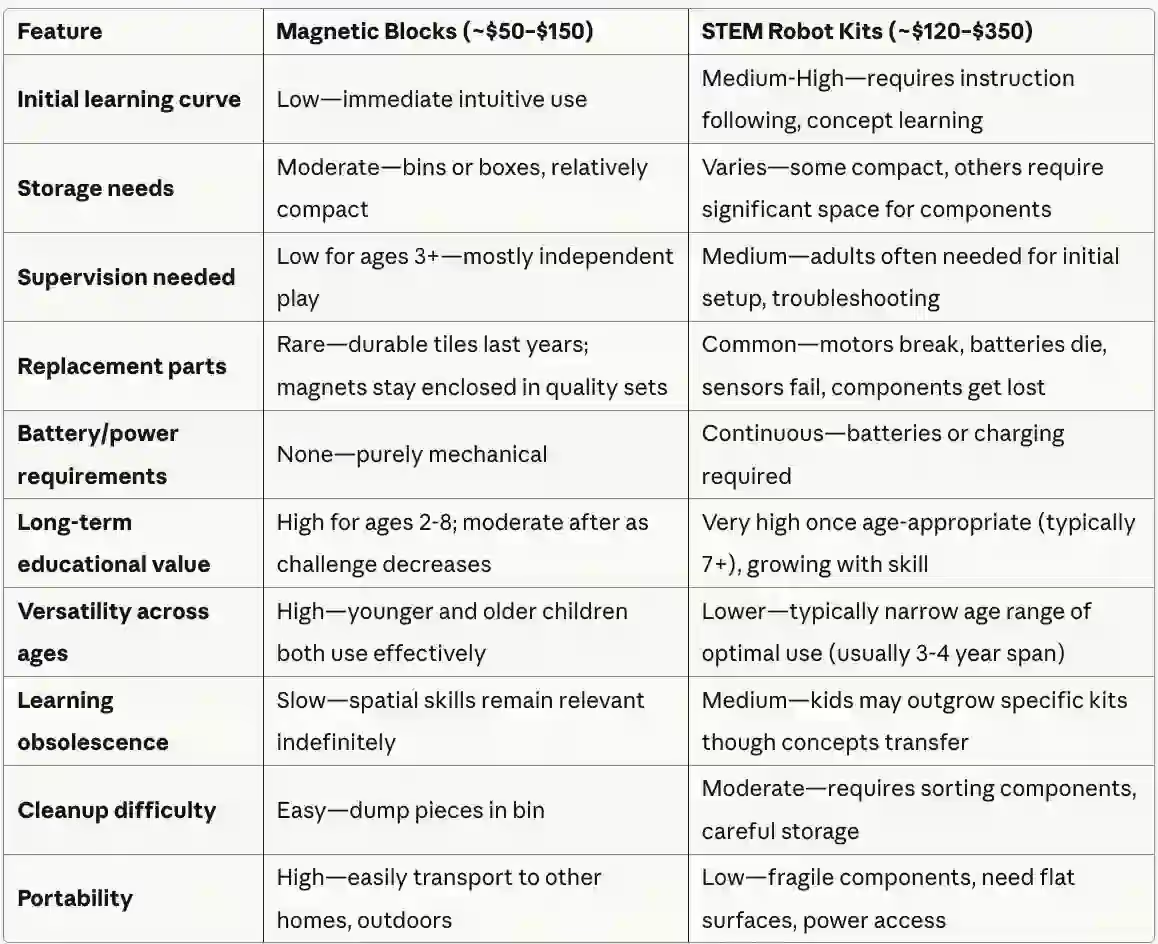
If you can only afford one investment (roughly $100-150 price point):
For children under 6: Magnetic blocks provide better value, accelerating more relevant skills faster and usable for more years before age-appropriate challenge is exhausted.
For children 7+: Robot kits potentially provide better value if the child shows interest and readiness, as computational thinking and engineering skills gained transfer broadly and prepare for future STEM learning.
For mixed-age families: Magnetic blocks work better as single purchase since all ages can use them. Robot kits typically suit one child's age range, making them less practical for households with varied ages.
The quality spectrum matters enormously. A $50 magnetic block set might be barely adequate or might crack easily, exposing dangerous magnets. A $120 set might be excellent quality lasting through multiple children. Similarly, a $120 robot kit might be frustrating and limited while a $300 kit provides years of expandable learning.
Research products thoroughly, prioritizing quality over quantity. According to toy safety guidance from the Consumer Product Safety Commission, quality materials meeting safety standards prevent injuries while providing better long-term educational value.
Choosing between these tools depends heavily on what skills you're prioritizing and what role you see yourself playing in your child's learning.
For Early Creativity and Spatial Integration
Recommendation: Magnetic blocks strongly preferred
If your primary goals include nurturing creativity, building spatial intelligence, encouraging self-directed play, and establishing foundational engineering intuition, magnetic blocks accelerate these skills faster than alternatives.
Start early (ages 2-3), provide ample unstructured play time, avoid over-directing or correcting, and allow creativity to flourish. Supplement with other open-ended construction materials (wooden blocks, cardboard, recycled materials) but let magnetic blocks be a staple due to their unique combination of satisfaction, versatility, and skill-building.
These early years establish patterns of creative confidence that research suggests predict innovative thinking in adolescence and adulthood. The investment pays dividends beyond immediate skill development.
For Problem-Solving, Sequencing, and Coding Skills
Recommendation: STEM robot kits once developmentally appropriate
If your primary goals include developing computational thinking, systematic troubleshooting, engineering discipline, and technology fluency, robot kits accelerate these skills faster than other approaches once children reach appropriate developmental stages (typically 7+, though some precocious 6-year-olds engage successfully).
Begin with age-appropriate kits emphasizing visual programming rather than text code initially. Expect initial frustration and provide patient support without solving problems for children. Gradually increase complexity as skills develop. Consider robotics clubs, competitions, or online communities providing social learning and motivation.
These middle childhood years establish computational thinking patterns that transfer to mathematics, science, and systematic reasoning across domains. According to educational research from MIT's Scratch programming initiative, early programming experiences correlate with enhanced problem-solving and logical thinking skills.
Recommendation: Sequential introduction with both maintained
If your goal is comprehensive STEAM (Science, Technology, Engineering, Arts, Mathematics) development integrating creativity with systematic thinking, the ideal approach sequences both tools appropriately:
This sequence accelerates overall skill development faster than exclusive focus on either tool because it builds complementary capacities in developmentally appropriate order. The creativity and spatial thinking established early transfer to engineering and programming later, while the systematic thinking developed through robotics enhances the sophistication of creative work.
Resources from the National Science Teaching Association support this integrated approach, showing that early hands-on exploration enhances later structured STEM learning more effectively than early formal instruction alone.
Which toy type is better for gifted learners?
Gifted children often show asynchronous development—advanced in some areas while age-typical in others. Many benefit from having both tools available simultaneously rather than strictly following age recommendations. A five-year-old who's intellectually ready for robot kits still benefits from magnetic blocks for spatial and creative development. A seven-year-old drawn to blocks shouldn't be pushed toward robotics just because they "could" handle it. Follow the child's interests and engagement rather than assumptions about what gifted children "should" prefer. Both tools can challenge at high levels depending on how they're used.
Can robot kits frustrate kids too early?
Absolutely. Introducing robot kits before children have the cognitive readiness for multi-step instruction following, abstract cause-effect relationships, and debugging protocols often produces frustration without meaningful learning. This can actually create negative associations with STEM fields. Signs of "too early" include constant adult dependence, inability to engage independently for even brief periods, meltdowns when things don't work immediately, and losing interest after one or two attempts. If you see these patterns, shelve the kit for 6-12 months and try again when developmental readiness increases.
Do magnetic blocks help with future engineering interest?
Research suggests that early hands-on construction play, including magnetic blocks, correlates with later STEM interest and spatial thinking skills that predict engineering success. However, this isn't deterministic—plenty of engineers never played with magnetic blocks, and plenty of children who love blocks don't pursue engineering. What magnetic blocks provide is accessible early experience with structural thinking, problem-solving, and creative engineering that may spark interest or simply develop transferable skills. They're one ingredient in fostering STEM engagement, not a guarantee or prerequisite.
How much supervision do STEM kits require?
This varies enormously by kit complexity and child age/personality. Initial setup and first projects typically require significant adult involvement—reading instructions together, troubleshooting technical issues, explaining programming concepts. However, many kits are explicitly designed to support increasing independence as children master basics. By third or fourth project, capable children might work mostly independently with occasional adult check-ins. Younger children (6-8) generally need more sustained involvement than older ones (9-12). Kits marketed as "educational" often require more adult facilitation than those marketed as "toys."
What if I only have the budget for one?
Base the decision on child's current age and interests, not aspirational goals. For children under 6, magnetic blocks provide better immediate value and accelerate more age-appropriate skills. For children 7+ showing genuine interest in technology and programming, robot kits might provide better value if budget allows only one STEM toy purchase. However, consider that magnetic blocks work well as shared family resources across ages while robot kits typically suit narrower age ranges. If you have multiple children spanning ages 3-10, blocks serve everyone while kits serve primarily the older children. Also consider non-purchase options: libraries often lend robot kits, schools may offer robotics clubs, and some community centers provide programming classes with equipment included.
Do kids need to master blocks before robots make sense?
"Master" is too strong, but having substantial construction play experience before introducing robotics typically accelerates robot learning because spatial thinking is already established. A child who's spent hundreds of hours building with blocks, Lego, or other construction toys approaches robot assembly with intuitive spatial understanding. They visualize how pieces fit together, predict structural stability, and troubleshoot mechanical problems faster than children without that experiential foundation. However, there's no minimum "block hours" requirement—it's about developmental readiness and having spatial thinking sufficiently established to focus cognitive resources on programming rather than simultaneously learning both spatial and computational concepts.
The question "what builds skills faster—magnetic blocks or STEM robot kits?" has no single answer because it's actually several questions disguised as one. Faster for which skills? At which age? For which child? In which context?
Here's what the research and practical experience reveal:
For parents and educators navigating these decisions, the practical wisdom is:
Start with open-ended building when children are young. Magnetic blocks from ages 2-6 establish spatial intelligence and creative confidence that support all future learning. Maintain this creative construction play even as you introduce structured challenges. The divergent thinking it develops balances convergent problem-solving from robotics. Introduce robot kits when children show readiness signals: interest in how things work, ability to follow multi-step instructions, frustration tolerance for challenges taking time to resolve, and genuine curiosity about technology and programming. Don't force progression from blocks to robots according to schedules or age charts. Follow the child's engagement and development rather than external timelines. Remember that "faster" skill development comes from appropriate matching, not from pushing advanced tools prematurely.
The beautiful truth is that you don't have to choose between creativity and logic, between exploration and structure, between magnetic blocks and robot kits. You choose both—sequentially, appropriately, responsively.
Start with blocks when hands are small and imagination is vast. Watch spatial thinking crystallize through thousands of building sessions. When systematic thinking emerges and technology fascinates, introduce robots. Watch as the spatial foundation accelerates programming comprehension and the programming challenges enhance spatial sophistication. And through it all, remember that the actual building—whether magnetic tiles or programmable robots—matters less than the thinking it develops, the curiosity it feeds, and the confidence it creates. Tools are just that: tools. What children build with them, both physically and cognitively, is what actually matters.
Tonight, look at what you have available. If it's magnetic blocks, encourage building and step back. If it's robot kits, be present for challenges and celebrate debugging. If it's both, appreciate how each serves different but equally valuable developmental purposes. And if it's neither, start with open-ended construction, trust the developmental sequence, and know that skills build fastest when tools match readiness rather than when the fanciest educational technology gets deployed prematurely.
The fastest skill development comes not from the most advanced tools but from the most appropriate ones, used at the right time, in the right way, with the right child. Everything else is just marketing.
NOVEMBER 21, 2025
NOVEMBER 21, 2025
NOVEMBER 21, 2025
NOVEMBER 21, 2025
NOVEMBER 20, 2025