

Magnetic Blocks for Dyslexic Children: Spatial Learning Advantages
NOVEMBER 21, 2025
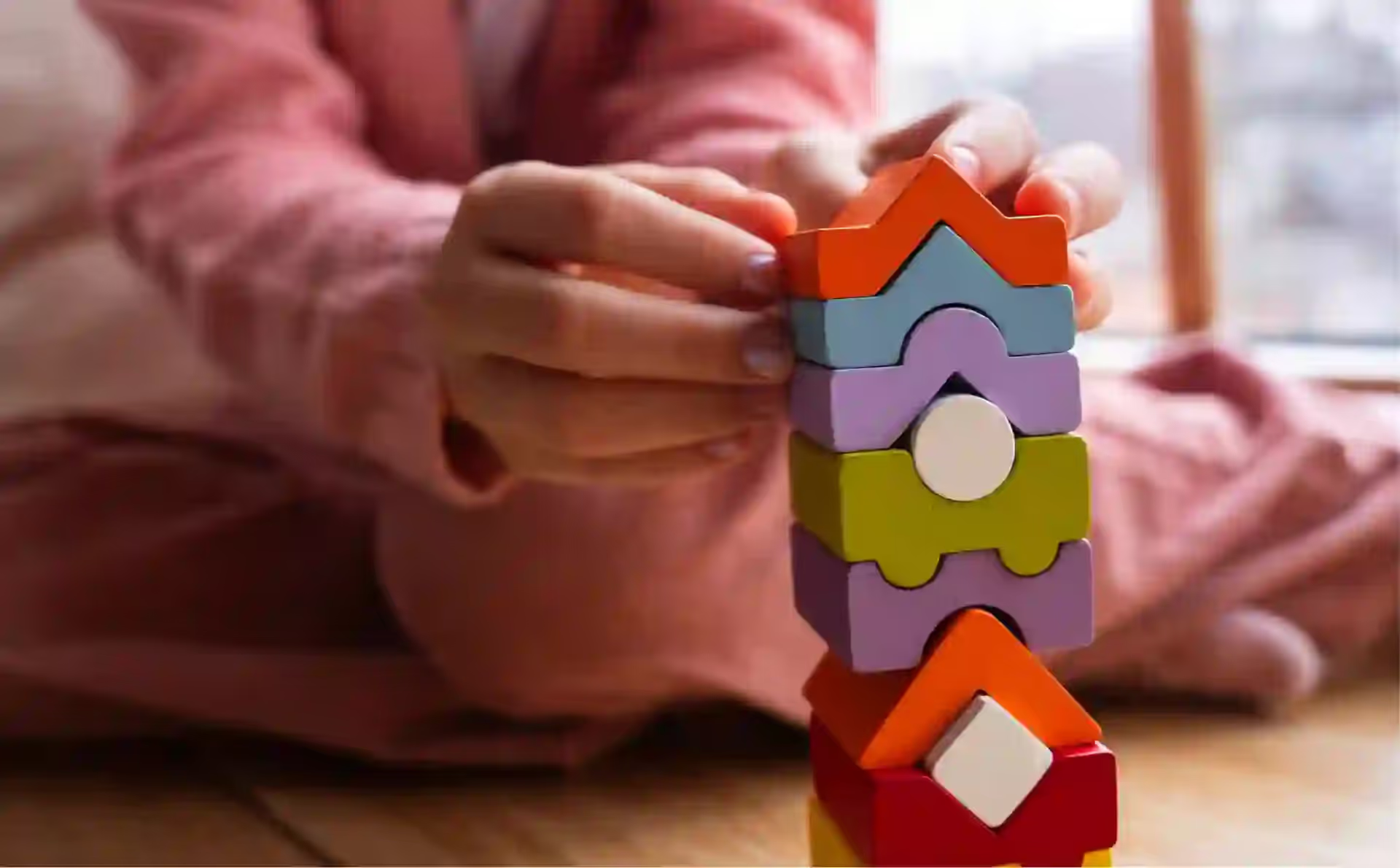
Your six-year-old sits surrounded by magnetic tiles, building what looks like a house. You ask casually, "What are you making?" She pauses, looks at her structure, and says, "It's a home for someone who feels lonely. See? I made big windows so they can see their friends outside. And this tall part is where they go to feel brave."
In that moment, those colorful plastic tiles stopped being simple construction toys. They became a medium for expressing complex emotions, practicing empathy, and working through social-emotional concepts that would be nearly impossible to articulate without the concrete, playful framework the building provides.
This is the untapped power of magnetic tiles for developing emotional intelligence—the capacity to recognize, understand, and manage emotions in yourself and others. While parents and educators have embraced these toys for their spatial reasoning and STEM benefits, their potential for building social-emotional skills remains largely overlooked.
Yet the research is clear. According to the Collaborative for Academic, Social, and Emotional Learning (CASEL), children with strong emotional intelligence demonstrate better academic performance, healthier relationships, and greater resilience in facing life's challenges. And these skills don't develop from lectures about feelings—they grow through repeated, meaningful practice in safe, engaging contexts.
Magnetic tiles offer exactly that context. Their open-ended nature invites storytelling. Their collaborative potential encourages negotiation and perspective-taking. Their visual, hands-on quality makes abstract emotions concrete and manageable. When play is intentionally structured—not controlled, but gently guided—these tiles become powerful tools for teaching children the emotional vocabulary, regulation strategies, and empathetic understanding that will serve them throughout their lives.
This article provides the framework, activities, and psychological understanding you need to transform magnetic tile play into emotional intelligence education. You'll discover specific role-play scenarios targeting different EQ competencies, learn how to facilitate emotion-focused play without forcing it, and understand why this approach works based on developmental psychology and educational research.

Before exploring how magnetic tiles build emotional intelligence, let's clarify what we're actually developing and why it matters so profoundly during the early childhood years.
Emotional intelligence (EQ) encompasses the abilities to recognize emotions in yourself and others, understand how emotions influence thinking and behavior, manage emotional responses effectively, and use emotional understanding to navigate social situations and build relationships. CASEL identifies five core social-emotional learning (SEL) competencies that together constitute emotional intelligence:
Self-awareness—recognizing one's own emotions, thoughts, and values and understanding how they influence behavior. A self-aware child can identify "I'm feeling frustrated" rather than just acting out the frustration through behavior.
Self-management—regulating emotions, thoughts, and behaviors effectively in different situations. This includes managing stress, controlling impulses, and motivating yourself. A child with self-management skills can take deep breaths when angry rather than immediately hitting.
Social awareness—taking the perspective of and empathizing with others, including those from diverse backgrounds and cultures. This involves recognizing social cues and understanding social norms. A socially aware child notices when their friend looks sad and asks what's wrong.
Relationship skills—establishing and maintaining healthy relationships through clear communication, active listening, cooperation, resisting inappropriate social pressure, and seeking help when needed. These are the skills that let children make friends, work in groups, and navigate conflicts constructively.
Responsible decision-making—making constructive choices about personal behavior and social interactions based on ethical standards, safety concerns, and social norms. This involves evaluating consequences and considering the well-being of self and others. According to research from the Harvard Center on the Developing Child, these capacities don't emerge automatically with age—they develop through thousands of interactions where children practice emotional and social skills with supportive adults and peers providing guidance and feedback.
The early childhood window (ages 3-10) is particularly critical for several developmental reasons. Young children's brains are experiencing rapid growth in regions supporting emotional regulation and social cognition. Neural plasticity is highest, meaning experiences literally shape brain architecture. Children are building foundational mental models of relationships, emotions, and social interaction that will influence patterns throughout life.
Additionally, this age range represents when children spend increasing time in social settings—preschools, schools, playdates, activities—where emotional and social competencies directly impact daily experiences. A four-year-old who can't recognize or manage frustration will struggle with the constant minor disappointments of group settings. A seven-year-old lacking empathy will have difficulty maintaining friendships. An eight-year-old without conflict-resolution skills will find group projects miserable.
Research documented by the American Psychological Association shows that children who develop strong emotional intelligence in early childhood demonstrate better academic achievement, fewer behavioral problems, more positive relationships, and greater psychological well-being in adolescence and beyond. The skills compound—early success in managing emotions and relationships creates positive experiences that further develop those capacities.
The challenge is that emotional intelligence can't be taught through traditional direct instruction. You can't lecture a four-year-old about empathy and expect them to suddenly feel others' emotions. You can't tell a six-year-old to regulate their anger and have them master the skill immediately.
Emotional intelligence develops through experience—specifically through guided practice in situations requiring emotional awareness, regulation, and social navigation. This is where structured play becomes invaluable. Play creates low-stakes environments where children can practice complex emotional and social skills with support, make mistakes without serious consequences, and build competencies through repetition that feels like fun rather than work.
Among the universe of toys available, magnetic tiles possess specific characteristics making them particularly effective for emotion-focused role-play and social-emotional development.
Open-ended building stimulates imagination and symbolic play. Unlike toys with predetermined functions or fixed narratives, magnetic tiles can become anything children imagine. A structure built from tiles isn't just a building—it's a house where characters live, a castle protecting frightened villagers, a hospital where hurt feelings get healed, or a bridge connecting lonely people.
This symbolic flexibility is crucial for emotional learning because it allows children to represent abstract emotional concepts concretely. When a child builds "a place where anger goes to cool down" or "a home that feels safe," they're making internal emotional experiences external and visible. This externalization helps them think about and discuss emotions that would otherwise remain vague, overwhelming internal states.
Neutral, non-threatening play materials reduce emotional defensiveness. Some children resist direct conversations about feelings, particularly when they're struggling emotionally. Questions like "how do you feel?" can trigger defensiveness or simple "I don't know" responses.
But when building with magnetic tiles, emotions can be explored indirectly through the structures and stories. A child who won't talk about feeling left out at school might eagerly build a scenario where "this block is lonely and the other blocks won't play with it." The emotional content is the same, but the indirect expression through play feels safer, allowing for genuine exploration and processing.
Collaborative building naturally encourages dialogue and negotiation. When children build together with magnetic tiles, they must communicate about their plans, negotiate differences, coordinate actions, and solve problems jointly. These interactions provide authentic practice in the relationship skills dimension of emotional intelligence.
"Should we make it taller or wider?" requires perspective-taking and compromise. "I think the tower needs a door here" invites discussion and potential disagreement that must be resolved. "Let's build it together" demands coordination and cooperation. These micro-interactions, repeated across play sessions, build the communication and collaboration capacities that constitute relationship skills.
Physical construction supports affective perspective-taking. Creating physical structures representing different emotional states or social situations helps children literally see multiple perspectives. When building "a happy house" versus "a sad house," children must think about what makes spaces feel different emotionally. When constructing "a place where friends meet" versus "a place where someone feels alone," they're exploring social connection and isolation concretely.
This co-constructed symbolic representation—building together while imbuing structures with emotional meaning—creates what developmental psychologists call "joint attention" around emotional concepts. Both builder and facilitator (parent, teacher, or peer) focus together on the same emotional idea made concrete through tiles, creating ideal conditions for learning and discussion.
Immediate, reversible construction reduces perfectionism and fear of failure. Emotional learning requires experimentation and sometimes getting things wrong. Children need to try different ways of handling situations, some of which won't work perfectly, without feeling like failures. Magnetic tiles support this experimentation beautifully. If a structure doesn't work, it's rebuilt in seconds. If an idea doesn't pan out, materials instantly reconfigure for new approaches. This low-stakes quality encourages the risk-taking and iteration essential for learning complex emotional and social skills.
These detailed activities provide frameworks for intentionally developing specific emotional intelligence competencies through magnetic tile play. Each includes setup, facilitation guidance, and reflection prompts to maximize learning.
Age Range: 4-7 years
Target EQ Skill: Self-awareness—recognizing and naming one's own emotions
Time: 15-20 minutes
Objective: Help children identify and express different emotions by building physical representations of feeling states.
Materials: Magnetic tiles in various colors, optional: emotion cards or face drawings showing different feelings
Setup:
Sit with your child in a comfortable play space with magnetic tiles accessible. Introduce the activity: "Today we're going to build special structures that show different feelings. Have you ever felt happy? Sad? Excited? Scared? We're going to build what those feelings might look like."
Activity Steps:
Choose an emotion to start with—happiness is often easiest. Ask your child: "If happiness was a building, what would it look like? What colors would it have? Would it be tall or wide? Pointy or round?" Let your child begin building while you build alongside them, narrating your choices: "I'm making my happy building really colorful and open, because when I'm happy I feel bright and friendly."
Once the first structure is complete, ask your child to tell you about it: "Tell me about your happy building. What makes it look happy?" This encourages emotional vocabulary and reflection on their choices.
Build 2-3 more emotion structures—perhaps sad, angry, and scared. Notice how your child represents each feeling differently through color, height, openness, and shape. Some children build "angry" as spiky and red, "sad" as droopy and blue, but any interpretation is valid—the goal is their emotional expression and awareness.
After building several emotion structures, play a simple game: "I'm going to tell you about a situation, and you point to which building shows how you might feel." Use scenarios relevant to their life: "Your best friend can't come to your birthday party. Which building is that feeling?" "You get to stay up late on a special night. Which building is that?"
Reflection Questions:
Variations: For younger children (3-4), focus on just two emotions—happy and sad. For older children (7-8), include more complex emotions like frustrated, jealous, or proud. Create an ongoing "feelings castle" that they add to over time, building a visual emotion vocabulary.
Age Range: 5-8 years
Target EQ Skill: Social awareness—empathy and perspective-taking
Time: 20-25 minutes
Objective: Practice seeing situations from another person's perspective by building structures representing different viewpoints.
Materials: Magnetic tiles, small toy figures or stuffed animals (optional)
Setup:
Explain that you'll be building structures for two different characters who see things differently. "Sometimes two people look at the same thing but feel very different ways about it. We're going to build to show how two people might feel differently."
Activity Steps:
Introduce a scenario: "Let's imagine two kids at a birthday party. One child, Alex, is really excited because they love parties and are having a great time. The other child, Sam, feels nervous because they don't know many people there and parties feel overwhelming."
Build two separate structures—one representing how Alex experiences the party (excited, open, bright) and one representing how Sam experiences it (anxious, protective, maybe enclosed). As you build, narrate the perspectives: "Alex's party experience feels big and exciting, so I'm making this really open and colorful. Sam's party experience feels a little scary, so this structure has walls that feel safe."
Now introduce a connecting element: "Both kids are at the same party. Let's build a bridge between their experiences. How could Alex help Sam feel better? How could they connect?" Build a literal bridge or pathway between the two structures, discussing what actions or words might help—maybe Alex inviting Sam to play a game together, or introducing Sam to other kids.
Let your child lead building the connection, prompting: "What could help Sam feel braver? What could Alex do to be a good friend?" This creates physical representation of empathetic action.
Reflection Questions:
Variations: Use scenarios from your child's real experiences—different kids' reactions to the first day of school, trying new foods, or facing challenges. For younger children, use simpler scenarios with more obvious emotions. For older children, explore more nuanced situations involving misunderstandings or conflicts requiring perspective-taking to resolve.
Age Range: 4-9 years
Target EQ Skill: Self-management—resilience and recovering from emotional setbacks
Time: 15-20 minutes
Objective: Practice emotional recovery and resilience when things don't go as planned.
Materials: Magnetic tiles
Setup:
This activity intentionally involves a structure falling or being knocked down, creating a manageable disappointment that allows practice in emotional recovery. Set up the activity: "We're going to build something really cool together. Sometimes when we build, things fall down. When that happens, we're going to practice feeling disappointed but then solving the problem together."
Activity Steps:
Build a collaborative structure—a tall tower, a house, or whatever interests your child. Build it reasonably tall so there's some risk of collapse. As you build, narrate the positive emotions: "This is exciting! It's getting so tall! I feel proud of what we're making."
At some point—either naturally or with a careful "accidental" nudge—let the structure fall. This is the key learning moment. Immediately model emotional awareness and regulation: "Oh no! It fell! I feel disappointed. My body feels frustrated." Pause, take a visible breath, and say: "I'm noticing my frustrated feeling. I'm going to take some breaths to help my body calm down."
Encourage your child to do the same, naming any emotions they're experiencing: "How are you feeling right now? Where do you feel that in your body?" Validate whatever they express: "It makes sense to feel upset when something we worked on falls down."
Then shift to problem-solving: "We have a choice. We could feel upset and not build anymore, or we could feel upset AND also try again. Which should we do?" Support their choice, and if they choose to rebuild (most will with encouragement), make it a collaborative effort: "Let's think about how to make it stronger this time. What could we do differently?"
As you rebuild, explicitly connect the experience to real-life emotional resilience: "This is what we do with feelings too. When something disappointing happens, we can notice how we feel, take care of our feelings, and then try again. That's called being resilient."
Reflection Questions:
Variations: For younger children, keep the structure simpler and recovery faster. For older children, introduce more complex "failures" like structures that don't work the way intended, requiring problem-solving beyond simple rebuilding. Discuss the difference between problems we can fix (falling towers) and problems we have to accept and adapt to (rainy days canceling outdoor plans).
Age Range: 3-6 years
Target EQ Skill: Relationship skills—inclusion, kindness, and social connection
Time: 10-15 minutes
Objective: Explore feelings of loneliness and social exclusion while practicing inclusive behaviors.
Materials: Magnetic tiles, possibly one tile in a different color or shape to represent the "lonely block"
Setup:
Choose one tile to be the main character—the "lonely block." Place it off to the side while building a group structure with other tiles. Introduce the scenario: "See this block over here? This is Lonely Block. Lonely Block feels sad because the other blocks are all playing together and Lonely Block is by itself. Have you ever felt lonely or left out?"
Activity Steps:
Build a structure representing other blocks "playing together"—perhaps a tower or house. Narrate how they're having fun but Lonely Block is watching from far away, feeling sad. Ask your child: "How do you think Lonely Block feels?" Validate their responses and expand: "Yes, probably sad, maybe also wishing the other blocks would invite them to play."
Now shift to problem-solving: "What could the other blocks do to help Lonely Block feel better?" Guide your child to suggest inclusive actions—inviting Lonely Block to join, building a special place for Lonely Block, making sure everyone is included.
Have your child physically move Lonely Block into the structure, adding it to the group. As they do, narrate the emotional shift: "Now how does Lonely Block feel? What changed?" Discuss how being included makes the lonely feelings go away and how the other blocks might feel good about being kind and including everyone.
Extend the scenario: "Let's make sure our building has room for everyone. If another new block comes, where could they fit? How would we make sure nobody feels left out?" This reinforces inclusive thinking and behavior.
Reflection Questions:
Variations: For older children (5-6), create more complex scenarios involving multiple characters with different personalities, some welcoming and some initially excluding, to explore peer dynamics more deeply. Act out both including and excluding scenarios to compare how different behaviors affect everyone's feelings. Connect to specific social situations your child faces—new kids at school, playground dynamics, or group activities.
Age Range: 4-8 years
Target EQ Skill: Self-management—emotional regulation strategies
Time: 15-20 minutes
Objective: Create a physical tool for practicing calming strategies and build awareness of regulation techniques.
Materials: Magnetic tiles, possibly labels or drawings of calming strategies
Setup:
Explain that you'll build a special tower where each level represents a different way to calm down when feeling upset, angry, or overwhelmed. "Sometimes our feelings get really big and we need ways to help ourselves calm down. We're going to build a tower that shows different calming strategies."
Activity Steps:
Discuss calming strategies your child might already know or introduce new ones: deep breathing, counting to ten, hugging a stuffed animal, taking a break in a quiet space, talking to an adult, drawing, listening to music, or moving their body.
Build a tower where each level represents a different strategy. As you add each level, explain and practice the strategy together. For "deep breathing," add a level and actually practice taking deep breaths together. For "counting," add a level and count slowly to ten together. For "talking to someone," add a level and practice saying "I need help, I'm feeling upset."
Make the building process itself calming—build slowly, deliberately, with focused attention. Model regulation: "I'm building slowly and carefully. Notice how focused and calm I feel when I build this way."
Once complete, the Calm Down Tower becomes a reference tool. Explain: "When you're feeling upset, you can think about this tower and remember all these ways to help yourself feel better. Which one would you like to try first?" Keep the tower built for several days as a visual reminder, or photograph it to reference later.
Reflection Questions:
Variations: For younger children, focus on just 2-3 very concrete strategies (breathing, hugging, counting). For older children, explore more sophisticated strategies and discuss when different strategies work best for different situations. Create individual Calm Down Towers personalized to each child's preferred strategies, acknowledging that different things work for different people.
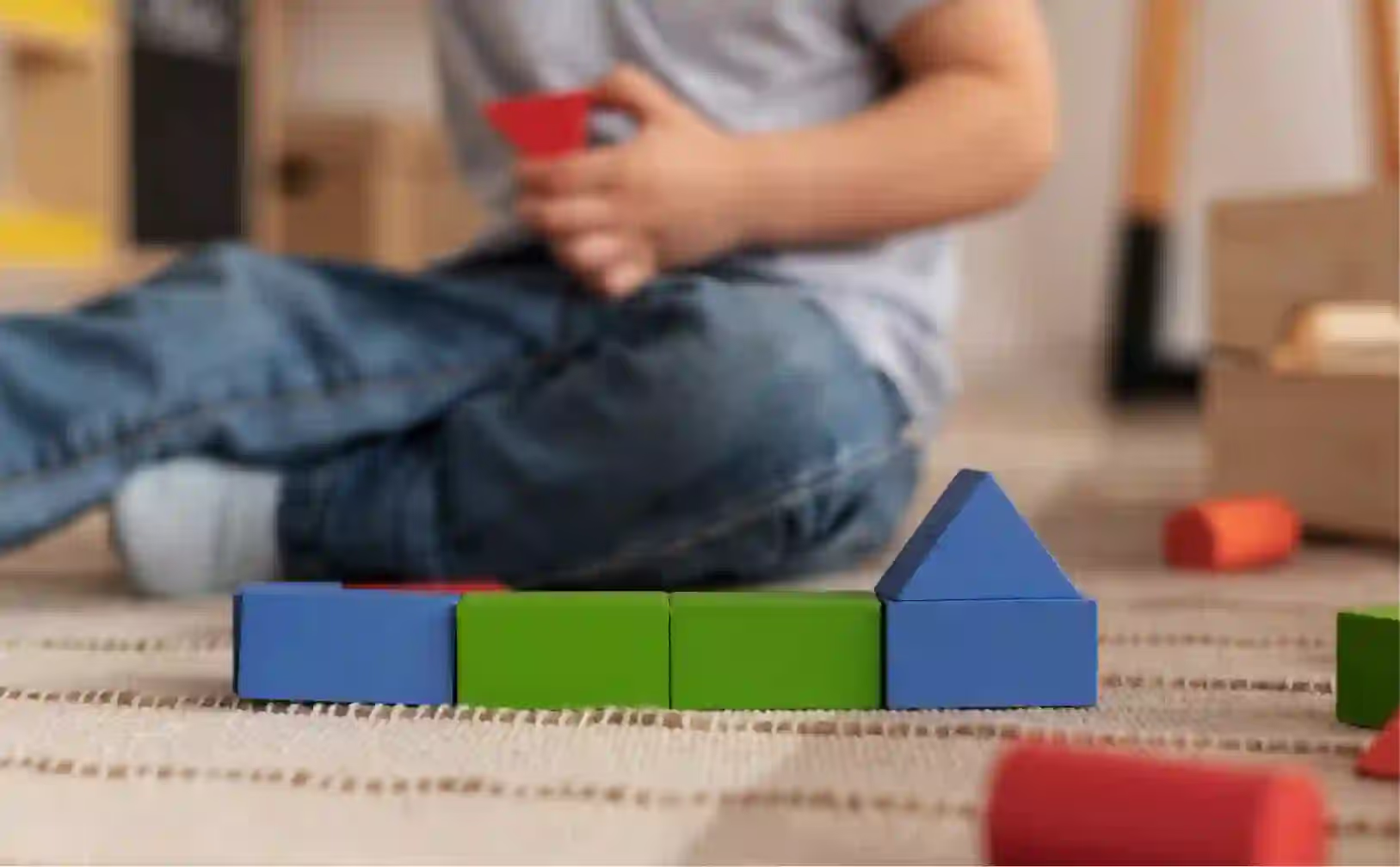
Age Range: 6-10 years
Target EQ Skill: Relationship skills—cooperation under stress, communication, shared regulation
Time: 20-30 minutes
Objective: Practice maintaining emotional regulation and cooperation when facing challenges, time pressure, or differing opinions.
Materials: Magnetic tiles, timer (optional)
Setup:
This activity works best with 2-4 children. Explain: "You're going to build together as a team, but there's a challenge. You have to build the tallest tower possible in
Activity Steps:
Set the challenge and start the timer. Initially, just observe. Children will likely have different ideas, might struggle to coordinate, could face frustration when the structure falls, and need to negotiate roles and strategies.
If conflict emerges, pause but don't solve it for them. Facilitate: "I notice you both have different ideas about how to build. What could you do to work this out?" Prompt strategies like: taking turns deciding, combining ideas, or trying one approach and switching if it doesn't work.
If frustration builds, pause for emotional regulation: "I see everyone's getting frustrated. Let's all take three deep breaths together." Model calming yourself even though you're not building, demonstrating that emotional states spread through groups and we can co-regulate together.
As they build, name the positive collaboration you observe: "I noticed you handed that piece to your partner exactly when they needed it. That's great teamwork." "You both stopped arguing and decided to try both ideas—that's excellent problem-solving."
When time ends, the height matters less than the process. Debrief extensively about the social-emotional experience rather than the product.
Reflection Questions:
Variations: Adjust the challenge: build without talking (requiring nonverbal communication), build blindfolded while partner gives directions (communication and trust), or build with specific requirements (must include all colors, must have a door, etc.). For younger children (ages 6-7), remove time pressure and simplify to basic cooperation challenges. For older children (9-10), add complexity like assigning roles (one builder, one supplier, one quality checker) requiring coordination.
Age Range: 5-9 years
Target EQ Skill: Relationship skills—repairing relationships after conflict
Time: 15-25 minutes
Objective: Practice apology, forgiveness, and relationship repair through enacted scenarios.
Materials: Magnetic tiles, two small toy figures or objects representing two friends
Setup:
Introduce the scenario: "We're going to tell a story about two friends who had an argument and hurt each other's feelings. Then we're going to help them repair their friendship and feel close again."
Activity Steps:
Build two separate structures representing the two friends' homes or spaces. Place them close together initially: "These two friends used to play together all the time and were very close."
Tell a story of conflict—something age-appropriate and relatable: "One day, Friend A accidentally knocked down a tower Friend B was building. Friend B got really angry and said mean things to Friend A. Then Friend A got upset and said they didn't want to be friends anymore. Now both friends feel sad." As you narrate, move the structures farther apart, physically representing the emotional distance the conflict created.
Ask your child: "How do you think each friend feels now?" Explore both perspectives—Friend A feels bad about knocking the tower down and sad that Friend B was so angry; Friend B feels bad about saying mean things and sad about losing the friendship. This validates that both people in conflicts have feelings and both might need to make amends.
Now guide the repair process: "What could these friends do to feel close again?" Prompt steps of apology and repair: Friend A could say sorry for knocking the tower and offer to help rebuild. Friend B could say sorry for the mean words and accept the apology. Both could agree to be more careful and communicate better next time.
As you discuss each repair step, physically move the structures closer together, building connection pieces between them. This visually represents relationship repair. Add a collaborative structure between their spaces: "Now they're building something together, showing that their friendship is working again."
Reflection Questions:
Variations: Use real conflicts your child has experienced (with permission and sensitivity). For younger children, keep scenarios simple—one clear misdeed, one clear apology. For older children, explore more complex conflicts where both parties contributed, require more nuanced repair, or involve misunderstandings rather than intentional harm. Practice actual apology language: "I'm sorry I
. I understand it made you feel . Next time I will ."Beyond structured activities, everyday magnetic tile play can incorporate emotional learning through storytelling techniques that help children process feelings, practice social skills, and develop emotional vocabulary.
Giving emotions to structures transforms building into narrative exploration. As children build, casually ask questions that invite emotional attribution: "Tell me about this building. Does it have any feelings?" or "If this tower could talk, what would it say?" These prompts encourage children to project emotions onto creations, providing indirect routes to discussing their own feelings. Children often express their current emotional states through play without realizing it. A child who builds aggressive, collision-focused scenarios might be working through angry feelings. One who repeatedly builds "safe places" or enclosed structures might be processing anxiety or need for security. By noticing these patterns without judgment, adults can gently explore underlying emotions: "I notice you've built a lot of strong, protective walls today. I wonder if you're feeling like you need extra protection from something?"
Introducing conflict-resolution scenarios through play provides practice without real-world stakes. Create simple stories with problems requiring social-emotional solutions: "These three blocks want to build something together, but they all have different ideas. What should they do?" Let your child problem-solve through play, trying different approaches to see what works. The beauty of toy-mediated conflict is that children can explore selfish, aggressive, or uncooperative responses without real consequences, then immediately try alternative approaches to compare outcomes. "Okay, so when the blocks argued and wouldn't cooperate, nothing got built and everyone felt mad. Let's try that again with the blocks listening to each other. What happens differently?"
Encouraging emotional vocabulary happens naturally when adults model rich feeling words during play. Instead of just "happy" and "sad," introduce: proud, disappointed, frustrated, excited, worried, relieved, jealous, grateful, embarrassed, confident. Use these words to describe characters' feelings: "I think this block feels disappointed that its plan didn't work out" or "These blocks seem really proud of what they built together."
Research shows that children with larger emotion vocabularies demonstrate better emotional regulation and social competence because they can identify emotional nuances more precisely, leading to more appropriate responses.
Parent and teacher modeling provides the scaffolding that transforms free play into emotional learning. This means:
Narrating your own emotional experiences during play: "I'm feeling a little frustrated that this piece won't connect. I'm going to try a different approach." This models both emotion awareness and regulation strategy. Wondering aloud about characters' emotions: "Hmm, I wonder how this block feels being left out of the group?" This invites empathy and perspective-taking without demanding it.
Asking open-ended questions rather than testing knowledge: "What do you think might help these characters solve their problem?" rather than "What should they do?" This positions the child as problem-solver rather than test-taker.
Validating all emotional expressions: "It makes sense that you'd feel frustrated when your tower falls" rather than "Don't be upset, it's just a toy." Validation teaches that emotions are acceptable and manageable rather than shameful or problematic.
Can magnetic tile role-play help with anxiety?
Yes, particularly for children whose anxiety involves social situations or emotional overwhelm. Building "safe places," practicing coping strategies through the Calm Down Tower, and working through anxiety-provoking scenarios in play provide concrete anxiety management tools. The indirect nature of toy-mediated exploration often feels safer than direct discussion for anxious children. However, magnetic tiles aren't therapy replacement—children with significant anxiety benefit from professional support using play as one component of treatment.
What if my child just builds and doesn't engage emotionally?
This is completely normal and doesn't indicate failure. Some children naturally gravitate toward pure construction without emotional narrative, particularly younger children, those less verbally oriented, or those simply not in the mood for guided activities. Don't force emotional engagement—instead, model it gently. As you build alongside them, casually narrate your own emotional experience: "I'm feeling proud of this strong tower I built." Over time, some children will naturally incorporate emotional elements when they're ready. Others may always prefer pure construction play, which still provides valuable learning just not specifically in the emotional domain.
How often should we do EQ play activities?
Quality matters more than quantity. One 15-minute emotion-focused activity done twice weekly with full engagement beats daily activities done as chores. Integrate emotional awareness into regular free play rather than making it always feel like structured lessons. Notice and name emotions when they naturally arise during any play: "You seem really proud of what you built!" This ongoing, natural emotional coaching matters more than formal activities. For children working on specific emotional challenges, more frequent structured practice (3-4 times weekly) can accelerate skill development.
Are these activities effective in group settings?
Yes, but require more facilitation than one-on-one activities. Group settings provide rich opportunities for peer-mediated learning, relationship skill practice, and observing how others handle emotions. However, they also introduce complexity—multiple personalities, peer dynamics, potential for conflict. Keys to success: small groups (3-4 children maximum), clear expectations established before activities begin, active adult facilitation redirecting as needed, and processing afterward to consolidate learning. Some activities (like the Team Challenge) are designed specifically for group settings, while others (like Feelings Castle) work better one-on-one or in pairs.
Can siblings with different personalities cooperate successfully?
Often yes, but expect different experiences than with same-age peers. Older siblings may naturally take leadership, which is fine if younger siblings aren't simply told what to do without input. Facilitators can explicitly structure turn-taking: "This time,
decides where this piece goes, and , your job is to support that choice." Siblings often bring their existing relationship dynamics—competitiveness, protectiveness, conflict patterns—into activities, providing valuable practice ground for relationship skills. Acknowledge this directly: "I notice you two sometimes argue about ideas. This is great practice in working that out." The key is supervision ensuring it remains constructive rather than devolving into familiar negative patterns.How do I know if an activity is working?
Look for these indicators: engagement—is your child focused and participating willingly? Emotion vocabulary increase—are they using more varied feeling words over time? Transfer—do you see them applying concepts from activities to real situations? Improved regulation—do emotional reactions become slightly more manageable across weeks and months? Openness—do they become more willing to discuss feelings? None of these happen immediately; emotional intelligence builds gradually across weeks and months of repeated practice.
Emotional intelligence isn't a luxury skill reserved for children in therapy or those experiencing problems. It's fundamental human capacity determining how we navigate relationships, manage stress, empathize with others, and build lives characterized by meaning and connection rather than isolation and emotional chaos.
And this capacity doesn't emerge automatically as children age. It develops through thousands of interactions where emotions are noticed, named, validated, and managed with support from caring adults who provide models, scaffolding, and patient practice opportunities. Structured role-play with magnetic tiles offers exactly these practice opportunities in formats young children love. Rather than lectures about emotions or forced conversations about feelings, these activities let emotional intelligence emerge naturally through play that's genuinely engaging.
The child building a "feelings castle" isn't doing therapy homework—they're playing. But within that play, they're developing self-awareness as they think about how different emotions feel and look. The siblings cooperating on the Team Challenge aren't completing an assignment—they're having fun together. But within that fun, they're practicing communication, compromise, and shared regulation under pressure.
These layered experiences accumulate. A four-year-old who builds emotion structures weekly for a year internalizes emotional vocabulary and self-awareness far beyond what direct instruction could achieve. A seven-year-old who practices empathy through "Bridge to Understanding" scenarios dozens of times develops genuine perspective-taking capacity that shows up in real playground conflicts. A six-year-old who rebuilds fallen towers while processing disappointment becomes a ten-year-old who handles academic setbacks with resilience.
The invitation is to start small and start today. You don't need perfect facilitation skills or psychological training. You don't need expensive materials or elaborate lesson plans. You need magnetic tiles, a child, and fifteen minutes.
Tonight, try the simplest activity: ask your child to build something that shows how they're feeling. Don't judge or correct their interpretation. Don't force conversation if they're not chatty. Just observe, be present, and maybe build your own feeling-structure alongside them. Notice what emerges. Notice what your child chooses to represent. Notice what they say or don't say. Notice how this small practice opens a window into their emotional world.
Then tomorrow, or next week, try it again. And again. Not as obligation, but as ritual—a protected space where feelings matter, where emotions are explored, and where the foundation for lifelong emotional intelligence gets built one tile at a time.
Because that's the truth about emotional intelligence: it doesn't arrive in dramatic breakthroughs. It grows through countless small moments of noticing feelings, naming them, managing them, understanding them in others, and learning that emotions—however big they feel—can be handled, expressed, and used as information guiding us toward the people we want to become.
Strong, emotionally intelligent minds are built exactly like towers of magnetic tiles—piece by piece, with patience, with occasional collapses requiring rebuilding, with creativity and problem-solving, and always, always with the support of caring people who believe the work matters and the child is worth the time.
So build those towers. Build those feelings castles and bridges to understanding. Build those calm-down structures and friendship repair pathways. Build, and watch, as something magnificent emerges—not just in the tiles, but in the child arranging them, discovering with each structure a little more about their own emotional landscape and how to navigate it with confidence, empathy, and grace.
NOVEMBER 21, 2025
NOVEMBER 21, 2025
NOVEMBER 21, 2025
NOVEMBER 21, 2025
NOVEMBER 20, 2025