

Magnetic Blocks for Dyslexic Children: Spatial Learning Advantages
NOVEMBER 21, 2025
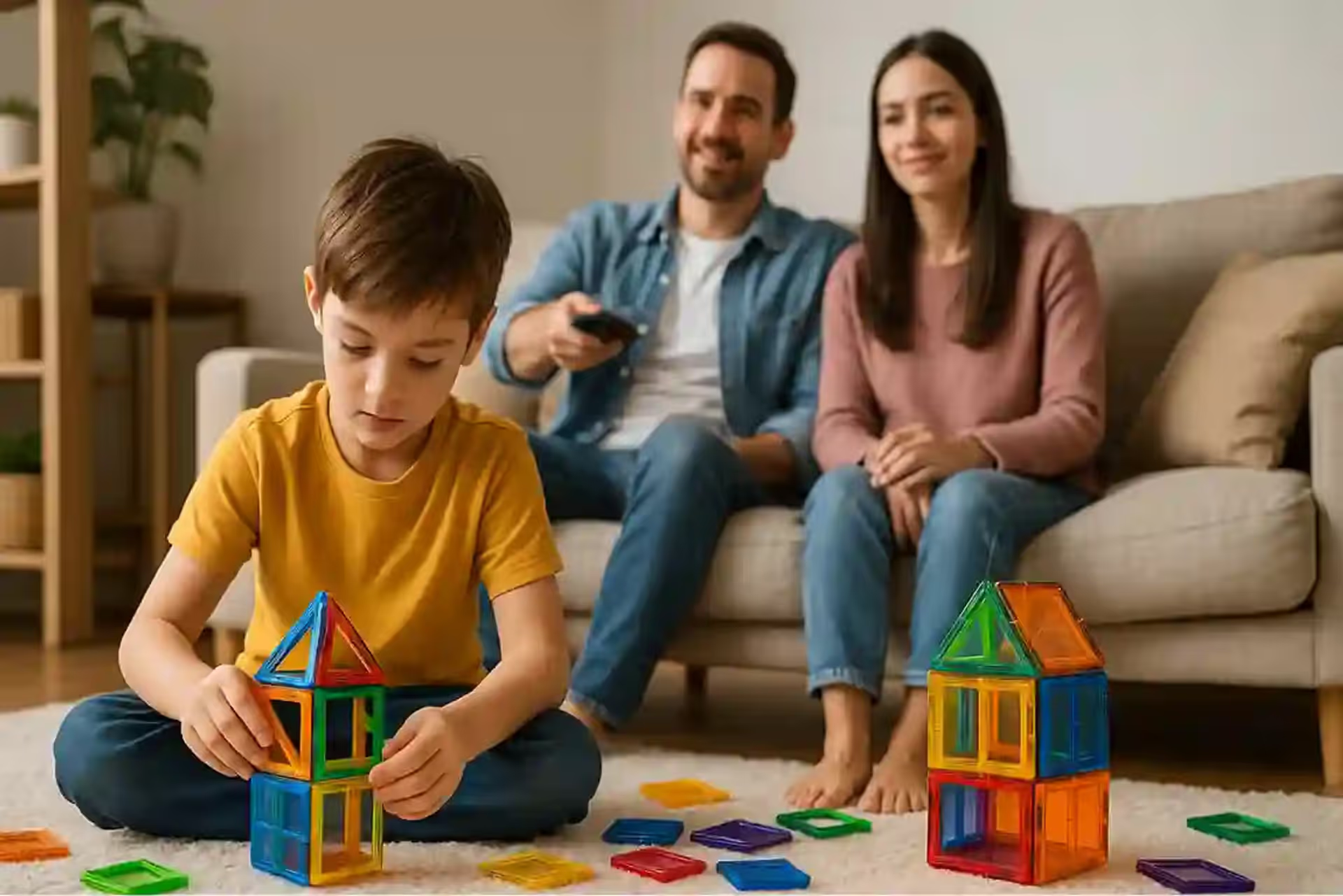
Your child stares at the iPad, completely absorbed, unreachable. You've tried everything – time limits, parental controls, reward charts. Nothing competes with the dopamine-dispensing machine in their hands. Yet across the room sits a box of magnetic blocks, gathering dust. The solution might be simpler than you think, but it requires understanding why screens captivate young minds and how physical toys can reclaim that attention.
The battle between screens and physical play isn't really about the activities themselves – it's about neurochemistry, reward patterns, and the fundamental ways children's brains respond to different types of stimulation. To successfully transition children from screens to magnetic blocks, we need to understand what makes digital devices so compelling and then strategically leverage the unique advantages that magnetic construction offers. This isn't about demonizing technology or returning to a pre-digital age. It's about creating balance through informed choices that respect both the reality of our digital world and the developmental needs of growing minds.
To understand how magnetic blocks can compete with screens, we first need to examine what happens in a child's brain during screen time. Digital devices trigger the release of dopamine – the neurotransmitter associated with pleasure and reward – through what scientists call variable ratio reinforcement. Think of it like a slot machine for the developing brain. Sometimes scrolling yields something interesting, sometimes not, but the uncertainty keeps the brain engaged, constantly seeking the next reward. This pattern creates what researchers at the National Institutes of Health describe as a "compulsion loop" that becomes increasingly difficult to break.
The developing brain is particularly vulnerable to these digital reward patterns because the prefrontal cortex – responsible for impulse control and decision-making – doesn't fully mature until the mid-twenties. When a seven-year-old plays a tablet game, their brain lacks the regulatory mechanisms to resist the carefully engineered psychological hooks. Game designers employ teams of behavioral psychologists to maximize engagement, creating experiences specifically designed to override natural stopping points. Every sound effect, color flash, and reward animation is calibrated to maintain that dopamine drip.
Screen activities also provide what psychologists call "attentional narrowing" – the visual and auditory stimulation creates a tunnel vision effect that blocks out environmental awareness. This explains why children seem deaf to parental calls during screen time. Their sensory processing becomes so focused on the screen that other inputs literally don't register. This intense focus feels satisfying in the moment but leaves children mentally exhausted afterward, often leading to the post-screen meltdowns many parents recognize.
Research from Common Sense Media shows that children ages 8-12 spend an average of 4-6 hours daily on screens, while teens average 7-9 hours. These statistics don't include time spent on screens for homework, revealing just how thoroughly digital devices have colonized childhood. The concern isn't simply about time displacement – that children could be doing other activities – but about the neurological impact of this sustained digital immersion on developing brains.
Perhaps the most concerning aspect of screen time is its fundamentally passive nature. Even interactive apps and games require minimal physical engagement – a finger swipe or tap. The brain receives constant stimulation without generating equivalent output. This imbalance between input and output disrupts normal neural development patterns that depend on active exploration and creation.
Children watching YouTube or playing tablet games enter a state researchers call "passive receptivity" – their brains process incoming information without the critical thinking, problem-solving, and creativity that characterize healthy cognitive development. Over time, this passive consumption pattern can reduce initiative, creativity, and the ability to self-entertain – creating a dependency cycle where children feel bored without external stimulation.
The American Academy of Pediatrics has revised its screen time recommendations multiple times as research reveals new concerns about developmental impacts. While previous guidelines focused primarily on limiting hours, newer recommendations emphasize the quality of digital engagement and the importance of balancing screen time with physical play, social interaction, and creative activities. The organization specifically highlights the risks of passive screen consumption during critical developmental windows when children's brains are rapidly forming neural connections that will shape cognitive abilities for life.
Now let's examine what happens in the brain during magnetic block play to understand why these toys can effectively compete with screens. When a child picks up magnetic tiles, multiple brain regions activate simultaneously – the motor cortex for hand movement, the visual cortex for spatial processing, the somatosensory cortex for touch feedback, and the prefrontal cortex for planning and problem-solving. This whole-brain activation contrasts sharply with the limited neural engagement of screen time.
The tactile sensation of magnets snapping together provides what neuroscientists call "proprioceptive feedback" – information about body position and movement that helps develop spatial awareness and motor planning. Each time tiles connect, the child's brain receives multiple streams of sensory data: the resistance before connection, the sudden snap of magnetic attraction, the click sound, and the visual confirmation of successful attachment. This multi-sensory experience creates richer neural encoding than any screen interaction could provide.
Most importantly, magnetic block play generates what researchers term "intrinsic motivation" – the drive to engage in an activity for its own sake rather than for external rewards. Unlike screen games that dispense points, badges, and level-ups, the reward in magnetic construction comes from the creation itself. When a child successfully builds a bridge that stands, the satisfaction originates internally from their sense of accomplishment. This intrinsic reward system develops self-motivation and resilience – qualities that external reward systems actually diminish.
Studies in developmental psychology demonstrate that hands-on construction play activates the brain's executive function networks more effectively than digital activities. These networks, centered in the prefrontal cortex, govern planning, working memory, flexible thinking, and self-control – precisely the capabilities that excessive screen time can impair. Magnetic blocks essentially provide targeted exercise for the brain regions most vulnerable to digital overexposure.

Simply removing screens and offering magnetic blocks won't work – we need to make the physical toys genuinely competitive with digital entertainment. The key lies in understanding that children aren't addicted to screens themselves but to the psychological rewards screens provide: novelty, achievement, social connection, and autonomy. Magnetic blocks can deliver all these rewards, but parents need to facilitate the transition strategically.
Start by creating what behavioral psychologists call "environmental design" – structuring the physical space to make magnetic blocks more accessible than screens. Place magnetic tiles in multiple locations where children naturally spend time. Keep sets in clear containers at child height, already partially assembled into intriguing shapes that invite completion. Meanwhile, create friction for screen access – not through rules but through environmental barriers. Tablets need to be retrieved from a high shelf, require passwords, or have dead batteries. The path of least resistance should lead to magnetic blocks.
Timing matters crucially in this transition. Don't attempt to replace screen time when children are tired, hungry, or emotionally dysregulated – these are states when the easy dopamine of screens feels necessary. Instead, introduce magnetic blocks during high-energy, positive mood periods when children have the cognitive resources for active play. Morning hours, after physical activity, or during that post-snack energy surge provide optimal transition windows.
The concept of "nudge theory," popularized by behavioral economists, applies perfectly to this transition. Rather than forcing change through restrictions and rules, we subtly alter the choice architecture to make the desired behavior easier and more appealing. This approach respects children's autonomy while guiding them toward healthier patterns.
Children's behavior mirrors what they observe more than what they're told. If parents constantly check phones while telling children to play with magnetic blocks, the message is clear: screens are what adults value. Successful digital detox requires parents to model the behavior they want to see. This doesn't mean abandoning technology entirely, but rather demonstrating that physical activities can be equally engaging for adults.
Begin by engaging with magnetic blocks yourself during times you'd typically default to phone scrolling. Build something while your morning coffee cools, create structures during commercial breaks, or construct patterns while waiting for dinner to cook. When children see adults genuinely engaged with magnetic blocks – not performatively playing for their benefit but actually absorbed in construction – it validates the activity as worthwhile. Children instinctively understand the difference between authentic engagement and educational theater.
Share your genuine struggles and successes with magnetic construction. When your tower falls, express real frustration before trying again. When you solve a building challenge, celebrate authentically. This emotional authenticity teaches children that magnetic blocks can provide the same emotional engagement as screens – frustration, triumph, flow, and satisfaction. Your modeling demonstrates that these feelings are worth pursuing through physical play rather than digital stimulation.
Research on social learning theory confirms that children learn behaviors primarily through observation and imitation of important adults in their lives. Albert Bandura's foundational research demonstrated that children don't just copy specific actions but internalize entire behavioral patterns, including attitudes and emotional responses. When parents demonstrate genuine enthusiasm for hands-on play, children absorb not just the actions but the underlying value system that makes physical construction worthwhile.
The transition from screens to magnetic blocks needs early victories to build momentum. Start with just 10 minutes of magnetic play before allowing screen time – this creates a positive association rather than positioning blocks as screen replacement. Gradually extend these pre-screen building sessions as children develop stamina for physical play.
Create "building challenges" that mirror video game quests:
These discrete, achievable goals provide the same satisfaction as completing game levels while developing real-world skills. The key is making challenges appropriately difficult – not so easy that they bore, not so hard that they frustrate. Adjust complexity based on your child's age and skill level, creating what psychologists call the "flow state" where challenge and ability align perfectly.
Different ages require different strategies for transitioning from screens to magnetic blocks. Toddlers (ages 2-4) haven't yet developed strong screen dependencies, making this the ideal time to establish magnetic blocks as a primary play option. At this age, the sensory appeal of magnetic connection often naturally competes with screens. Parents can leverage this by creating "magnetic moments" throughout the day – quick building sessions during diaper changes, constructing while waiting for meals, or building bedtime structures. The key is frequency rather than duration, establishing magnetic play as a normal part of daily routine before screen habits solidify.
Elementary age children (5-9) present unique challenges as they've likely developed screen preferences but remain cognitively flexible enough to develop new interests. For this group, the transition works best when magnetic blocks connect to their existing screen interests. If they love Minecraft, emphasize the similarity between digital and physical building. If they watch engineering videos on YouTube, challenge them to recreate structures with magnetic tiles. This age responds well to documentation – photographing creations, making stop-motion videos, or keeping building journals bridges their digital and physical worlds.
Tweens and teens (10+) require the most sophisticated approach as screens often serve social and identity functions beyond entertainment. Magnetic blocks must offer equivalent social capital and self-expression opportunities. Creating Instagram-worthy geometric art, engineering TikTok-able chain reactions, or building architectural models for school projects positions magnetic construction as sophisticated rather than childish. This age group benefits from advanced sets with more pieces and complex possibilities, preventing the activity from feeling regressive.
The developmental windows for different cognitive abilities mean that screen time impacts various age groups differently. Research from Harvard University demonstrates that the first five years of life represent a critical period for brain architecture formation, when neural connections form at a rate that will never be matched later in life. Excessive passive screen time during these years can literally alter brain structure in ways that become increasingly difficult to remediate as children age.
One of screens' most powerful hooks is social connection – whether through multiplayer games, social media, or shared cultural references. Magnetic blocks need to offer equivalent social rewards to compete effectively. This requires intentionally creating social contexts for magnetic play that feel as connecting and validating as digital interactions.
Family building sessions provide the most immediate social context. Designate specific times for collaborative construction where everyone contributes to a shared project. These sessions shouldn't feel forced or educational but genuinely fun and connecting. Create family challenges, inside jokes about building failures, and shared memories around magnetic construction. When children associate magnetic blocks with positive family bonding, the activity gains emotional resonance that screens can't match.
Peer connections through magnetic blocks require more orchestration but yield powerful results. Organize building playdates where magnetic construction is the primary activity. Create competitions, collaborative challenges, or building exchanges where children create structures for each other. When magnetic blocks become a social currency among peers – something to discuss, share, and compete around – they gain the social validation that makes activities feel worthwhile to children.
Consider starting or joining a local building club where children meet regularly to construct with magnetic blocks. Many public libraries now offer maker spaces and STEM programs that incorporate construction toys, providing ready-made social contexts for physical play. These community programs validate magnetic building as an activity worthy of social time and attention, counteracting the cultural perception that meaningful socializing happens primarily through screens.
Parents often measure digital detox success purely through reduced screen time, but this metric misses the deeper transformation. True success appears in qualitative changes: increased attention span during non-screen activities, improved emotional regulation, enhanced creativity in play, and greater initiative in seeking activities. These changes develop gradually and non-linearly, with progress often appearing in unexpected ways.
Watch for changes in how children approach boredom. Screen-dependent children typically express boredom as emergency requiring immediate resolution through digital entertainment. As magnetic block play develops, children begin treating boredom as opportunity for creation. They might spontaneously start building when waiting, use magnetic tiles to process emotions, or default to construction during transition times. This shift from passive consumption to active creation represents fundamental cognitive rewiring.
Document the complexity evolution in magnetic constructions. Early builds might replicate screen content – recreating video game characters or YouTube structures. Over time, constructions become increasingly original, complex, and personally meaningful. Children begin building representations of their thoughts, feelings, and experiences rather than external media. This progression from imitation to creation indicates successful cognitive transition from passive consumption to active generation.
Keep a photo journal of your child's magnetic block creations over several months. Review these periodically to observe patterns you might otherwise miss in daily life. You'll likely notice increasing sophistication in structural engineering, more creative use of color and shape, and progression from literal representations to abstract artistic expression. These visual records provide concrete evidence of cognitive development that occurs gradually enough to escape notice in real-time.
Beyond reduced screen dependency, parents consistently report unexpected benefits from magnetic block engagement. Sleep improves as children process their day through building rather than screen stimulation before bed. Sibling relationships strengthen through collaborative construction. Fine motor skills advance rapidly from precise tile manipulation. Emotional regulation improves as children learn to persist through building frustrations.
Perhaps most surprisingly, many parents report that their own screen time decreases as they become engaged in magnetic building alongside their children. The digital detox becomes a family transformation rather than a child-specific intervention, creating household-wide benefits that extend beyond the initial goal of reducing children's screen time.
The relationship between screen time and sleep quality has been extensively documented by sleep researchers. The blue light emitted by screens suppresses melatonin production, making it harder to fall asleep. But beyond the physical effects of light exposure, the mental stimulation of screen content keeps children's brains activated when they should be winding down. Magnetic block play, especially in softer lighting conditions, provides constructive activity without the arousing effects of digital media, supporting natural circadian rhythms and better sleep.
The path from screens to magnetic blocks rarely runs smoothly. Children may initially reject magnetic blocks as "boring" compared to the instant gratification of screens. This resistance is neurological rather than preferential – their brains have adapted to the high-stimulation environment of digital media, making normal stimulation feel insufficient. Think of it like taste adaptation after eating very sweet foods – normal flavors seem bland until your palate readjusts.
The solution isn't to make magnetic blocks more stimulating but to gradually reduce overall stimulation levels so children's sensory baselines can recalibrate. This might mean accepting temporary boredom as children's brains adjust to lower stimulation levels. Parents often cave during this adjustment period, reintroducing screens to avoid dealing with complaints. However, this "boredom valley" typically lasts only 3-7 days before children's nervous systems adapt and they begin finding magnetic blocks genuinely engaging.
Another common obstacle is the "all or nothing" mentality – parents either allow unlimited screens or attempt complete elimination. This binary approach usually fails because it doesn't acknowledge screens' legitimate role in modern life. Instead, focus on creating screen-free zones and times where magnetic blocks become the default option. Morning hours before school, the hour after returning home, and the wind-down period before bed can become sacred screen-free times where physical play dominates.
Resistance to change is a predictable human response, especially when that change involves removing something pleasurable. Change management research from organizational psychology applies surprisingly well to family dynamics. The most successful transitions involve clear communication about why change is happening, involvement of all stakeholders in the transition plan, celebration of small wins, and patience with the inevitable setbacks that occur during any major behavioral shift.
Long-term success requires embedding magnetic block play into family culture rather than treating it as a temporary intervention. This means creating rituals, traditions, and ongoing practices that make physical construction a natural part of daily life. Consider establishing "building seasons" where the family works toward major construction goals, similar to how screens have series or game seasons that maintain long-term engagement.
Develop family building traditions that children anticipate and value. Weekend morning builds while parents drink coffee, post-dinner construction competitions, or holiday-themed building challenges create positive associations that strengthen over time. These traditions should feel special rather than obligatory – something children would miss if skipped rather than endure reluctantly. The goal is making magnetic block time feel as culturally important as family movie night or game time.
Connect magnetic building to larger family values and goals. If creativity is valued, celebrate innovative constructions. If persistence matters, acknowledge when children work through building frustrations. If collaboration is important, emphasize successful joint projects. When magnetic blocks become a vehicle for expressing and developing family values, they gain significance beyond mere screen alternatives.
Consider creating a "gallery wall" where children's magnetic block creations are photographed and displayed prominently in your home. This physical recognition of their work validates the time and effort invested in construction play, signaling that these creations matter as much as academic achievements or sports accomplishments. Rotate the gallery monthly, creating an archive of past builds that children can look back on with pride, seeing their progression and growth over time.
The goal isn't eliminating screens entirely but creating healthy balance where physical play holds equal appeal. This balance looks different for every family based on values, schedules, and children's individual needs. Some families might achieve 50/50 screen/physical play splits, while others might be satisfied with 70/30. The key is intentionality rather than default patterns.
Consider how screens and magnetic blocks can complement rather than compete. Children might research building techniques online, then execute them physically. They might photograph magnetic creations to share digitally, bridging physical and digital worlds. This integration acknowledges that children will live in a digital world while ensuring they develop crucial physical manipulation and spatial reasoning skills through tangible play.
Regular recalibration keeps the balance healthy as children grow and circumstances change. What works for a six-year-old won't suit a ten-year-old. Summer balance differs from school year patterns. Flexibility and ongoing adjustment prevent the screen-physical play balance from becoming another source of family stress. The goal is sustainable patterns that support development while acknowledging modern realities.
The concept of "media mentorship" promoted by media literacy educators suggests that parents should guide children's media consumption rather than simply limiting it. This means watching, playing, and engaging with digital content alongside children, discussing what they're experiencing, and helping them develop critical thinking about media messages. When applied to the screen-physical play balance, this mentorship extends to helping children recognize when screens serve genuine purposes versus when they're default behaviors driven by boredom or habit.

The Martinez family struggled with three children constantly fighting over tablet time. They introduced magnetic blocks gradually, first as a "pre-screen" activity, then as an alternative during conflicts. Within two months, the children were collaborating on massive magnetic structures instead of arguing over devices. Screen time decreased by 60% without any explicit limits – the children simply became more interested in building together.
Eight-year-old Sarah was averaging six hours of YouTube daily, concerning her parents and teachers. Her mother began building with magnetic blocks herself each evening, creating increasingly elaborate structures without inviting Sarah to join. Sarah's curiosity eventually overcame her screen preference, and she began building alongside her mother. Six months later, Sarah's teacher reported dramatic improvements in attention span, creativity, and social engagement.
The Chen family used magnetic blocks to address their son's gaming addiction. Instead of removing games, they created real-world "quests" using magnetic construction – complete with levels, achievements, and rewards. Their son initially participated reluctantly but gradually became absorbed in the physical challenges. His gaming decreased from 8 hours to 2 hours daily as magnetic building filled the psychological needs gaming had been meeting.
These success stories share common elements: gradual implementation rather than sudden elimination, parental involvement and modeling, connection to existing interests, and patience through the adjustment period. None of these families succeeded by simply buying magnetic blocks and hoping for the best – they invested time, creativity, and strategic thinking into making the transition successful.
Parents attempting digital detox through magnetic blocks don't need to work in isolation. Online communities share building challenges, document success stories, and provide support during difficult transitions. Local libraries increasingly offer magnetic block programs where children can build together screen-free. These community connections provide social reinforcement that strengthens individual family efforts.
Educational resources help parents maximize magnetic blocks' developmental benefits while maintaining engagement. STEM activity guides provide structured challenges that develop specific skills. Building technique videos – watched together, then executed physically – bridge digital and physical worlds productively. These resources prevent magnetic play from becoming repetitive while ensuring educational value.
Professional support may help families struggling with severe screen dependency. Occupational therapists can design magnetic block interventions targeting specific developmental needs. Child psychologists can address underlying anxiety or attention issues that drive screen dependency. These professionals increasingly recognize magnetic blocks as therapeutic tools for addressing various childhood challenges beyond screen time.
Parent support groups, both online and in-person, provide crucial emotional support during the challenging transition period. Hearing other families' struggles and successes normalizes the difficulties you're experiencing and provides practical strategies that worked in similar situations. Many communities have Facebook groups dedicated to screen-free parenting where members share resources, encouragement, and accountability.
One of the most encouraging aspects of transitioning from screens to magnetic blocks is the brain's remarkable neuroplasticity – its ability to reorganize and form new neural connections throughout life. This means that even children who've spent years in screen-heavy environments can develop the neural pathways associated with hands-on construction play. The brain isn't permanently shaped by early experiences but remains responsive to new patterns of stimulation and activity.
Research in cognitive neuroscience demonstrates that intensive engagement in spatial reasoning tasks – exactly what magnetic block play provides – can strengthen and expand the brain regions responsible for these abilities. Studies using functional MRI have shown measurable changes in brain activation patterns after just weeks of regular construction play, with increased activity in regions associated with problem-solving, spatial visualization, and creative thinking.
The implications are profound: it's never too late to introduce magnetic blocks as a screen alternative. Whether your child is three or thirteen, their brain retains the capacity to develop new preferences, skills, and neural pathways. The key is providing sufficient opportunity and support for these new patterns to establish themselves, recognizing that older children and those with more entrenched screen habits will require longer adjustment periods and more strategic intervention.
While magnetic blocks serve as an excellent screen alternative, the broader goal is developing a diverse play repertoire that doesn't depend on digital devices. Once children rediscover the satisfaction of hands-on construction, they often become more receptive to other physical play options: outdoor exploration, art projects, board games, sports, and imaginative play. Magnetic blocks serve as a gateway to this richer play landscape, demonstrating that non-digital activities can be genuinely engaging.
The skills developed through magnetic block play – spatial reasoning, persistence, creative problem-solving, and frustration tolerance – transfer to other domains. Children who learn to work through building challenges often show improved persistence with homework, sports practice, and social conflicts. The meta-lesson of magnetic block play extends beyond construction: that sustained effort toward meaningful goals provides deeper satisfaction than passive consumption of entertainment.
As children develop confidence and competence with magnetic blocks, gradually introduce additional screen-free activities, using the same strategic principles: environmental design, parental modeling, connection to existing interests, and celebration of progress. The goal is creating a lifestyle where screens occupy an appropriate but limited role in a rich tapestry of physical, social, and creative activities.
The transition from screens to magnetic blocks represents more than a simple activity swap – it's a fundamental shift in how children engage with their environment and develop their minds. While screens offer passive consumption and external validation, magnetic blocks provide active creation and intrinsic satisfaction. This difference shapes not just how children play but who they become as thinkers, problem-solvers, and creators.
Success in this transition requires patience, strategy, and recognition that we're working against powerful psychological and social forces. The tech industry invests billions in making screens irresistible to developing minds. But parents armed with understanding of child development, strategic implementation of alternatives, and commitment to long-term change can successfully rebalance their children's relationship with technology.
The goal isn't to return to a pre-digital childhood but to ensure children develop the full range of cognitive, motor, and creative capabilities that physical play provides. Magnetic blocks offer a bridge between the digital future our children will inhabit and the hands-on learning their brains need to develop fully. By making this transition successfully, we give our children not just an alternative to screens but a foundation for lifelong learning, creativity, and resilience that no app could ever provide.
The journey from screen dependency to balanced play isn't always linear or easy, but it's profoundly worthwhile. Every moment children spend manipulating physical objects, solving three-dimensional problems, and creating tangible structures contributes to neural development that will serve them throughout life. The magnetic blocks gathering dust in your closet might just be the most powerful parenting tool you own – not because they're inherently magical, but because they engage children's minds, hands, and hearts in ways that truly support healthy development. The question isn't whether magnetic blocks can compete with screens, but whether we're willing to invest the time and strategy to help them do so.
NOVEMBER 21, 2025
NOVEMBER 21, 2025
NOVEMBER 21, 2025
NOVEMBER 20, 2025
NOVEMBER 20, 2025