

Magnetic Blocks for Dyslexic Children: Spatial Learning Advantages
NOVEMBER 21, 2025

Walk into any gifted education classroom, and you'll likely spot premium magnetic building sets among the carefully curated learning materials. These aren't random toy selections or budget-filling purchases. Gifted education specialists choose magnetic blocks deliberately, recognizing how these seemingly simple tools activate complex cognitive processes that gifted minds crave. The connection between magnetic construction and advanced cognitive development runs deeper than most parents or even educators realize.
To understand why magnetic blocks have become essential in gifted education, we need to examine what makes gifted learners unique. Their brains don't just work faster – they work differently, creating neural connections across multiple domains simultaneously. When a gifted child builds with magnetic tiles, they're not simply stacking shapes. They're engaging in multi-dimensional problem-solving that exercises the exact cognitive muscles that define giftedness: divergent thinking, systems analysis, creative synthesis, and metacognitive awareness. Let's explore how this happens at the neurological level.
Before we can appreciate why magnetic blocks particularly suit gifted learners, we need to understand how gifted brains differ structurally and functionally from typical brains. Neuroimaging studies reveal that gifted individuals show increased white matter density, particularly in regions connecting different brain areas. Think of white matter as the brain's superhighway system – in gifted individuals, these highways are not only more numerous but also more efficient, allowing rapid communication between brain regions that typically work in isolation.
This enhanced connectivity manifests in what researchers call "cognitive flexibility" – the ability to shift between different mental frameworks rapidly. When a gifted child manipulates magnetic blocks, their brain simultaneously processes spatial relationships, mathematical patterns, aesthetic considerations, and structural engineering principles. A typical child might focus on one aspect at a time, but the gifted brain naturally integrates these multiple dimensions into a cohesive understanding. This is why a simple request to "build a house" might result in a gifted child creating a structure that demonstrates understanding of architectural principles, symmetry, color theory, and even narrative elements, all without explicit instruction.
The prefrontal cortex, responsible for executive functions, shows heightened activation in gifted individuals even during rest states. This means their brains are constantly seeking patterns, making connections, and generating hypotheses about the world around them. Magnetic blocks provide an ideal medium for this constant cognitive hunger because they offer infinite possibilities within a structured system. The magnetic connections create rules and constraints that the gifted mind can explore, test, and transcend through creative problem-solving.
Dabrowski's Theory of Positive Disintegration describes five areas of overexcitability common in gifted individuals: psychomotor, sensual, intellectual, imaginational, and emotional. Magnetic blocks uniquely engage multiple overexcitabilities simultaneously. The tactile sensation of magnets snapping together satisfies sensual overexcitability. The physical manipulation addresses psychomotor needs. The problem-solving aspects feed intellectual overexcitability, while the creative possibilities engage imaginational overexcitability.
This multi-sensory engagement explains why gifted children often become deeply absorbed in magnetic block play for extended periods. They're not just playing – they're feeding multiple cognitive and sensory needs simultaneously in a way that few other activities can match. The depth of engagement often surprises parents who struggle to find activities that hold their gifted child's attention.
Understanding these overexcitabilities helps explain why gifted children sometimes seem paradoxically both advanced and intense. Their heightened sensitivity to stimuli isn't a disorder to be managed but a characteristic of their cognitive wiring that can be productively channeled through appropriate activities. Magnetic blocks provide exactly this kind of channeling – they offer complex stimulation without overwhelming sensory input, allowing gifted children to engage their intensities constructively.
Divergent thinking – the ability to generate multiple creative solutions to open-ended problems – stands as a hallmark of giftedness. Traditional educational materials often constrain thinking to convergent paths, seeking single correct answers. Magnetic blocks, however, naturally promote divergent exploration. Consider a simple challenge: create a structure that can hold a tennis ball. A gifted child might generate dozens of solutions, each employing different engineering principles, aesthetic approaches, and material configurations.
The magnetic connection system itself encourages divergent thinking through what cognitive scientists call "productive failure." When magnets repel instead of attract, or when structures collapse due to magnetic interference, children must reconceptualize their approach. This isn't simply trial and error – it's systematic hypothesis testing that develops scientific reasoning. A gifted child building with magnetic tiles learns that magnetic poles have orientation, that magnetic fields interact through materials, and that structural stability depends on magnetic force distribution. They discover these principles not through instruction but through divergent exploration and pattern recognition.
Research from the University of Georgia's Torrance Center for Creativity shows that activities promoting divergent thinking in childhood correlate with creative achievement in adulthood more strongly than IQ scores. Magnetic blocks provide a particularly pure form of divergent thinking practice because they combine complete creative freedom with physical constraints that demand innovative problem-solving. Every building session becomes an exercise in generating, evaluating, and refining multiple solution pathways – exactly the cognitive process that distinguishes highly creative individuals.
The beauty of magnetic blocks lies in their paradoxical nature: they're simultaneously limitless and bounded. The physical pieces are finite, yet the combinations are essentially infinite. This creates what psychologists call "creative constraints" – limitations that actually enhance creativity by providing structure within which imagination can operate. Gifted children, who often struggle with the overwhelming possibilities of completely open-ended tasks, thrive within this structured freedom.
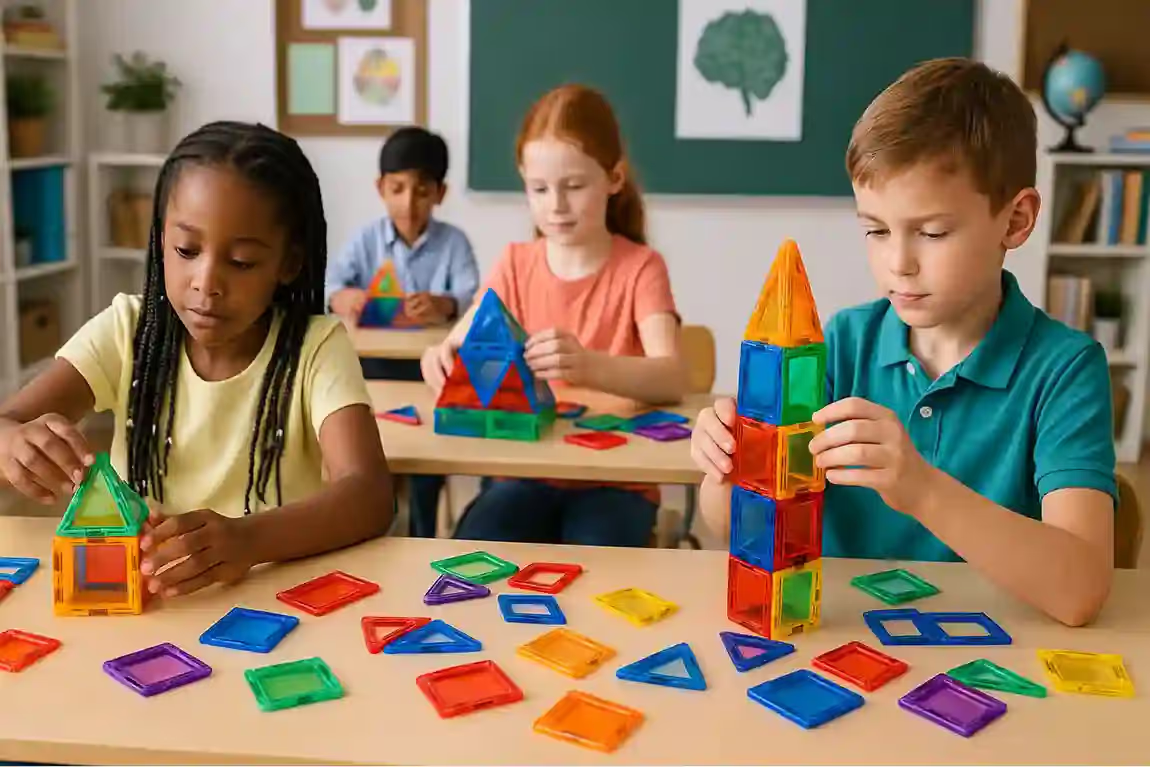
While gifted children often show advanced intellectual capabilities, their executive functions – planning, working memory, cognitive flexibility, and inhibitory control – may develop asynchronously. This creates the paradox of a child who can understand complex mathematical concepts but struggles to organize their backpack. Magnetic blocks provide a unique training ground for executive functions because they require simultaneous management of multiple cognitive processes within a concrete, manipulable medium.
Working memory, the ability to hold and manipulate information mentally, gets constant exercise during magnetic construction. A child building a complex structure must remember their overall design goal, track which pieces they've already used, maintain awareness of structural weak points, and adjust their plan based on available resources. This cognitive juggling act strengthens working memory capacity in a way that feels like play rather than work. The three-dimensional nature of magnetic construction adds another layer of complexity, as children must mentally rotate and transform shapes to predict how they'll fit together.
Inhibitory control – the ability to resist impulsive actions and maintain focus on long-term goals – develops through the patience required for complex magnetic constructions. Gifted children often struggle with perfectionism and frustration when reality doesn't match their vision. Magnetic blocks teach them to work through these emotions productively. When a tower collapses, they must inhibit the impulse to quit or rage, instead analyzing what went wrong and trying again. This emotional regulation practice occurs within a low-stakes environment where failure is temporary and fixable.
The asynchronous development common in gifted children makes executive function development particularly crucial. These children might have the intellectual capacity of teenagers while possessing the emotional regulation skills of much younger children. Research on gifted education emphasizes that supporting executive function development is as important as providing intellectual challenges, and magnetic blocks uniquely address both needs simultaneously.
Gifted learners naturally gravitate toward understanding systems rather than isolated facts. They want to know not just what happens, but why and how different elements interact to create emergent properties. Magnetic blocks provide a perfect laboratory for systems thinking because they create structures where the whole genuinely exceeds the sum of parts. A magnetic bridge isn't just stacked blocks – it's a system where each piece contributes to overall stability through force distribution, magnetic field interactions, and geometric relationships.
Consider how a gifted child approaches building a magnetic sphere. They must understand that triangular tiles create curvature through angular relationships, that the magnetic polarities must alternate in specific patterns, and that structural integrity depends on force distribution across multiple connection points. This isn't information they're taught – it's knowledge they construct through systematic experimentation and observation. They're learning topology, materials science, and engineering principles through direct manipulation rather than abstract instruction.
The complexity scales naturally with the child's developing capabilities. A younger gifted child might explore how different shapes affect structural stability. An older child might investigate how magnetic field strength varies with distance, using this knowledge to create cantilevered structures that seem to defy gravity. This self-scaling complexity ensures that magnetic blocks remain cognitively challenging throughout development, preventing the boredom that often plagues gifted learners with typical educational materials.
Systems thinking extends beyond the immediate construction task to broader conceptual understanding. Children begin recognizing that complex systems appear everywhere – in ecosystems, social organizations, economic systems, and technological networks. The hands-on experience with physical systems through magnetic building creates mental models that transfer to abstract systems thinking in other domains. This transferable skill becomes invaluable as gifted students progress to higher-level coursework requiring integration across multiple disciplines.
Educational researchers use specific metrics to assess creative thinking, including fluency (number of ideas generated), flexibility (variety of approaches), originality (uniqueness of solutions), and elaboration (detail and complexity). Magnetic block activities naturally develop all four dimensions of creativity, which explains their prevalence in gifted programs focused on nurturing creative potential.
Fluency develops through open-ended building challenges where children generate multiple solutions. A gifted program might ask students to create ten different ways to bridge a gap between two tables using magnetic tiles. This exercise pushes beyond the first obvious solution, forcing children to explore increasingly creative approaches. The physical nature of the materials means ideas must be practically viable, adding a reality-testing component that pure imagination exercises lack.
Flexibility emerges as children shift between different types of solutions – perhaps starting with architectural approaches, then moving to sculptural methods, then discovering engineering principles that open entirely new solution categories. This cognitive flexibility, the ability to shift mental frameworks fluidly, represents a core component of creative genius. Gifted programs explicitly cultivate this flexibility through varied magnetic block challenges that require different thinking modes.
Originality emerges when children combine magnetic blocks in unexpected ways. Gifted learners often discover non-obvious uses for pieces – using the magnetic properties themselves as structural elements, creating optical illusions with transparent tiles, or building kinetic sculptures that move. These original applications arise from deep understanding of the materials' properties combined with creative vision. The magnetic aspect adds unique possibilities not available with traditional blocks, such as suspended elements or structures that change configuration through magnetic attraction and repulsion.
Elaboration, the ability to develop ideas with rich detail and complexity, manifests in the increasingly sophisticated structures gifted children create over time. Initial builds might be functional but simple. As experience grows, children add decorative elements, incorporate multiple sub-systems, and create structures with layers of meaning and purpose. This progression from simple to complex, from utilitarian to artistic, mirrors the creative development process that characterizes artistic and scientific innovation.
Gifted children often struggle with social-emotional development, experiencing intensities and sensitivities that complicate peer relationships. Magnetic block activities in gifted programs frequently incorporate collaborative elements that address these challenges while maintaining cognitive rigor. When gifted children build together, they must negotiate design decisions, share resources, and integrate different vision styles – all crucial social skills that transfer beyond the building context.
The concrete nature of magnetic construction provides a scaffold for abstract social concepts. Compromise becomes visible when two children merge their building designs. Leadership and followership alternate naturally as different children contribute expertise in various aspects of construction. Conflict resolution happens through physical problem-solving rather than purely verbal negotiation. A dispute about structural design resolves through testing both approaches and observing which works better.
Perfectionism, a common challenge for gifted learners, meets its match in the inherent imperfection of magnetic building. Tiles might not align perfectly, colors might not match ideally, and structures might lean slightly. These minor imperfections teach gifted children to balance their high standards with practical reality. They learn that functional success can coexist with aesthetic imperfection, and that iteration and improvement matter more than initial perfection.
Social-emotional learning research demonstrates that gifted children benefit enormously from activities that provide both intellectual challenge and emotional growth opportunities. The dual nature of magnetic block activities – simultaneously demanding cognitive effort and requiring social negotiation – makes them ideal for developing the whole child rather than just their intellectual capabilities.
Mathematics in gifted programs extends far beyond arithmetic into abstract reasoning, pattern recognition, and mathematical modeling. Magnetic blocks provide a tangible interface for exploring advanced mathematical concepts that would typically require years more cognitive development to understand symbolically. Through magnetic construction, gifted elementary students can explore concepts usually reserved for high school or college mathematics.
Topology, the study of spatial properties preserved through deformation, becomes accessible through magnetic tile manipulation. Children discover that certain structures can transform into others through continuous deformation, while others cannot. They learn about Euler's formula (V – E + F = 2) not through memorization but through counting vertices, edges, and faces of their constructions and discovering the pattern themselves. This experiential learning creates deeper understanding than symbolic manipulation alone could achieve.
Fractals and self-similarity emerge naturally in magnetic constructions. A gifted child might discover that they can create structures where each component mirrors the whole's organization – a smaller pyramid made of pyramids, or a cube constructed from cubic modules. These discoveries lead to discussions about infinity, recursion, and mathematical beauty that engage gifted learners' philosophical interests alongside their mathematical reasoning.
Symmetry groups, transformation geometry, and geometric optimization all become accessible through magnetic construction. When gifted children build, they're not just creating physical structures – they're conducting mathematical experiments that reveal deep principles about space, form, and relationship. The hands-on nature of this exploration makes abstract concepts concrete, building intuitive understanding that later supports formal mathematical study.
Vygotsky's concept of the Zone of Proximal Development (ZPD) – the space between what a learner can do independently and what they can achieve with guidance – presents unique challenges in gifted education. Gifted learners often have vastly expanded ZPDs, capable of making cognitive leaps that would overwhelm typical learners. Magnetic blocks provide an ideal medium for working within these expanded zones because complexity can be precisely calibrated to maintain optimal challenge.
A gifted educator might scaffold magnetic block challenges by introducing constraints that push students just beyond their comfort zone. For instance, building a structure using only triangular pieces, or creating something that can support weight while using minimal materials. These constraints force gifted learners to abandon familiar strategies and develop new approaches, keeping them within their ZPD where maximum learning occurs.
The self-evident feedback from magnetic construction allows gifted learners to work at the edge of their capabilities without constant adult intervention. When a structure fails, the failure itself provides information about what went wrong. This immediate feedback loop enables gifted children to iterate rapidly through increasingly sophisticated solutions, accelerating their progression through developmental stages that might take typical learners much longer to traverse.
Longitudinal studies of gifted individuals reveal that early spatial reasoning abilities predict STEM achievement more accurately than verbal or mathematical scores. The National Science Foundation's research shows that students with strong spatial skills are 2-3 times more likely to pursue STEM careers. Magnetic blocks in gifted programs specifically target this spatial intelligence, providing early cultivation of talents that might otherwise remain dormant.
The transition from magnetic block construction to professional STEM skills is more direct than many realize. Architects report that their childhood building experiences directly influenced their career choice and design approach. Engineers describe how understanding force distribution through magnetic play helped them grasp structural engineering principles. Computer scientists connect their understanding of modular programming to early experiences with modular magnetic construction. These aren't mere correlations but causal relationships where early spatial experiences shape cognitive development and career trajectories.
Gifted programs recognize this connection and use magnetic blocks strategically to identify and develop specific talents. A child who consistently creates aesthetically pleasing structures might be guided toward architectural design challenges. One who focuses on mechanical movement might explore engineering applications. This talent identification and development process helps gifted children understand their own strengths and interests, crucial for making informed educational and career decisions later.
The research documenting these long-term effects has grown increasingly sophisticated. Studies tracking individuals from early childhood through career establishment reveal that spatial reasoning abilities in elementary school predict not just STEM career choice but also innovation within those careers. Patents, publications, and creative professional achievements all correlate with early spatial development, suggesting that magnetic block experiences contribute to the innovation capacity that drives technological and scientific advancement.
Different gifted programs employ magnetic blocks in varied ways, each targeting specific cognitive development goals. The Johns Hopkins Center for Talented Youth uses them in their spatial reasoning curriculum, challenging students to recreate complex three-dimensional puzzles from two-dimensional projections. This develops the mental rotation abilities crucial for advanced mathematics and engineering.
The Davidson Institute incorporates magnetic blocks into their profoundly gifted programs, using them to explore advanced physics concepts like tensegrity structures and geodesic domes. Students learn about force vectors, structural efficiency, and mathematical optimization through hands-on construction rather than abstract formulas.
Regional gifted programs often use magnetic blocks for cross-curricular projects that integrate science, technology, engineering, arts, and mathematics (STEAM). Students might build historical monuments while learning about the civilizations that created them, or construct molecular models while studying chemistry. This integration helps gifted learners see connections between disciplines, fostering the interdisciplinary thinking that characterizes innovative problem-solving.
Some programs have developed sophisticated curriculum sequences around magnetic blocks, progressing from basic spatial exploration through advanced engineering challenges to theoretical physics investigations. These sequences provide structure while maintaining the open-ended exploration that gifted learners need. Each level introduces new constraints or concepts that deepen understanding while building on previous experiences.
Traditional assessment methods often fail to capture the full range of gifted students' abilities. Magnetic block activities provide alternative assessment opportunities that reveal cognitive capabilities hidden by conventional testing. When a child creates an intricate magnetic structure, educators can observe planning abilities, spatial reasoning, persistence, creative problem-solving, and aesthetic sensibility – none of which appear on standardized tests.
Portfolio assessment using magnetic constructions has become increasingly common in gifted programs. Students document their building process through photographs, videos, and reflective journals. They explain their design decisions, describe challenges encountered, and articulate solutions discovered. This documentation reveals metacognitive processes – how students think about their own thinking – which indicates advanced cognitive development more accurately than test scores alone.
The complexity and originality of magnetic constructions also serve as informal measures of cognitive development. Educators trained in gifted education can recognize advanced thinking through structural choices that demonstrate understanding of physical principles, mathematical relationships, or aesthetic principles beyond age-typical development. A six-year-old who independently discovers that triangular bracing prevents rectangular collapse demonstrates engineering intuition that suggests exceptional spatial intelligence.
Performance-based assessment through magnetic blocks also addresses the challenge of identifying gifted students from underrepresented populations who might not perform well on traditional standardized tests. Spatial construction abilities transcend language barriers and cultural differences, providing a more equitable lens for recognizing exceptional potential. Programs committed to diversity in gifted education increasingly rely on these alternative assessment methods to identify talents that conventional testing might miss.
Even within gifted programs, abilities vary significantly. Some students excel in spatial reasoning while others show strengths in verbal or mathematical domains. Magnetic blocks allow for natural differentiation without creating obvious ability groupings that might damage self-esteem or peer relationships. The same materials can support vastly different complexity levels based on individual readiness and interest.
Tiered challenges provide one differentiation approach. All students might work with the same magnetic tiles, but receive different complexity levels in their building challenges. One student might build a stable bridge, another might calculate the maximum load their bridge can support, while a third might optimize their design for minimal material use. Each student works at their challenge level while participating in the same general activity.
Choice boards offer another differentiation strategy. Students select from various magnetic block challenges based on their interests and strengths. Options might include artistic creation, engineering challenges, mathematical exploration, or scientific modeling. This self-selection allows students to work in their strength areas while occasionally choosing challenges that develop weaker domains. The variety prevents any student from exhausting the possibilities, maintaining long-term engagement.
Interest-based differentiation recognizes that gifted learners often develop passionate interests in specific domains. Magnetic blocks can be incorporated into these interest areas, whether a child is fascinated by architecture, space exploration, medieval castles, or abstract art. By connecting magnetic construction to existing passions, educators maintain motivation while developing spatial reasoning skills that transfer across domains.
Csikszentmihalyi's concept of flow – the state of complete absorption in an activity where time seems to disappear – occurs when challenge level perfectly matches skill level. Gifted learners often struggle to achieve flow in traditional educational settings because materials are insufficiently challenging. Magnetic blocks, with their infinite complexity potential, can consistently provide the optimal challenge necessary for flow states.
Observing a gifted child in flow while building with magnetic tiles reveals the profound engagement these materials can generate. Their breathing slows, extraneous movement ceases, and their attention becomes laser-focused on the construction. This isn't mere concentration – it's a state of optimal cognitive functioning where learning accelerates and creativity flourishes. The ability to reliably induce flow states makes magnetic blocks invaluable for gifted programs seeking to maximize learning potential.
The self-adjusting difficulty of magnetic construction maintains flow states longer than pre-structured activities. As children's skills improve, they naturally attempt more complex constructions, keeping challenge and ability in balance. This automatic difficulty adjustment means educators don't need to constantly provide new materials or instructions – the children's own ambition drives increasing complexity.
Flow experiences in childhood also contribute to long-term well-being and achievement. Research shows that individuals who regularly experienced flow states during childhood develop better self-regulation, higher intrinsic motivation, and greater resilience. For gifted children, who often face perfectionism and anxiety, regular access to flow states through magnetic building provides both cognitive benefits and emotional regulation support.
Twice-exceptional (2e) students – those who are both gifted and have learning disabilities or other challenges – present unique educational needs that magnetic blocks can address effectively. These students possess exceptional abilities in some areas while struggling significantly in others. Traditional assessments often miss their giftedness because disabilities mask their strengths, or conversely, their giftedness masks their disabilities.
Magnetic blocks provide a medium where twice-exceptional students can demonstrate their exceptional abilities without being limited by challenges like dysgraphia, processing speed deficits, or attention difficulties. A student with dysgraphia might struggle to write an essay but can create sophisticated structures demonstrating advanced engineering understanding. A student with ADHD might have difficulty sitting still for lectures but can maintain hours of focused engagement with magnetic construction.
The non-verbal nature of magnetic blocks particularly benefits twice-exceptional students with language-based learning disabilities. They can explore complex concepts, develop sophisticated problem-solving strategies, and demonstrate advanced thinking without needing to produce written work or verbal explanations. This allows their giftedness to emerge without being constrained by their disability.
Success experiences with magnetic blocks can also boost self-esteem in twice-exceptional learners who often feel frustrated by the discrepancy between their abilities and their performance in traditional academics. When they build impressive structures or solve complex spatial challenges, they receive concrete evidence of their intellectual capabilities. These positive experiences can motivate them to persist through challenges in areas where their learning disabilities create difficulty.
The use of magnetic blocks in gifted education isn't based on intuition alone – substantial research supports their cognitive benefits. A 2019 study from Purdue University's Gifted Education Research and Resource Institute found that gifted students who engaged in regular spatial construction activities showed 23% greater improvement in mental rotation tasks compared to control groups. These improvements persisted even when tested six months after the intervention ended.
Brain imaging studies reveal neurological changes associated with magnetic block use. Research from Stanford's Graduate School of Education shows increased activation in the posterior parietal cortex during and after magnetic construction activities. This brain region, crucial for spatial reasoning and mathematical thinking, shows structural changes after extended engagement with three-dimensional building materials. The neuroplasticity demonstrated in these studies suggests that magnetic block activities don't just exercise existing abilities but actually develop new cognitive capacities.
Long-term outcome studies tracking gifted program participants into adulthood find correlations between early spatial construction experience and later achievement. Students who participated in magnetic block-intensive programs showed higher rates of STEM degree completion, patent applications, and creative professional achievement. While correlation doesn't prove causation, the consistency of these findings across multiple studies suggests that spatial construction experiences play a meaningful role in talent development.
Meta-analyses examining multiple studies on spatial training in gifted education consistently find moderate to large effect sizes, indicating that these interventions produce meaningful and lasting cognitive gains. The research base has grown sufficiently robust that spatial reasoning development is now recognized as an essential component of comprehensive gifted education programming.
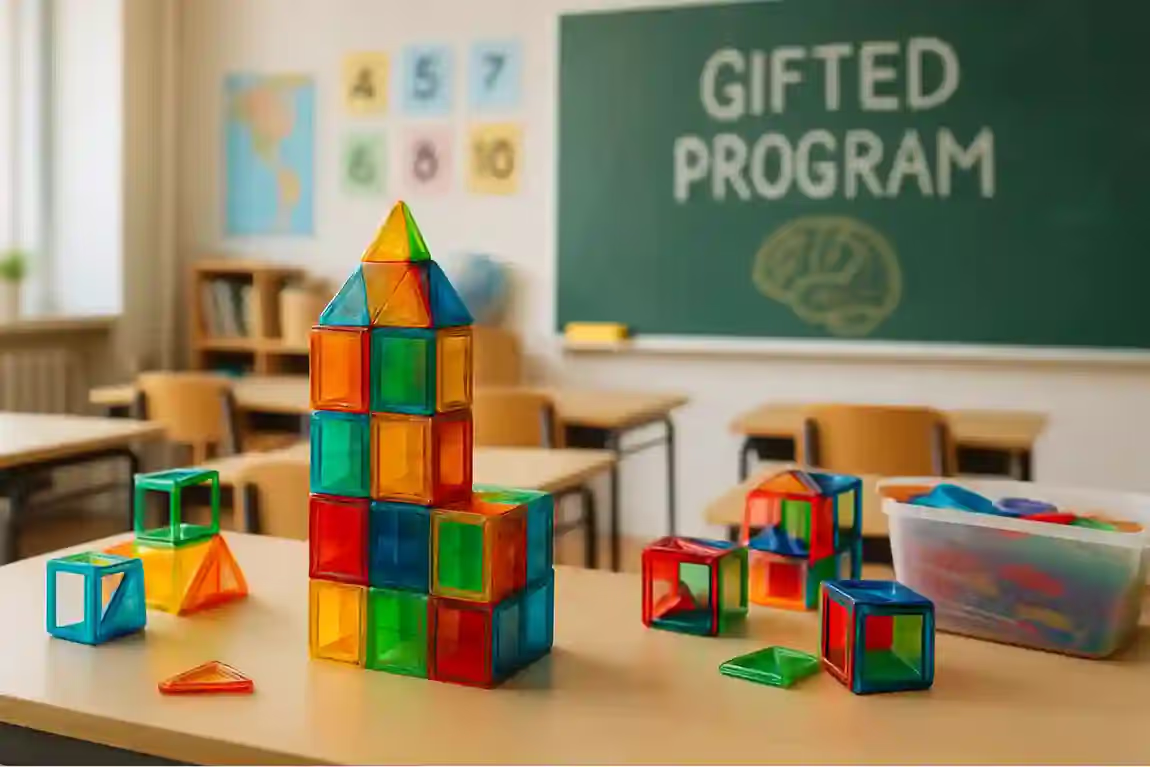
The developing brain's remarkable plasticity – its ability to form new neural connections and reorganize existing networks – makes childhood the optimal time for spatial reasoning development. Magnetic block activities capitalize on this plasticity by providing rich, varied spatial experiences that literally shape brain structure. MRI studies show that children engaged in regular spatial construction activities develop stronger connections between visual processing regions and regions responsible for mathematical thinking.
This neural development has cascading effects beyond immediate spatial skills. The posterior parietal cortex, strengthened through magnetic block manipulation, supports not just spatial reasoning but also numerical processing, abstract reasoning, and even social cognition. By developing this crucial brain region through hands-on construction, gifted programs support cognitive development across multiple domains simultaneously.
The critical period for spatial development occurs during elementary school years, making early intervention particularly important. Gifted students who receive systematic spatial training through magnetic blocks during this window show advantages that persist throughout their educational career and into professional life. Programs that wait until middle or high school to address spatial reasoning miss this crucial developmental window when the brain is most receptive to spatial learning.
As our understanding of giftedness evolves from a fixed trait to a developmental process, the role of magnetic blocks in gifted education continues to expand. New research on twice-exceptional learners – those who are both gifted and have learning disabilities – shows that magnetic blocks can provide success experiences for students who struggle in traditional academic domains. Virtual and augmented reality extensions of magnetic building offer possibilities for even more complex cognitive challenges that transcend physical limitations.
The integration of sensors and programming into magnetic blocks opens new frontiers for gifted education. Students can now build structures that respond to environmental inputs, creating bridges between physical construction and computational thinking. These "smart" magnetic blocks allow gifted learners to explore concepts like feedback loops, algorithmic thinking, and system dynamics through tangible manipulation.
Perhaps most importantly, magnetic blocks in gifted programs help redefine what we mean by intelligence and achievement. They validate spatial-mechanical intelligence alongside verbal-linguistic abilities, creating more inclusive definitions of giftedness. As educators recognize the diverse manifestations of exceptional ability, magnetic blocks serve as both assessment tools and development catalysts for talents that traditional education might otherwise overlook.
The benefits of magnetic blocks in gifted education extend beyond individual cognitive development to support broader educational objectives. In an increasingly complex, technology-driven world, spatial reasoning, systems thinking, and creative problem-solving have become essential competencies for success. Gifted programs using magnetic blocks don't just develop individual students – they cultivate the cognitive capabilities society needs to address complex challenges in engineering, medicine, environmental science, and technology.
The interdisciplinary nature of magnetic block activities mirrors the interdisciplinary thinking required in modern professional contexts. Scientists increasingly work at the boundaries between disciplines, combining insights from multiple fields to generate innovative solutions. The spatial-mathematical-artistic-engineering synthesis that occurs during magnetic construction prepares gifted students for this kind of boundary-crossing thinking that characterizes cutting-edge research and development.
Communication skills also benefit from magnetic block activities when students explain their designs, justify their engineering decisions, or teach building techniques to peers. These communication challenges require translating spatial thinking into verbal or written form, developing the ability to communicate complex technical concepts – a crucial skill for STEM professionals who must collaborate with diverse teams and explain their work to non-specialist audiences.
For educators implementing magnetic block programs in gifted settings, several key principles maximize effectiveness:
The physical environment significantly impacts the quality of magnetic block experiences. Proper lighting helps students see subtle color variations and structural details. Smooth, level surfaces enable precise construction. Adequate space allows multiple students to work simultaneously without interference. These environmental factors might seem trivial but substantially affect whether students can fully engage their cognitive capabilities.
Scheduling also matters. Magnetic block sessions work best when scheduled during high-energy periods rather than end-of-day times when cognitive resources are depleted. Some programs incorporate brief daily building sessions to maintain continuity, supplemented by extended weekly sessions for major projects. This rhythm provides both skill practice and opportunities for ambitious undertakings requiring sustained effort.
The presence of magnetic building sets in gifted programs represents more than a trend or preference – it reflects deep understanding of how exceptional minds develop. These materials provide cognitive challenges that match the intensity and complexity gifted learners crave while developing crucial skills often neglected in traditional curricula. Through magnetic construction, gifted students exercise executive functions, explore advanced mathematical concepts, develop creative problem-solving strategies, and build the spatial reasoning abilities that predict future STEM success.
The cognitive benefits extend beyond immediate skill development to fundamental changes in how gifted learners approach problems. They learn to think in systems rather than isolation, to iterate rather than perfect, to collaborate rather than compete. These meta-cognitive developments prove as valuable as any specific knowledge gained, preparing gifted students not just for academic success but for the complex, interconnected challenges they'll face as future innovators and leaders.
As we continue to understand the unique needs and potentials of gifted learners, magnetic blocks will likely remain central to gifted education. They offer something rare in educational materials – genuine complexity that emerges from simple components, unlimited potential within structured constraints, and engagement that sustains across years of development. For gifted minds that hunger for challenge and creation, magnetic building sets provide not just an educational tool but a cognitive playground where exceptional abilities can flourish and develop into the innovative capacities that will shape humanity's future.
NOVEMBER 21, 2025
NOVEMBER 21, 2025
NOVEMBER 21, 2025
NOVEMBER 20, 2025
NOVEMBER 20, 2025