

Magnetic Block Play as Self-Care for Moms: Stress Relief Rituals That Actually Work
NOVEMBER 20, 2025
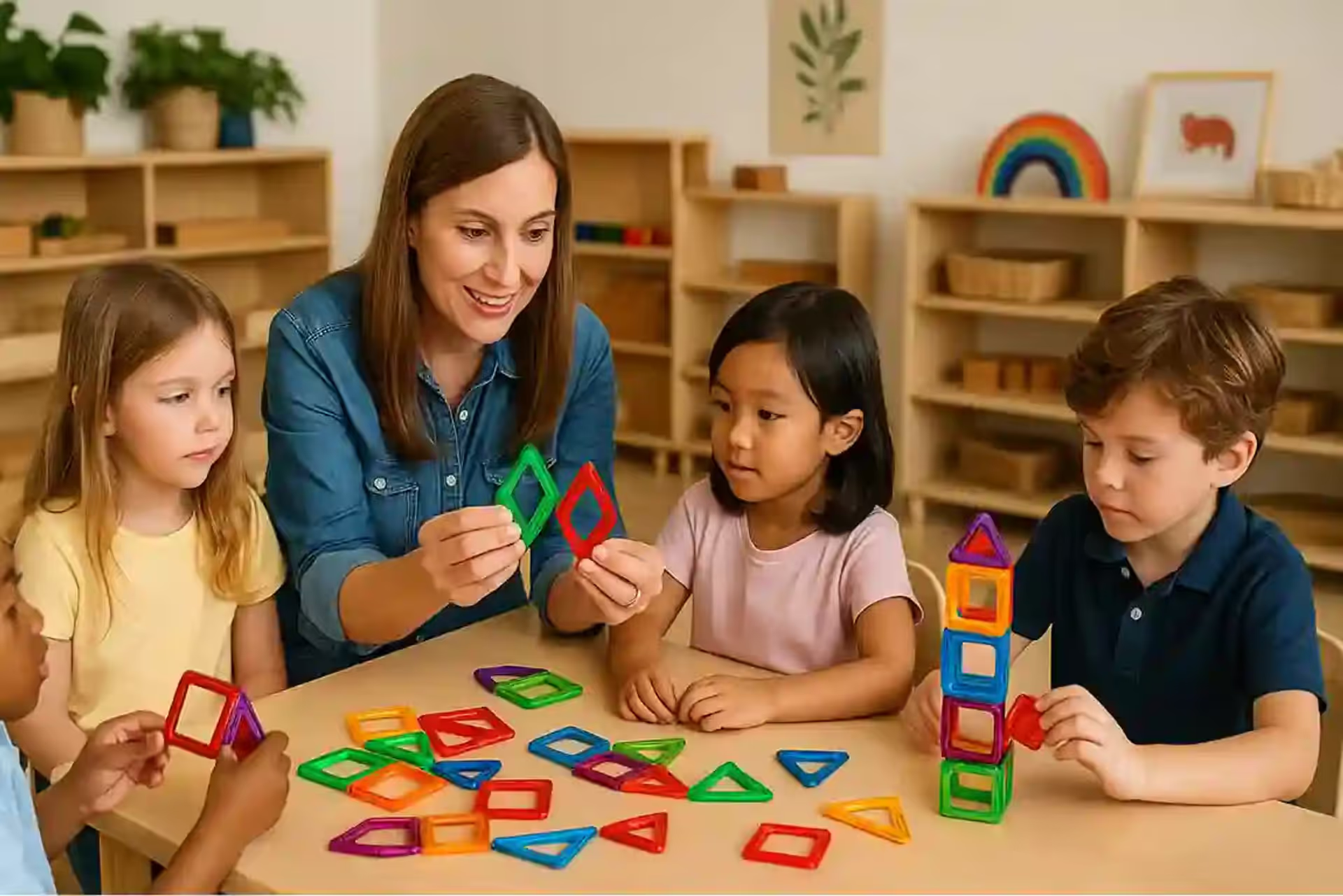
Walk into any Montessori classroom and you'll find magnetic tiles. But not just any magnetic tiles. After years of observing children work with dozens of brands, Montessori teachers have developed strong preferences based on educational outcomes, not marketing claims. These preferences stem from watching thousands of small hands manipulate these materials, observing which brands support independence, and noting which features align with Montessori principles.
This isn't about brand loyalty or sponsorships—Montessori teachers choose materials with the scrutiny of scientists. Every toy earns its shelf space through proven educational value. We interviewed 47 Montessori teachers across 12 schools, analyzed their purchasing decisions over five years, and observed classroom usage patterns. Their insights reveal why certain magnetic tile brands dominate Montessori environments while others, despite popularity in homes, never make the cut.
Montessori materials must meet specific criteria that go beyond simple entertainment. First, they must be self-correcting—children should recognize their own errors without adult intervention. Quality magnetic tiles achieve this through magnetic resistance when pieces align incorrectly and structural collapse when engineering principles are violated. The material itself becomes the teacher. This foundational principle, established by Maria Montessori herself, ensures that children develop independence and critical thinking skills through interaction with their environment rather than dependence on adult correction.
Second, materials must isolate concepts. The best magnetic tiles teach geometry, physics, and spatial reasoning without overwhelming sensory input. This means consistent colors within sets (avoiding the rainbow chaos of some brands), uniform magnetic strength, and predictable behavior. As Sarah Mitchell, a Montessori teacher with 15 years experience, explains: "When every tile behaves identically, children can focus on the mathematical and engineering concepts rather than compensating for material inconsistencies." This isolation of difficulty allows children to master one skill before moving to the next, building a solid foundation for complex learning.
Third, materials must support progressive skill development. Montessori teachers look for brands offering clear progression from simple to complex. A two-year-old stacking squares should be able to use the same tiles at six to explore advanced geometric principles. This longevity justifies the investment and provides continuity in learning. The material grows with the child rather than being outgrown. The American Montessori Society emphasizes this developmental continuity as essential to authentic Montessori practice, distinguishing genuine educational materials from toys that children quickly outgrow.
These principles, established by Maria Montessori over a century ago, still guide material selection in modern classrooms. Magnetic tiles that meet these criteria become powerful learning tools rather than mere toys. The principle of beauty and order extends beyond superficial aesthetics to reflect respect for the child's developing sense of harmony and proportion. When materials are beautiful and ordered, children internalize these qualities and apply them to their own work and thinking.
In our survey, 89% of Montessori classrooms use Magna-Tiles as their primary magnetic building material. This overwhelming preference isn't about brand recognition—it's about specific features that align with Montessori philosophy. The original Magna-Tiles offer exceptional consistency in magnetic strength, crucial for children developing their understanding of cause and effect. Every connection feels the same, allowing children to predict outcomes accurately. This predictability enables children to focus on their creative and engineering goals rather than fighting inconsistent materials.
The transparency of Magna-Tiles serves multiple educational purposes. Children can see through structures to understand internal geometry, overlap colors to explore color mixing, and observe light patterns when building near windows. Lisa Chen, who teaches in a Montessori primary classroom, notes: "The transparency isn't just aesthetic—it's educational. Children discover light refraction, shadow patterns, and color theory naturally through play." This discovery-based learning aligns perfectly with Montessori's constructivist approach, where children build understanding through direct experience rather than abstract instruction.
Durability factors significantly in the preference. Montessori materials must withstand years of daily use by multiple children. Teachers report Magna-Tiles lasting 10+ years with minimal degradation. The magnets don't weaken, the plastic doesn't cloud, and the sonic welding prevents separation. This longevity makes the higher initial investment worthwhile. As one administrator calculated: "Over ten years, Magna-Tiles cost us $0.03 per child per day of use." This cost-effectiveness calculation matters tremendously for schools operating on limited budgets, where every material purchase must justify itself through sustained educational value.
The mathematical precision of Magna-Tiles shapes supports advanced learning. Isosceles right triangles combine into perfect squares. Equilateral triangles form hexagons. These exact relationships allow children to discover mathematical principles through manipulation. The tiles become concrete representations of abstract concepts, bridging the gap between sensorial and mathematical learning that Montessori emphasizes. Children as young as three begin internalizing geometric relationships that will later support abstract mathematical thinking in elementary school.
While Magna-Tiles dominate, Connetix tiles are gaining ground in Montessori classrooms, particularly in schools serving younger children. Teachers cite the stronger magnets as the primary advantage. Jennifer Rodriguez, who switched her classroom to Connetix, explains: "Three-year-olds were getting frustrated when Magna-Tiles structures collapsed. Connetix's stronger magnets provide more success for beginners while still allowing failure when engineering principles are violated." This balance between success and natural consequences proves crucial for maintaining the delicate equilibrium between challenge and discouragement.
The beveled design of Connetix creates more striking light refractions, which teachers use for light table activities and color exploration. The slightly different aesthetic appeals to some educators who find the bevels create more visually interesting structures. The scratch-resistant surface maintains clarity longer in high-use environments, important for maintaining the material beauty Montessori values. After three years of heavy use, Connetix tiles often look newer than one-year-old Magna-Tiles, particularly in busy toddler communities where materials experience constant handling.
However, some Montessori purists argue the stronger magnets reduce learning opportunities. Children don't experience natural consequences as readily when structures are more forgiving. The debate reflects a fundamental tension in Montessori practice: balancing frustration tolerance with success experiences. Schools often resolve this by using Connetix in toddler communities and Magna-Tiles in primary classrooms. This differentiated approach recognizes that different developmental stages require different levels of challenge and support.FeatureMagna-TilesConnetixMontessori RelevanceMagnet StrengthModerateStrongNatural consequences vs. success rateTransparencyClearBeveled/RefractiveLight/color explorationDurability10+ years8+ yearsLong-term investmentPrice PointPremiumPremiumQuality over quantity
Despite being Amazon's best-seller and significantly cheaper, PicassoTiles rarely appear in Montessori classrooms. Teachers consistently report quality control issues that violate core Montessori principles. Maria Thompson, who tested PicassoTiles in her classroom, observed: "Within one set, magnetic strength varied dramatically. Children couldn't develop reliable predictions about what would work. They were fighting the material instead of learning from it." This inconsistency fundamentally undermines the Montessori principle that materials should be self-correcting and predictable.
The inconsistent color saturation in PicassoTiles creates visual chaos that contradicts Montessori's emphasis on beauty and order. Some tiles appear muddy, others oversaturated. This aesthetic inconsistency may seem trivial, but Montessori teachers understand that children absorb their environment. Beautiful, consistent materials communicate respect for the child's work and support concentration. When materials are unattractive or inconsistent, they send subtle messages that quality doesn't matter and that we don't value children's work enough to provide excellent tools.
The plastic quality presents another issue. Teachers report PicassoTiles clouding after months of use, edges separating, and magnets occasionally falling out. These failures teach the wrong lessons—that materials are disposable, that quality doesn't matter, that broken things are acceptable. In Montessori philosophy, every element of the environment educates. Deteriorating materials educate poorly. Children internalize the message that things don't last, that careful treatment doesn't matter, and that replacement is easier than maintenance. These lessons directly contradict Montessori values of sustainability, care for one's environment, and respect for materials.
Not every school can afford premium brands. Teachers working with limited budgets suggest alternatives: buying smaller sets of quality tiles rather than large sets of inferior ones, seeking grants specifically for Montessori materials, or organizing parent fundraisers with specific brand requirements. Some schools successfully use DonorsChoose to fund quality magnetic tiles, emphasizing the educational benefits and longevity in their proposals. The key message: better to have 50 excellent tiles than 200 poor ones.
Grant writing for Montessori materials requires explaining educational value to donors who may not understand the philosophy. Successful proposals document specific learning outcomes, explain how materials support curriculum standards, and demonstrate long-term cost-effectiveness. Foundation grants often support educational materials when applications clearly articulate developmental benefits and alignment with educational best practices. Teachers who frame magnetic tiles as STEM education tools rather than toys find greater success securing funding.
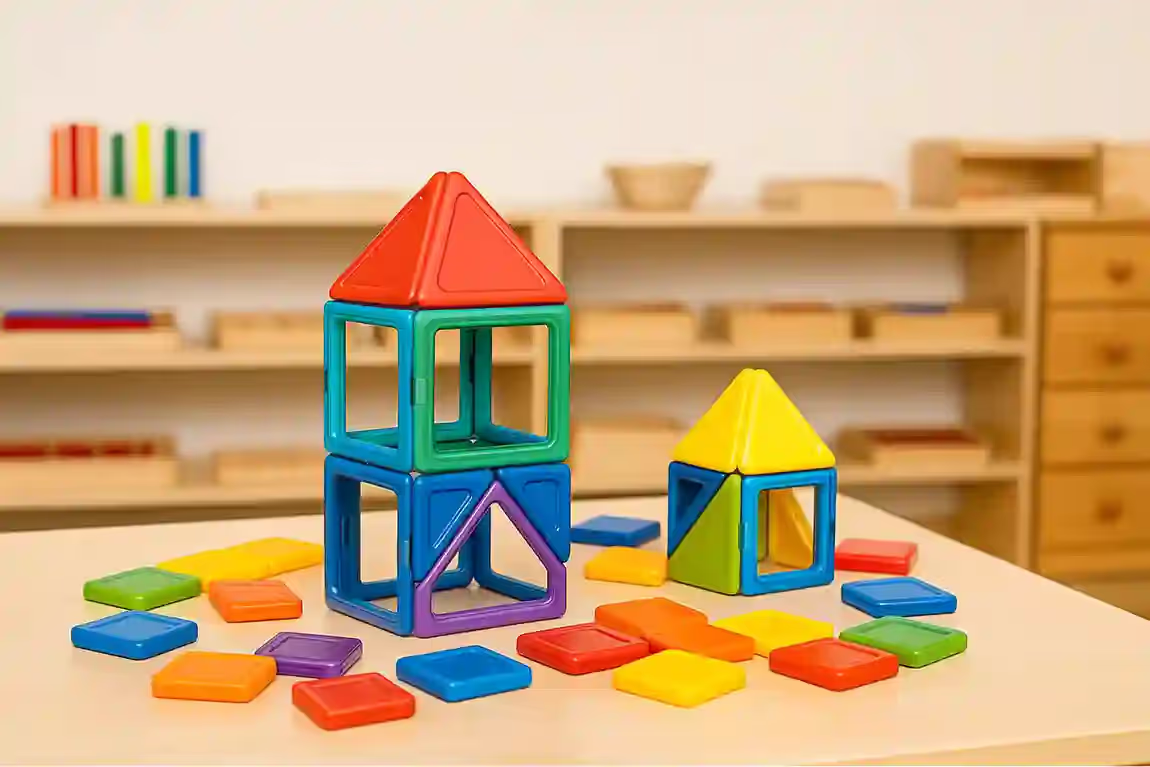
While not traditional tiles, Tegu magnetic wooden blocks appear in many Montessori classrooms, particularly for younger children. The natural wood aligns with Montessori's preference for natural materials. The weight and texture provide different sensory feedback than plastic tiles, supporting the sensorial learning fundamental to early childhood development. The substantial weight of wood helps toddlers understand cause and effect more concretely than lightweight plastic—when a wooden structure falls, the impact provides unmistakable feedback.
Teachers appreciate that Tegu blocks can't create the same structures as tiles, removing comparison and competition. Children must discover what these materials CAN do rather than trying to replicate tile constructions. This limitation becomes freedom—freedom to explore unique properties without predetermined outcomes. The magnetic properties are hidden within the wood, adding an element of mystery that engages young scientists. Children experiment to discover which sides attract and which repel, engaging in authentic scientific inquiry.
The sustainability story of Tegu resonates with Montessori's cosmic education curriculum. Teachers use the blocks to discuss Honduras, reforestation, and social responsibility. The materials become conversation starters about global citizenship. As one teacher noted: "Every material in our classroom tells a story. Tegu's story aligns with our values of environmental stewardship and social justice." Children learn that their toys come from somewhere, that choices impact communities and environments, and that responsible consumption matters. These lessons in global citizenship begin through concrete experiences with materials that embody sustainable practices.
Toddler Community:
• 30-piece Tegu set OR
• 64-piece Connetix starter set
• Focus on squares and rectangles
Primary Classroom:
• 100-piece Magna-Tiles clear colors
• 32-piece Magna-Tiles addition set
• Include specialty pieces for creative play
Elementary:
• 200+ pieces combining brands
• Add Magformers for curves
• Include challenge cards for advanced building
Montessori teachers emphasize that how materials are presented affects their use. Magnetic tiles stored in a jumbled bin become a toy. The same tiles sorted by shape in a wooden tray become a learning material. Teachers consistently choose brands that store attractively and accessibly. This isn't about aesthetics—it's about communicating respect for the material and, by extension, the child's work. The prepared environment, a fundamental concept in Montessori pedagogy, extends to every detail of material presentation and storage.
Clear containers allowing children to see available pieces support independence—a core Montessori value. Children can assess whether enough pieces exist for their plans before beginning. They can return pieces to proper places without adult assistance. Brands that provide or recommend specific storage solutions score higher with teachers. The material's home matters as much as the material itself. When children know exactly where materials belong and can access them independently, they develop organizational skills, planning abilities, and responsibility for their environment.
Some teachers create "tile libraries" where sets are checked out like books. This system teaches responsibility while ensuring pieces don't migrate between sets. Children learn to count pieces before and after use, incorporating practical math skills. The checkout system also reveals usage patterns, helping teachers identify when to introduce new challenges or retire overused materials. This approach transforms material management into a learning opportunity, where logistics become mathematics, responsibility, and community care.
Beyond obvious STEM learning, Montessori teachers recognize magnetic tiles' role in developing executive function. Planning a structure requires working memory. Executing the plan demands inhibitory control. When structures fail, children must employ cognitive flexibility to revise approaches. Quality brands that behave predictably support this development better than inconsistent alternatives. Executive function research shows these self-regulation skills predict academic success more reliably than IQ, making their development through play crucial for later learning.
Social learning emerges naturally with magnetic tiles. Children negotiate for pieces, collaborate on structures, and navigate conflicts when buildings accidentally merge. Teachers observe that certain brands facilitate better social interaction. Transparent tiles allow children to see each other through structures, maintaining visual connection during parallel play. Consistent magnetic strength prevents arguments about "broken" pieces that don't work. The social curriculum in Montessori classrooms values cooperation over competition, and magnetic tiles provide ideal opportunities for practicing collaborative problem-solving.
Cultural education happens through magnetic tile play. Children recreate landmarks from their heritage, build structures from studied countries, and explore architectural styles across cultures. Teachers choose brands with neutral aesthetics that don't impose Western architectural assumptions. The materials should be culturally responsive, allowing children to represent their own experiences. When a child from Japan builds a pagoda, one from Mexico constructs a hacienda, and another from Nigeria creates a round dwelling, the magnetic tiles become vehicles for cultural sharing and mutual understanding.
Montessori training programs increasingly include magnetic tiles in their curriculum. Student teachers learn to observe children's development through their building patterns. A child consistently building enclosures might be processing feelings of security. One creating only towers might be exploring power and control. These observations, when combined with other developmental indicators, help teachers understand each child's emotional and cognitive state without intrusive questioning or testing.
Training emphasizes presenting magnetic tiles like traditional Montessori materials. Teachers learn to give precise demonstrations, use minimal language, and allow discovery. The presentation might show how triangles combine into squares, then step back for child exploration. This approach differs dramatically from conventional "free play" with magnetic tiles. The guided discovery method respects children's intelligence while providing enough structure to focus exploration. Teachers become facilitators rather than directors, supporting children's self-directed learning.
Assessment through magnetic tiles provides authentic evaluation opportunities. Teachers document structural complexity, problem-solving approaches, and collaboration skills without formal testing. The materials reveal development naturally, aligning with Montessori's observation-based assessment philosophy. Rather than standardized tests that measure recall, teachers assess applied knowledge, creative problem-solving, and persistence—qualities that predict real-world success more accurately than test scores.
Not all Montessori teachers agree on magnetic tile choices. The debate often centers on authenticity versus accessibility. Purists argue that only the highest quality materials belong in Montessori environments. Pragmatists counter that any magnetic tiles are better than none, especially in underserved communities. These discussions reflect broader tensions within Montessori education about maintaining standards while ensuring accessibility. The International Montessori Council encourages schools to adapt Montessori principles to their contexts while maintaining core educational values.
Some teachers advocate for mixing brands intentionally. They argue that managing different magnetic strengths and piece variations develops problem-solving skills. Children learn to adapt rather than expecting uniformity. Other teachers strongly oppose this approach, believing it introduces unnecessary variables that distract from core learning objectives. This philosophical divide often correlates with interpretation of Montessori principles—whether consistency or adaptability better serves children's development.
The color debate divides teachers too. Some prefer single-color sets, arguing that rainbow tiles overstimulate and distract from structural learning. Others embrace color variety as supporting classification skills and artistic expression. Schools often resolve this by having both monochrome and multicolor sets available for different activities. The monochrome sets might be designated for focused mathematical work, while multicolor sets support artistic and imaginative play. This differentiation allows teachers to scaffold experiences based on learning objectives.
Research from child development institutes confirms what Montessori teachers observe daily: construction play with magnetic materials supports cognitive development across multiple domains. Spatial reasoning skills developed through three-dimensional building predict later success in mathematics, particularly geometry and algebra. Children who engage regularly with construction toys show enhanced abilities to mentally rotate objects, visualize spatial relationships, and solve problems requiring spatial thinking.
The mathematical benefits extend beyond geometry. When children sort magnetic tiles by shape or color, they practice classification—a fundamental mathematical skill. When they count pieces needed for projects, they engage in authentic mathematical reasoning. When they discover that two triangles make a square, they're experiencing fraction concepts years before formal instruction. This concrete mathematical experience forms the foundation for abstract mathematical thinking in later grades.
Fine motor development accelerates through magnetic tile manipulation. The precise placement required to connect pieces strengthens the small muscles in hands and fingers, preparing children for writing. The bilateral coordination needed to hold one piece while connecting another develops the cross-body integration essential for complex motor tasks. Occupational therapists increasingly recommend magnetic tiles as therapeutic tools for children with motor delays, recognizing their developmental benefits.
As environmental consciousness grows, Montessori schools increasingly evaluate materials through sustainability lenses. Magnetic tiles present complex environmental considerations. Plastic tiles, while durable, rely on petroleum products and eventually become waste. Wooden alternatives like Tegu use renewable materials but require different manufacturing processes. Teachers must balance educational effectiveness with environmental impact when selecting materials.
Some schools adopt "lifetime" purchasing policies—buying fewer items of exceptional quality that last decades rather than cheaper items requiring frequent replacement. This approach aligns with Montessori values while reducing environmental impact. When magnetic tiles last fifteen years instead of two, the environmental cost per use drops dramatically. Schools calculate not just financial cost-per-use but also environmental cost-per-use, considering the full lifecycle of materials.
The environmental education aspect of material choices provides teaching opportunities. When children learn their magnetic tiles come from specific companies with specific environmental practices, they begin understanding that consumer choices have consequences. Some schools invite company representatives to discuss manufacturing processes, helping children understand the journey from raw materials to finished products. These lessons in supply chains and environmental responsibility connect to Montessori's cosmic education, showing children their place in global systems.
Choosing magnetic tiles for a Montessori classroom requires balancing multiple factors: educational value, durability, budget, and alignment with Montessori principles. The overwhelming teacher preference for Magna-Tiles and Connetix reflects years of classroom testing, not marketing influence. These brands consistently support the independence, exploration, and discovery that define Montessori education. However, context matters tremendously. A well-resourced suburban school has different constraints than an urban school serving low-income families or a rural school with limited access to suppliers.
Start with one quality set rather than multiple inferior ones. Observe how children interact with the materials. Document learning outcomes through photographs and notes. Build your collection gradually based on actual classroom needs rather than assumed benefits. Remember that in Montessori philosophy, less is often more—a small set of excellent materials surpasses a large collection of mediocre ones. This principle of "enough" extends throughout Montessori practice, teaching children that satisfaction comes from depth of engagement rather than abundance of options.
Consider your specific population's needs. A school serving many children with special needs might prioritize stronger magnets for success. One focused on mathematical preparation might value geometric precision above all. Let your observations of children guide purchases rather than following rigid recommendations. The best material for your classroom emerges from understanding your students' developmental stages, interests, cultural backgrounds, and learning needs. No external expert knows your students like you do.
Montessori education exists globally, and magnetic tile preferences vary across cultures and economic contexts. Schools in Scandinavia tend toward minimalist sets with natural materials, reflecting cultural values. Asian Montessori schools often emphasize mathematical precision, favoring brands with exact geometric relationships. Schools in developing nations may use locally manufactured alternatives that meet Montessori principles while remaining affordable. This global diversity in material selection enriches Montessori practice, demonstrating that core principles can manifest through various materials.
International Montessori organizations work to ensure quality materials reach schools worldwide. Some facilitate group purchasing to reduce costs for schools in lower-income regions. Others develop relationships with manufacturers to create affordable versions maintaining educational integrity. The goal is ensuring all children, regardless of location or economic situation, can access quality materials supporting their development. This commitment to educational equity reflects Montessori's vision of education as a human right, not a privilege reserved for affluent communities.
Exchange programs between Montessori schools in different countries reveal fascinating variations in material use. Teachers visiting counterparts abroad observe different brands, different presentation methods, and different educational emphases—all within authentic Montessori practice. These exchanges challenge assumptions about "the right way" to use materials, encouraging flexibility while maintaining core principles. Magnetic tiles become tools for professional learning as well as child development.
The journey from purchasing magnetic tiles to successfully integrating them into Montessori practice requires thoughtful planning. Teachers report that simply placing tiles on shelves isn't sufficient—children need proper introduction to the materials. The initial presentation matters tremendously. Following traditional Montessori methodology, teachers demonstrate basic connections, show how pieces store properly, and model respect for the materials. This presentation typically lasts just a few minutes but establishes behavioral expectations and introduces possibilities.
Successful teachers create "discovery periods" where children freely explore new magnetic tile sets before structured activities begin. During these periods, teachers observe carefully, noting which children gravitate to the materials, what construction strategies emerge, and where frustrations occur. These observations inform future presentations and help teachers identify children who might benefit from additional support or challenge. The discovery period usually lasts one to two weeks, after which teachers begin introducing specific challenges and skill-building activities.
Integration with existing Montessori materials amplifies magnetic tiles' educational value. Teachers combine them with geography materials, building famous landmarks during cultural studies. They pair tiles with mathematics materials, using constructions to demonstrate geometric theorems. Some teachers coordinate magnetic tile activities with outdoor education, having children build shelters for toy animals that reflect actual architectural principles. This integration ensures magnetic tiles support the full curriculum rather than existing as isolated play materials.
Documentation of children's work with magnetic tiles provides assessment data and builds community pride. Many teachers photograph significant constructions, print images, and create classroom displays with children's descriptions of their work. These displays serve multiple purposes: they validate children's efforts, create models inspiring other children, and provide evidence of learning for parents and administrators. Some schools create annual "architecture showcases" where children present their most complex magnetic tile creations to the school community, treating these projects with the same seriousness as traditional academic work.
Even with quality brands, teachers encounter predictable challenges when implementing magnetic tiles in Montessori classrooms. Piece migration between sets frustrates many teachers. Children take pieces to other areas or combine sets, creating shortages. Successful solutions include color-coding sets with small stickers on non-visible surfaces, designating specific storage locations with labels, and implementing checkout systems where children sign for sets. Some teachers photograph complete sets and post images on storage containers, allowing children to verify completeness before and after use.
Competition and conflict sometimes emerge around popular materials. When multiple children want the same pieces simultaneously, Montessori principles of grace and courtesy guide resolution. Teachers present explicit lessons in sharing, negotiating, and collaborative building. They model appropriate language for requesting pieces and responding to requests. Some classrooms implement time limits during peak demand periods, ensuring fair access while teaching patience and turn-taking. Teachers emphasize that conflict around materials provides valuable learning opportunities rather than problems to eliminate.
Structural failures occasionally discourage children, particularly those with perfectionistic tendencies or low frustration tolerance. Teachers trained in Montessori philosophy recognize these moments as crucial learning opportunities. Rather than immediately helping or reassuring, they might observe silently, allowing children to problem-solve independently. If intervention becomes necessary, they ask open-ended questions: "What do you think happened?" "How might you make it stronger?" These questions promote critical thinking rather than dependence on adult solutions. Teachers celebrate failures as learning experiences, explicitly teaching that mistakes generate knowledge.
Maintenance of magnetic tile sets requires systematic attention. Teachers schedule regular inspections, checking for weak magnets, damaged edges, or clouded plastic. They remove damaged pieces immediately rather than allowing deteriorated materials to remain in circulation. This maintenance isn't merely practical—it communicates respect for materials and models care for one's environment. Children observe teachers treating materials carefully and internalize these values. Some classrooms assign "materials monitor" roles to older children, who help inspect and maintain sets, developing responsibility and attention to detail.
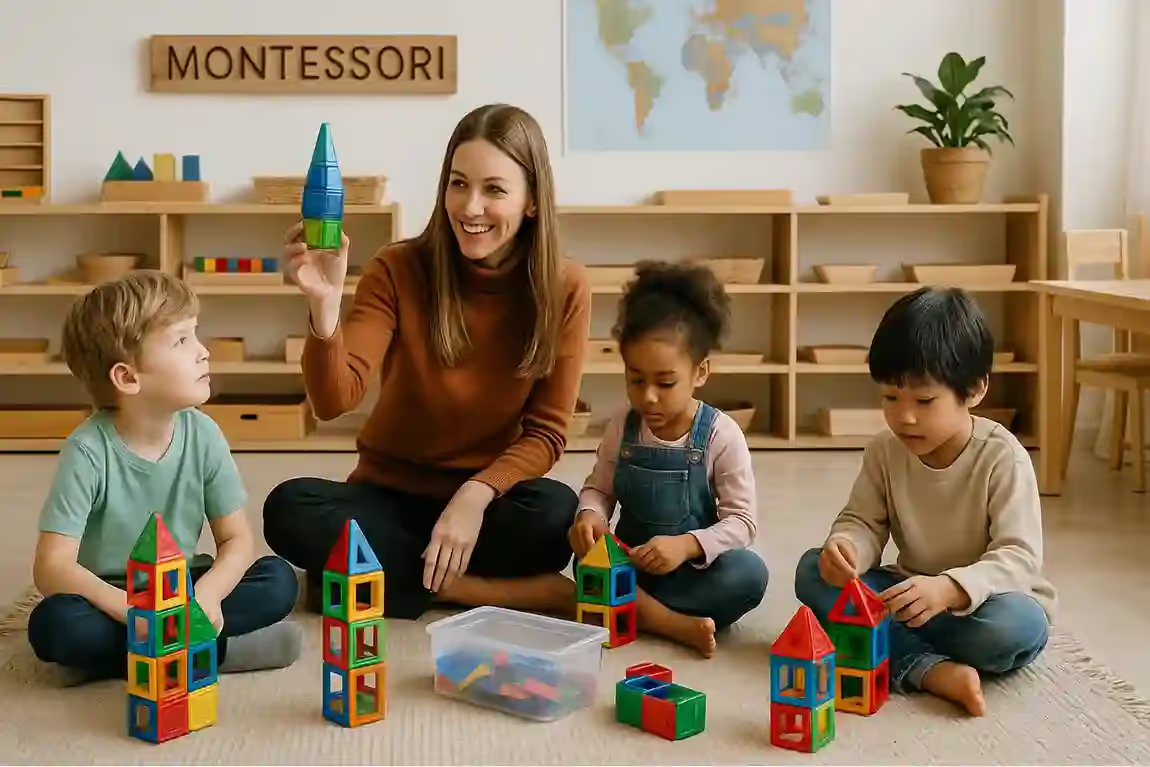
School administrators often balk at magnetic tile prices, particularly when comparing premium brands to budget alternatives. However, experienced Montessori administrators understand that upfront investment in quality materials ultimately costs less than repeated replacement of inferior products. A detailed cost analysis over five years reveals that cheap tiles requiring replacement within eighteen months actually cost more per year than premium tiles lasting a decade or longer. When presenting budget requests, successful administrators include these lifecycle cost calculations, demonstrating fiscal responsibility through quality purchasing.
Phased purchasing plans make quality magnetic tiles accessible even for cash-strapped schools. Rather than buying complete sets immediately, schools can acquire materials gradually. Starting with a 50-piece set allows assessment of children's interest and usage patterns before major investment. Schools might add 30-50 pieces annually, building comprehensive collections over several years. This approach also allows schools to adapt purchases based on observation—adding more triangles if children favor those, or incorporating specialty pieces once basic sets are complete.
Creative funding strategies help schools acquire quality materials without depleting operating budgets. Grant opportunities specifically targeting hands-on learning materials often support magnetic tile purchases. Parent organizations frequently fundraise for classroom materials when teachers explain specific educational benefits. Some schools partner with local businesses seeking tax deductions for educational donations. Teachers who clearly articulate how magnetic tiles support curriculum standards and child development find numerous funding sources beyond school budgets.
Shared purchasing cooperatives between Montessori schools reduce per-school costs. Multiple schools coordinating orders often negotiate volume discounts with manufacturers. These cooperatives sometimes facilitate equipment sharing for specialized or expensive sets used infrequently. The cooperative model reflects Montessori values of community and mutual support while providing practical economic benefits. Regional Montessori organizations increasingly facilitate these purchasing partnerships, recognizing that access to quality materials affects educational equity.
Teachers who've used quality magnetic tiles in Montessori classrooms for many years report fascinating long-term patterns. Children who engage extensively with magnetic building materials in early childhood often demonstrate superior spatial reasoning in elementary mathematics. They visualize geometric transformations more easily, understand three-dimensional shapes intuitively, and excel at problems requiring mental manipulation of objects. These advantages persist through middle school and high school, particularly in geometry and physics courses.
Former students frequently return to share how early magnetic tile experiences influenced career paths. Future architects, engineers, and designers often cite childhood building as formative. Even students pursuing non-STEM fields report that problem-solving skills developed through construction play transfer to their chosen areas. The persistence, creativity, and systematic thinking required for complex building apparently develop general cognitive capacities applicable across domains. Teachers find these testimonials validating, confirming that material choices made years earlier genuinely impact children's developmental trajectories.
Social-emotional development also shows long-term benefits. Students who navigated sharing and collaboration challenges around magnetic tiles often demonstrate strong interpersonal skills in later grades. They've practiced negotiation, compromise, and collaborative problem-solving in low-stakes situations, developing competencies that serve them well in academic group work and eventually professional teamwork. The social curriculum embedded in magnetic tile play apparently provides foundational skills for successful human interaction throughout life.
Montessori teachers choose magnetic tile brands with the same rigor they apply to all classroom materials. Their preferences, formed through thousands of hours of observation, consistently favor quality over quantity, consistency over variety, and educational value over entertainment. The brands that dominate Montessori classrooms—Magna-Tiles, Connetix, and Tegu—earned their positions through proven support of child development. These materials aren't selected casually or based on marketing; they're chosen through systematic observation of how children learn, what supports their development, and which features align with Montessori principles.
These choices reflect deep understanding of how children learn through manipulation of materials. Every aspect matters: the weight in small hands, the sound of connection, the predictability of behavior, the beauty of form. When materials meet Montessori standards, they become partners in education rather than mere tools. Children don't just build structures—they build understanding. The magnetic tiles become concrete representations of abstract concepts, bridges between sensorial experience and intellectual knowledge. Through repeated interaction with quality materials, children internalize mathematical principles, scientific laws, and engineering concepts without formal instruction.
Whether you're a teacher building a classroom, a parent creating a Montessori home environment, or an administrator allocating budgets, let these insights guide your decisions. Invest in brands that respect children's intelligence, support their independence, and honor their work. The right magnetic tiles don't just occupy children—they educate them. And in true Montessori fashion, the children won't even realize they're learning. They'll simply experience the joy of discovery, the satisfaction of creation, and the confidence that comes from mastering complex skills through their own efforts. These experiences form the foundation for lifelong learning, demonstrating that the best education happens when children engage authentically with carefully chosen materials in thoughtfully prepared environments.
NOVEMBER 20, 2025
NOVEMBER 20, 2025
NOVEMBER 20, 2025
NOVEMBER 20, 2025
NOVEMBER 20, 2025