

Magnetic Blocks for Dyslexic Children: Spatial Learning Advantages
NOVEMBER 21, 2025
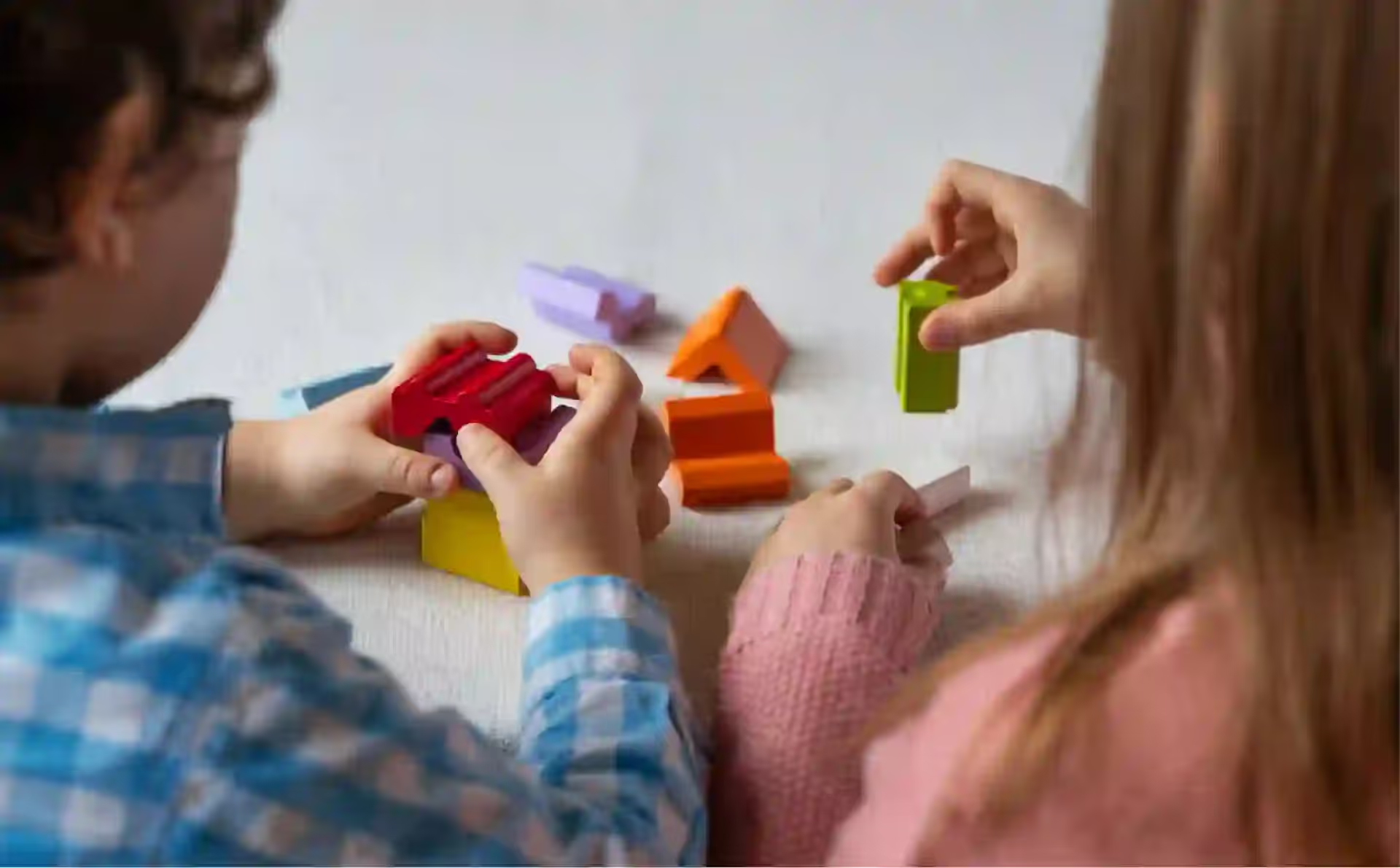
Your four-year-old sits surrounded by colorful magnetic tiles, deeply focused. She's building a tower, but not randomly—she's recreating the structure she saw in a picture book ten minutes ago. She reaches for a square piece, pauses, pulls her hand back, and selects a triangle instead. "No, wait," she murmurs to herself. "It needs this one first, then the square." She adjusts her approach, tests stability, and when a section collapses, she doesn't dissolve into frustration. Instead, she studies what fell, quietly says "try a different way," and rebuilds with a modified design.
What you're witnessing isn't just construction play. It's executive function in action—the cognitive control systems that allow your child to plan, remember, resist impulses, stay focused, and adapt when circumstances change. These aren't abstract concepts relegated to psychology textbooks. They're the mental muscles determining whether your child can follow multi-step directions at school, wait their turn during circle time, shift between activities without meltdowns, and persist through challenges rather than giving up immediately.
Executive functions are better predictors of school readiness and academic success than IQ scores. According to research from the Harvard Center on the Developing Child, these skills affect everything from reading comprehension to math problem-solving, from social relationships to emotional regulation. Children with strong executive functions adapt better to kindergarten, perform better academically throughout school, and demonstrate better life outcomes decades later.
The remarkable news is that executive functions aren't fixed—they develop through experience, particularly through certain types of play that challenge and exercise these cognitive control systems. And among play materials, magnetic blocks offer unique advantages for building executive function skills through their immediate feedback, three-dimensional construction possibilities, and open-ended nature that invites planning, problem-solving, and creative flexibility.
This isn't about turning play into work or drilling your toddler with cognitive exercises. It's about understanding how the construction play children naturally love also strengthens the neural circuitry supporting self-regulation, working memory, and mental flexibility. It's about being intentional with play materials and knowing which activities naturally scaffold executive function development—then setting up environments where children exercise these skills while having fun.
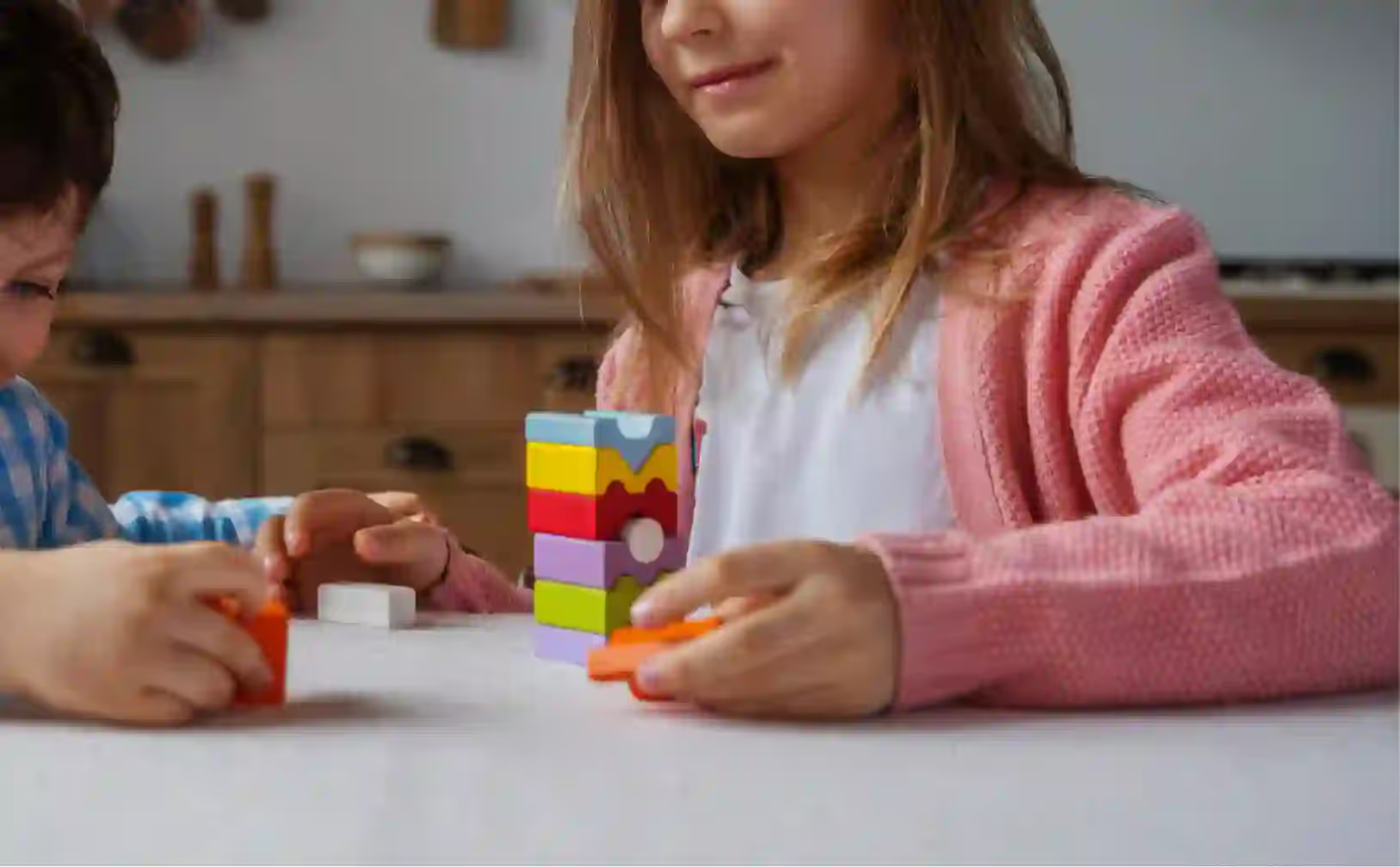
Executive functions are the cognitive processes controlling goal-directed behavior, allowing us to plan, focus attention, remember instructions, manage multiple tasks, and regulate emotions. Think of them as the brain's air traffic control system, coordinating incoming information, managing competing demands, and directing appropriate responses.
The three core executive functions form the foundation for more complex cognitive abilities. Working memory holds and manipulates information temporarily—remembering instructions while following them, keeping track of what you've already done in a multi-step task, or mentally rotating an object to visualize how it would look from a different angle. Inhibitory control (also called response inhibition or self-control) allows suppressing impulses, resisting distractions, and stopping automatic responses in favor of more thoughtful ones—not blurting out answers, waiting your turn, or choosing the right tool rather than grabbing the first one you see. Cognitive flexibility enables switching between tasks, adapting when situations change, seeing problems from multiple perspectives, and adjusting strategies when initial approaches don't work.
These three core functions integrate to produce higher-order skills like planning, reasoning, and problem-solving. They emerge gradually across early childhood, with different functions developing at different rates and continuing to mature well into adolescence and early adulthood.
Developmental timeline of executive functions shows predictable patterns while acknowledging individual variation. Around age 2-3, basic inhibitory control emerges—toddlers can begin stopping themselves from doing something forbidden, though this control is fragile and context-dependent. Simple working memory appears as children remember where they left toys or follow two-step instructions. Cognitive flexibility is rudimentary, with toddlers often rigidly attached to routines and struggling with unexpected changes.
By ages 3-5, executive functions develop rapidly during the preschool years. Working memory expands, allowing children to hold more information and for longer periods. Inhibitory control strengthens—children can wait longer for rewards, resist more tempting distractions, and catch themselves before making errors more consistently. Cognitive flexibility improves as children become less rigid, can consider alternative perspectives, and adapt to changing rules in games.
The 5-8 year period brings continued maturation with increasing sophistication. Children handle more complex working memory demands, maintain inhibitory control for extended periods, and flexibly switch between different mental sets. However, these skills remain far from adult levels—executive functions continue developing through adolescence with some aspects not fully maturing until the mid-twenties.
According to the National Institute of Child Health and Human Development, this extended development reflects both brain maturation—particularly of prefrontal cortex regions underlying executive control—and accumulated experience. Genes provide the basic architecture, but experiences literally shape neural connections through neuroplastic processes where frequently used pathways strengthen while unused ones prune away.
Neuroplastic scaffolding describes how experiences support brain development by providing structures that guide neural maturation. Just as physical scaffolding supports building construction before structures can stand independently, environmental supports and challenging experiences scaffold developing executive functions. Play that requires memory, self-control, and flexibility doesn't just test these abilities—it actively builds the neural infrastructure supporting them.
Metacognitive monitoring—thinking about your own thinking—represents a higher-order function emerging from executive function development. Young children gradually become aware of their own mental processes, recognizing when they don't understand something, knowing they need to remember information, or realizing their current strategy isn't working. This self-awareness allows children to consciously deploy executive function strategies rather than just automatically responding.
Research documented by Zero to Three, an organization focused on infant and toddler development, emphasizes that executive functions develop through supported practice in everyday activities. Children need opportunities to exercise these skills in contexts meaningful to them, with challenges slightly beyond their current ability but achievable with effort—what developmental psychologists call the "zone of proximal development."
This is where thoughtfully structured play enters. Play provides low-stakes practice environments where children can attempt executive control, experience consequences when control fails, and try again without the serious repercussions of real-world failures. Building towers that collapse teaches planning and error-correction without actual danger. Waiting your turn in a game exercises inhibitory control with only the mild disappointment of not going first, not the severe consequences of social violations in more important contexts.
The key is that play must be appropriately challenging—too easy and no executive function exercise occurs; too hard and children become frustrated and disengage. This is why adult scaffolding matters, gradually increasing challenge as children's skills develop while providing support preventing overwhelming frustration.
While all block play supports cognitive development, magnetic blocks offer specific advantages for executive function building that conventional wooden or plastic interlocking blocks don't fully provide.
The magnetic attachment mechanism creates unique affordances. Unlike wooden blocks requiring precise placement and gravitational balance, or interlocking blocks demanding fine motor precision to connect, magnetic tiles snap together with satisfying ease even when children's placement isn't perfect. The magnets provide self-correcting alignment—pieces pulled close enough to connect automatically adjust to optimal positions. This reduces fine motor demands, allowing children to focus cognitive resources on planning, remembering, and problem-solving rather than struggling with physical manipulation.
This cognitive load reduction is crucial. Working memory has limited capacity. When too much of that capacity goes toward wrestling with difficult-to-connect pieces, less remains for the executive function skills you want to develop. Magnetic blocks' ease of connection means more working memory available for remembering what you're building, planning next steps, and holding multiple possibilities in mind while deciding which to pursue.
The immediate sensory feedback from magnetic clicks provides visceral information about successful connections. This tactile and auditory confirmation helps children develop body awareness and spatial understanding while reinforcing cause-and-effect relationships—particular placements produce particular results. For children with developing self-regulation, this clear feedback supports metacognitive monitoring by making it obvious when attempts succeed or fail.
Three-dimensional construction possibilities with magnetic tiles enable building in ways wooden blocks can't match. Vertical walls, geometric enclosures, bridges, and cantilevered structures emerge easily. This 3D capacity challenges spatial working memory—children must mentally rotate pieces, visualize how structures will look when complete, and remember complex three-dimensional patterns. These spatial working memory demands transfer to mathematical thinking, particularly geometry and spatial reasoning that predict later STEM success.
Transparency and color patterns in most magnetic tiles add visual interest while creating opportunities for pattern-making, color sorting, and light exploration that engage attention and invite sustained focus. The aesthetic appeal sustains engagement longer than plain blocks might, providing extended periods for executive function exercise.
Open-ended possibilities without predetermined end products mean children must generate their own goals, plan approaches, and persist without external reinforcement from "completing" a prescribed model. This self-directed quality exercises executive functions more vigorously than closed activities with single correct solutions. When building freely, children practice setting internal goals (inhibitory control's cousin—self-monitoring), remembering what they're trying to achieve (working memory), and adjusting when initial plans don't work (cognitive flexibility).
While free play with magnetic blocks naturally supports executive function development, intentionally designed activities can target specific skills more directly. These activities work as occasional structured play rather than replacing free exploration—think of them as cognitive training that complements the general fitness of unstructured play.
Memory Matching Tower (Working Memory Development)
Target age: 3-6 years
Primary skill: Visual working memory, pattern replication
Materials needed: Magnetic tiles (at least 20 pieces in various shapes and colors), timer (optional)
Activity steps:
Create a simple structure using 4-6 magnetic pieces, arranging them in a specific pattern—perhaps a square base with two triangles forming a roof and a specific color arrangement. Show this "model tower" to your child for 15-20 seconds, then hide it behind a barrier or remove it from view. Challenge your child to recreate the structure from memory using their own pieces. Once they've built what they remember, reveal the model and compare—what matched? What differed? Discuss memory strategies like talking themselves through the pattern, creating a mental picture, or chunking information into memorable units.
Variations: Increase complexity by using more pieces, introducing specific color sequences, or reducing viewing time as skills improve. For younger children (2-3 years), start with just 2-3 pieces and allow them to look back and forth between model and their construction. For older children (6-8 years), introduce delayed reconstruction—show the model, have them do a different brief activity, then reconstruct from memory, building working memory maintenance across interference.
Executive function coaching: Narrate memory strategies aloud: "Let me think... there was a red square on the bottom, and then a blue triangle on top. I need to remember: red square, blue triangle." This metacognitive modeling teaches children they can use verbal rehearsal and visualization as memory tools rather than assuming memory just happens (or doesn't) automatically.
Stop & Go Build-and-Freeze (Inhibitory Control Training)
Target age: 2-5 years
Primary skill: Response inhibition, motor control, following changing rules
Materials needed: Magnetic tiles, music player or bell/timer
Activity steps:
Explain that you'll play music while your child builds whatever they want with magnetic tiles. When the music stops (or bell rings), they must immediately freeze—hands off the tiles, body still—no matter what they were doing mid-movement. Keep freezes brief (5-10 seconds), then restart music and building continues. Make it playful rather than punitive—the challenge is stopping yourself, not catching someone out. Gradually increase difficulty by stopping at unpredictable intervals, keeping freeze periods longer, or adding rule variations like "freeze and close your eyes" or "freeze in a funny pose."
Variations: Reverse the rules—build during silence, freeze when music plays. Add complexity with color rules—"only touch blue pieces when music plays, only red pieces during silence." For older children, introduce more complex rules requiring mental shifting.
Executive function coaching: Celebrate successful inhibition enthusiastically—"Wow, you stopped so quickly even though you were reaching for that piece!" This reinforces that inhibitory control is valuable and noticeable. When children struggle to stop, normalize it: "Stopping yourself is really hard! Let's practice. You're getting better at controlling your hands even when your brain really wants to keep building."
Switch-It Shape Challenge (Cognitive Flexibility Practice)
Target age: 4-8 years
Primary skill: Task-shifting, rule-switching, mental flexibility
Materials needed: Magnetic tiles in various shapes, categories cards (optional)
Activity steps:
Create a simple categorization game where you call out rules that determine which pieces can be used. Start with "only squares"—child builds using only square tiles for 30-60 seconds. Then switch: "now only triangles"—child must stop using squares and switch to building with triangles only. Continue switching between categories: only blue pieces, only small pieces, only pieces with straight edges, only one shape of each color, and so on. Make transitions unpredictable to practice genuine flexibility rather than memorized sequences.
Variations: Have your child call out category switches, exercising working memory (remembering what categories you've already used) plus the metacognitive awareness of recognizing when it's time to change. Create themed challenges—"build a castle but you can only use pieces that match the color of the sky/grass/sun" requiring children to hold the theme in working memory while flexibly selecting appropriate pieces. For advanced players, introduce conflicting rules requiring prioritization: "use blue pieces, but no squares—what if you want a blue square?"
Executive function coaching: When children automatically reach for excluded pieces, gently remind: "Ooh, remember our rule right now—what were we using?" This supports metacognitive monitoring. Praise successful switches: "You were building with squares, and as soon as I said triangles, you switched! That's your flexible thinking working."
Peer Collaboration Mission (Social Executive Function)
Target age: 4-8 years
Primary skill: Collaborative planning, shared working memory, social inhibitory control
Materials needed: Magnetic tiles, collaborative goal (build a structure for a toy, create an enclosure that fits specific dimensions, etc.)
Activity steps:
Partner children (sibling pairs, parent-child, or peers) to build a structure together toward a shared goal. The challenge isn't just building—it's coordinating. Each child can only touch tiles when it's their designated turn (practicing inhibitory control by waiting). Before each turn, the builder must announce their plan—"I'm going to add a blue triangle to the top"—requiring verbalization that supports working memory and planning. Partners can suggest alternatives, but the current builder makes final decisions, practicing cognitive flexibility in considering others' ideas while maintaining their own planning thread.
Variations: Introduce resource limitations—only 15 pieces total to accomplish the goal, requiring negotiation and planning. Create roles—one child is "designer" who plans but can't touch pieces, the other is "builder" who constructs but must follow the designer's verbal instructions exactly, exercising receptive working memory and verbal working memory simultaneously. For younger children, simplify to taking turns adding one piece each without the announcement requirement.
Executive function coaching: Pause periodically to reflect: "You're both remembering what we're trying to build while taking turns. That's hard!" When conflicts arise over different visions, coach problem-solving: "You each have different ideas. How can we use both, or choose one together?" This develops the emotional regulation aspect of executive function—managing disappointment and compromise while maintaining goal focus.
Reflective Build Journal (Metacognitive Development)
Target age: 5-8 years (with writing/drawing ability)
Primary skill: Metacognition, planning awareness, reflective thinking
Materials needed: Magnetic tiles, notebook or paper, drawing materials
Activity steps:
Before building, child draws or writes what they plan to create. This preview requires them to think ahead and form a mental image before acting—pure working memory and planning exercise. They build their structure, then afterward, draw or describe what they actually created and reflect on differences. Guide reflection with questions: "What was hardest? What worked well? What would you do differently next time? What surprised you?" Over time, reviewing past journal entries shows progress and patterns in their building, supporting metacognitive awareness of their own learning.
Variations: For younger children (4-5), simplify to verbal planning—tell you what they'll build before starting, then verbal reflection afterward. Photograph structures creating visual records to review later. Create challenge journals where you pose specific building problems to solve, and children document their solution attempts across multiple sessions, building awareness of strategy development over time.
Executive function coaching: The journal itself is a metacognitive tool—seeing past work makes thinking visible. Emphasize process over product: "Look how you've tried three different ways to make tall towers stable. You're learning what works through experimenting." This builds growth mindset alongside executive function—understanding that abilities develop through practice rather than being fixed traits.
Pattern Continuation Challenge (Working Memory + Cognitive Flexibility)
Target age: 3-6 years
Primary skill: Pattern recognition, working memory, rule application
Materials needed: Magnetic tiles in multiple colors and shapes
Activity steps:
Create a simple repeating pattern (red square, blue triangle, red square, blue triangle) and have your child continue it. Start with AB patterns (two-element repetition), progress to ABC patterns (three-element repetition), then introduce patterns involving both shape and color (blue square, blue triangle, red square, blue triangle...). Increase working memory load by making patterns longer before repetition. Add cognitive flexibility by changing the pattern rule mid-stream—"okay, now we're going to switch colors but keep the same shape pattern."
Variations: Have your child create patterns for you to continue, exercising their planning and rule-creation abilities. Introduce complex patterns with multiple attributes—size, shape, and color all following different pattern rules simultaneously. Create vertical or three-dimensional patterns instead of just horizontal ones, adding spatial working memory demands.
Executive function coaching: Make the pattern rule explicit: "The rule is square-triangle-square-triangle, and we keep repeating that." This verbal encoding supports working memory. When errors occur, help analyze: "Let's see... the pattern was going square-triangle-square, and you put a square next. Does that follow the rule?" This metacognitive check teaches self-monitoring.
Delayed Gratification Builder (Inhibitory Control)
Target age: 3-6 years
Primary skill: Impulse control, delayed gratification, goal maintenance
Materials needed: Magnetic tiles, special "prize" pieces (unique shapes, colors, or sizes)
Activity steps:
Place special attractive pieces (perhaps pieces with wheels, curved pieces, or particularly vibrant colors) in view but designated as "later pieces." Child must build a structure using regular pieces first, and only after completing a predetermined goal (building to certain height, using all pieces from a specified pile, or sustaining building for a set time) can they access the special pieces. This exercises inhibitory control—those special pieces are visually tempting throughout, but child must resist impulsively grabbing them. It also practices working memory (remembering the rule and goal) and sustained attention (staying focused long enough to earn access).
Variations: Use timers providing concrete visualization of waiting duration. Create "earned access" systems where completing smaller milestone goals earns access to progressively better pieces. For older children, introduce complex rules about when special pieces can be used, requiring working memory to track eligibility.
Executive function coaching: Acknowledge the difficulty: "Those sparkly pieces look so cool! But you're waiting until you finish the base first. That's great self-control." Provide countdowns or visual cues about progress toward the goal: "You're halfway there!" When children struggle, problem-solve together: "The waiting is really hard. What could help you remember not to touch those yet? Should we cover them with a cloth? Should you tell yourself 'not yet, almost' in your head?"
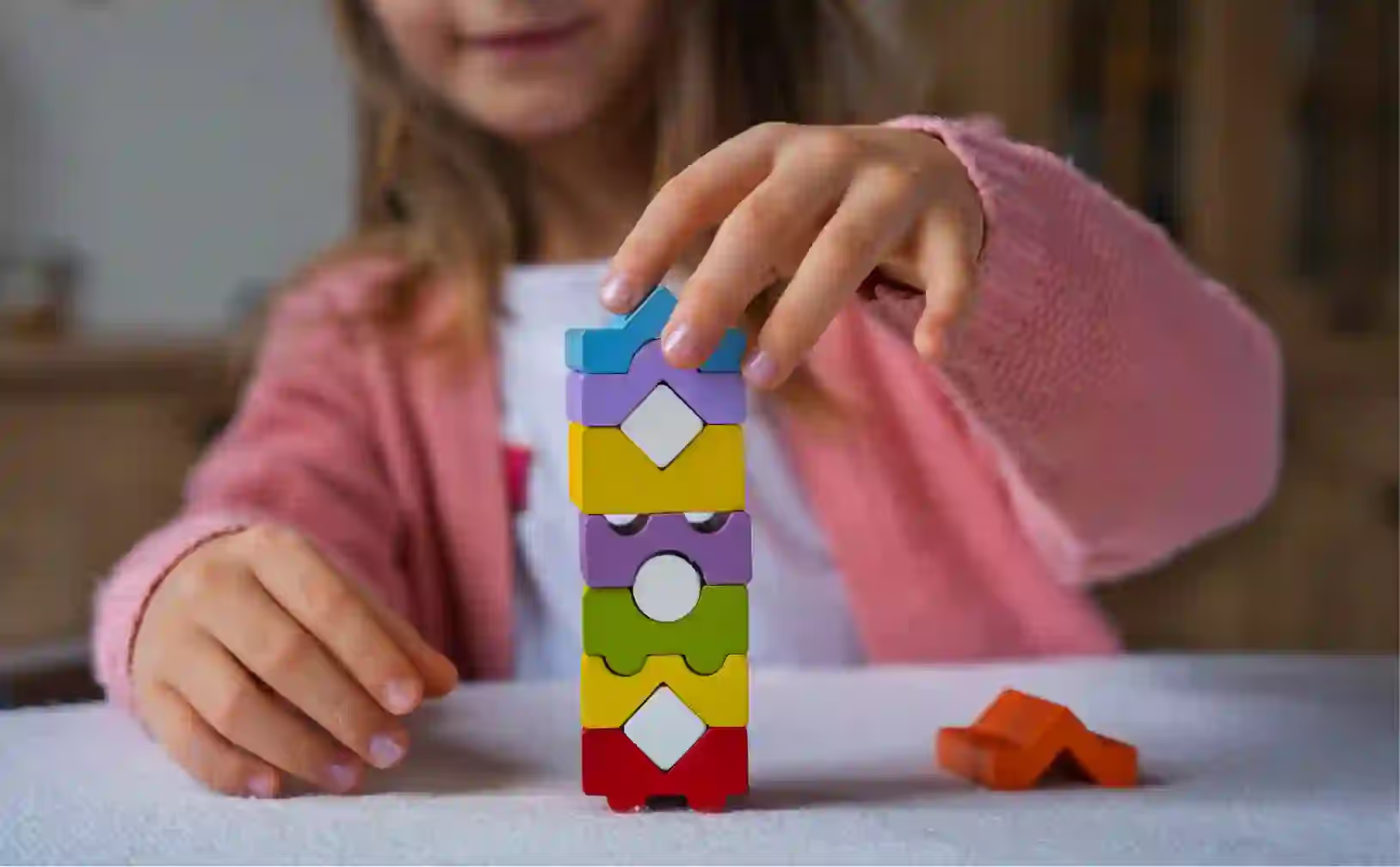
Executive function development thrives on consistency and integration into daily life rather than relying solely on isolated practice sessions. The most effective approach embeds executive-function-building play naturally into existing routines and environments.
Morning setup rituals can incorporate executive function practice. Before school or the day's activities begin, spend 10-15 minutes with magnetic block free play. This quiet, focused activity helps children transition from sleep/breakfast mode into learning mode by activating executive functions. The open-ended nature means children direct themselves, exercising goal-setting and planning first thing in the day. For children who struggle with morning transitions, this predictable activity provides structure that reduces anxiety while exercising the very skills that make transitions easier.
Transitions between activities often trigger meltdowns in young children partly because shifting between activities requires cognitive flexibility many young children haven't fully developed. Using brief magnetic block sessions as transition buffers helps. After outdoor play and before snack, a 5-minute building period helps children wind down from high-energy activity while maintaining engagement. The shift from running around to focused building exercises inhibitory control (body calming) and attention shifting. Similarly, after focused activities like reading or puzzles, brief building allows different cognitive engagement while transitioning to the next scheduled activity.
Evening wind-down routines benefit from calm, focused play before bed. Magnetic block building 30-45 minutes before bedtime activates attention and focus while remaining calm enough not to interfere with eventual sleep. Building together provides parent-child connection time while the adult can scaffold executive function development through guided play. Reflecting on the day's builds or planning tomorrow's projects during evening sessions exercises working memory and planning in time-aware contexts.
Homeschool integration allows deep incorporation of magnetic block activities into structured learning. Use blocks to teach mathematical concepts—geometric shapes, symmetry, fractions (half a circle made from two curved pieces), spatial relationships, and measurement. Building structures to meet specific dimensional requirements exercises working memory (holding the requirements in mind) and planning. Science investigations using magnetic blocks to explore physics concepts like balance, gravity, magnetic forces, and structural engineering integrate executive function practice with content learning.
Language arts benefits from block integration too. Children can build scenes representing stories, requiring working memory to recall narrative details and sequencing. They might create letters or spell words with blocks, connecting literacy to spatial-motor activity. Story problem-solving challenges where children must build structures meeting criteria from story contexts exercise reading comprehension alongside planning and working memory.
Classroom applications for preschool and early elementary teachers include designated magnetic block centers as permanent play stations. Centers work best when teachers intentionally rotate challenges rather than leaving the same materials indefinitely. Post weekly or biweekly challenges—"Can you build a bridge strong enough to hold this toy car?" or "Create a pattern structure using only three colors"—providing goals that scaffold executive function practice. Teachers can photograph structures children build, creating documentation for reflection supporting metacognitive development.
Small-group activities using collaborative building challenges teach social executive function—coordinating with peers, negotiating plans, and managing the frustration when others' ideas differ from your own. These social-emotional aspects of executive function are equally important as cognitive dimensions since real-world executive function always involves emotion regulation and social awareness.
Montessori alignment is natural since Montessori emphasizes self-directed learning, hands-on materials, and supporting executive function through practical life activities. Magnetic blocks fit Montessori's "control of error" principle—the blocks themselves provide feedback about structural stability without adult intervention. They support independence since children can use them without continuous adult assistance. Introducing magnetic blocks within orderly prepared environments with clear storage and usage expectations teaches working memory (remembering procedures) and inhibitory control (following classroom norms).
Reggio Emilia approaches emphasize learning through relationships, documentation, and environment as third teacher. Magnetic blocks can be documented extensively through photographs showing building progression, supporting metacognitive reflection. Adult-child collaboration in building projects aligns with Reggio's co-construction of knowledge. Displaying finished structures in the environment and revisiting them over time builds working memory while demonstrating that learning accumulates across time rather than being forgotten after each activity.
STEAM integration (Science, Technology, Engineering, Arts, Mathematics) uses magnetic blocks as tools for interdisciplinary exploration. Engineering challenges naturally arise in building stable, functional structures. Mathematical thinking emerges through geometry, counting, patterns, and spatial reasoning. Artistic expression appears in color choices, aesthetic design decisions, and creative representation. Scientific investigation examines magnetic forces, structural physics, and properties of materials. Technology connections include documenting builds digitally, researching architectural styles to recreate, or programming paths robots must navigate through block structures. This integrated approach exercises executive functions across content domains, building general capacity rather than narrow skills.
Scaffolding strategies maximize executive function development at appropriate challenge levels. For young children or those with weaker executive functions, provide more structure: give specific goals rather than complete open-ended play, use timers to make durations concrete, and offer visual supports like picture instructions or model structures to reduce working memory demands. As skills strengthen, gradually remove scaffolds. Ask planning questions before building: "What do you want to make? What pieces might you need? What should you do first?" Then allow building with minimal interruption. Afterwards, facilitate reflection: "How did it go? What was tricky? What worked well?"
Rotation schedules maintain interest and prevent boredom. Rather than having all magnetic blocks available always, rotate subsets—one week provide only geometric tiles, next week add wheels and specialty pieces, following week introduce themed building challenges. Rotation creates fresh engagement with familiar materials while working memory benefits from novelty. When materials return after absence, children experience them with renewed interest and often demonstrate new skills developed during the interim.
The executive functions developed through early childhood play aren't just about kindergarten readiness—they predict outcomes across the lifespan.
Longitudinal research tracking children from preschool through adulthood reveals that early executive function skills predict academic achievement better than early academic skills themselves. A preschooler with strong inhibitory control, working memory, and cognitive flexibility is more likely to succeed in elementary reading and mathematics than a preschooler who can already read or do basic math but has weak executive functions. This is because executive functions enable learning itself—paying attention to instruction, remembering what was taught, managing frustration during difficult material, and flexibly applying knowledge to new problems.
The effects compound over time. Children with strong executive functions learn more efficiently, creating knowledge advantages. They manage challenges better, building resilience. They regulate behavior more effectively, creating better relationships with teachers and peers. These advantages accumulate across educational years, affecting high school graduation rates, college enrollment and completion, and career success.
Research from the Harvard Center on the Developing Child documents that adults with stronger executive functions show better health outcomes (resisting unhealthy impulses, maintaining medical routines), better financial stability (planning for future rather than impulsive spending), stronger relationships (managing emotional reactions, considering others' perspectives), and greater life satisfaction. The ability to plan, focus attention, and flexibly adapt to circumstances affects virtually every life domain.
Play-based learning's role in developing these lifelong capabilities explains why early childhood education emphasizing play consistently produces better long-term outcomes than narrowly academic preschools. Structured play providing supported practice in executive function skills builds cognitive architecture supporting all future learning. This is why pediatricians, developmental psychologists, and early childhood educators increasingly emphasize play's importance—it's not frivolous entertainment but essential developmental work.
The specific materials matter less than the nature of play. Magnetic blocks offer particular advantages for executive function development, but many play activities build these skills: dramatic play requiring planning and role maintenance, board games exercising turn-taking and rule-following, outdoor play demanding physical impulse control and risk assessment, and arts activities requiring planning and sustained attention. The key is providing diverse play opportunities with appropriate challenges and supportive adult scaffolding.
The investment in high-quality play materials and protected time for play produces returns extending decades into the future. The child exercising working memory while building magnetic structures at age 4 is strengthening neural circuits that will help them remember multi-step mathematical procedures at age 14, manage complex work projects at age 24, and navigate cognitive aging at age 74. This isn't hyperbole—it's neuroplasticity. Experiences shape brains, and early experiences during periods of rapid development have disproportionate influence on lifelong cognitive patterns.
Are magnetic blocks safe for toddlers under 3?
Most standard magnetic block sets are labeled 3+ due to potential hazards from small internal magnets if pieces crack or seams separate. However, manufacturers produce toddler-specific magnetic blocks with extra-large pieces (4+ inches) and enhanced safety features designed for 18 months+. Only use these specially designed sets with younger children, supervise constantly, and inspect pieces regularly for any damage. At first sign of cracks or loose magnets, immediately discard pieces and discontinue use.
Can block play really improve self-regulation?
Yes, with consistent practice and appropriate challenges. Self-regulation involves inhibitory control, emotional regulation, and sustained attention—all components of executive function. Structured play activities requiring children to follow rules, wait turns, manage frustration when builds collapse, and persist toward goals provide genuine practice in self-regulation skills. The key is that play must challenge children appropriately—neither too easy (no executive function demand) nor too hard (overwhelming frustration preventing practice).
How often should I schedule executive-function activities?
Brief frequent sessions prove more effective than occasional long ones. Aim for 10-20 minutes daily of intentional executive-function-building play, plus unstructured free play with magnetic blocks available for child-directed exploration. Daily practice builds skills more effectively than weekly hour-long sessions because neural plasticity responds to consistent activation. However, even 3-4 times weekly provides benefit if daily isn't feasible. Consistency matters more than duration.
What if my child prefers screen time over blocks?
Many children show screen preference due to screens' highly stimulating, low-effort engagement. However, excessive screen time can actually impair executive function development by providing passive entertainment requiring minimal self-regulation. Gradually reducing screen access while increasing availability of engaging alternatives helps. Make block play social by building together initially rather than expecting immediate independent engagement. Introduce novel elements (special new pieces, building challenges, themed projects) maintaining interest. Some children need explicit teaching that initial disinterest or frustration is normal and doesn't mean they "don't like" blocks—persistence through initial challenge is itself executive function practice.
At what age should I start structured executive-function activities?
Very simple structured activities can begin around age 2.5-3 once children show basic language comprehension and ability to follow simple rules. However, keep activities brief, simple, and playful rather than overly formal. The line between structured activity and guided play should be nearly invisible—children should experience it as fun games, not lessons. By ages 4-5, children can handle more complex structured activities with multiple rules and longer durations. Always adjust difficulty to individual child's current abilities rather than rigidly following age recommendations.
Can magnetic blocks help children with ADHD or executive function disorders?
Magnetic blocks can be useful tools within comprehensive treatment plans for executive function challenges, including ADHD. The immediate feedback, clear cause-effect relationships, and engaging nature help maintain attention. Structured activities provide explicit executive function practice in manageable doses. However, magnetic blocks alone don't treat ADHD—they're one component of multi-faceted approaches including behavioral interventions, environmental modifications, and sometimes medication. Consult with pediatricians, psychologists, or occupational therapists for comprehensive treatment plans if executive function challenges significantly impair daily functioning.
How do I know if activities are the right difficulty level?
Appropriate challenge produces focused engagement without overwhelming frustration. If your child succeeds easily without concentration, the activity is too easy—increase complexity. If your child becomes frustrated within 2-3 minutes and disengages, it's too hard—simplify. The "just right" challenge creates moderate effort with success achievable through sustained focus. You'll observe concentrated attention, possible verbalization of thinking, brief frustrations followed by problem-solving rather than quitting, and genuine satisfaction at completion. Adjust difficulty continuously as skills develop.
Should I intervene when my child struggles or let them figure it out?
The answer is "both strategically." Allowing some struggle builds frustration tolerance and problem-solving, which are themselves executive function components. However, excessive frustration impairs executive function and teaches helplessness rather than persistence. Intervene when frustration begins escalating toward meltdown but before the child completely disengages. Ask questions rather than solving directly: "What have you tried? What else could you try? What happened when the tower fell before?" This scaffolds problem-solving while keeping ownership with the child. Direct help is appropriate when skills are genuinely beyond current abilities.
The colorful tiles scattered across your living room floor represent far more than toys. They're training equipment for the cognitive control systems your child will rely on throughout life—in kindergarten classrooms managing transitions, in middle school juggling multiple homework assignments, in high school regulating emotions during social challenges, in college sustaining attention through demanding coursework, and in adulthood navigating complex careers and relationships.
Executive functions aren't abstract psychological constructs. They're the mental tools determining whether your child can focus on the teacher while classmates whisper nearby, remember three-step directions while excited about recess, stop themselves from blurting out answers during group discussions, and adapt when the daily schedule changes unexpectedly. They're the difference between children who dissolve into frustration at first challenge and those who pause, consider alternatives, and persist.
The remarkable news is that these capabilities develop through experience, and play provides ideal practice environments. The magnetic block structures your child builds today are literally constructing neural pathways supporting cognitive control. Each time they remember their building plan while selecting pieces, they're strengthening working memory circuits. Each pause before grabbing a piece to deliberately choose the right one exercises inhibitory control. Each adjustment when towers topple builds cognitive flexibility.
However, if choosing to invest in magnetic blocks, choose for quality and functionality over trendy features. Adequate piece count and variety, reliable construction, safety certifications, and good storage matter more than novelty items or premium brands. A mid-range set ($70-130) from a reputable manufacturer often provides the best combination of quality, variety, and value for executive function development.
Most importantly, prioritize joy. Executive function development happens most effectively when children are engaged, interested, and enjoying themselves. If magnetic blocks become battles, they're not serving their purpose. Some children naturally gravitate toward construction toys while others prefer different play styles. Honor individual preferences while gently expanding interests. The goal is supporting development through play, not forcing play that feels like work.
The neural circuits supporting executive function continue developing well into the twenties. Early childhood establishes foundations, but the building continues across years. The magnetic block play you facilitate at age 4 is just the beginning of a lifelong journey of cognitive development. Starting now with intentional, playful experiences gives your child advantages that compound across time.
NOVEMBER 21, 2025
NOVEMBER 21, 2025
NOVEMBER 21, 2025
NOVEMBER 21, 2025
NOVEMBER 20, 2025