

Magnetic Block Challenges for Rainy Days: 30-Minute Building Ideas
NOVEMBER 21, 2025
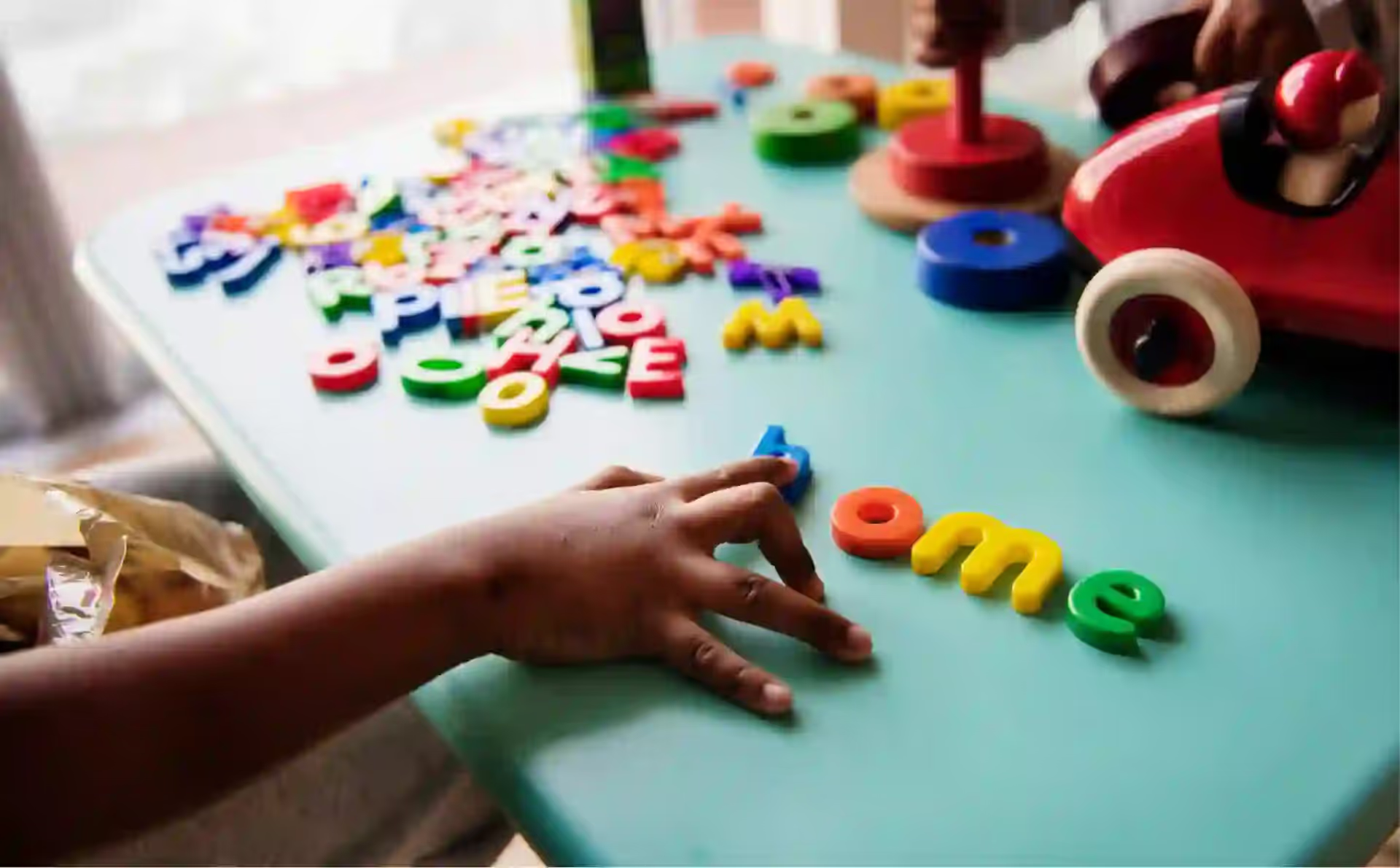
Your three-year-old arranges magnetic letters on the refrigerator, carefully spelling "GATO" while you chop vegetables. Minutes later, she points to the family cat and announces "CAT!" with equal enthusiasm. She's not confused—she's bilingual, and her brain is performing linguistic gymnastics that would exhaust most adults.
This scene plays out in millions of American homes where families are raising children in two or more languages. According to the U.S. Department of Education, approximately 22% of school-age children speak a language other than English at home, with that percentage climbing steadily each year. Spanish-English bilingualism leads, but Mandarin-English, Arabic-English, and dozens of other language pairs create the rich linguistic tapestry of modern America.
Parents in these households face a beautiful challenge: how do you nurture two languages simultaneously without overwhelming young children or yourself? How do you make language learning feel like play rather than work? And how do you find tools that support both languages without requiring separate, expensive materials for each?
Enter magnetic tiles—those colorful alphabet letters and building pieces that have decorated refrigerators and play tables for generations. What many parents don't realize is that these simple manipulatives are exceptionally powerful tools for bilingual learning with magnetic tiles, offering hands-on, multi-sensory language experiences that traditional flashcards and worksheets can't match.
Magnetic tiles work because they engage children's natural drive to manipulate, arrange, and create. They make abstract letter symbols tangible. They allow experimentation without judgment—mix up letters, try different combinations, build words in both languages side-by-side. And they transform language learning from a formal lesson into an organic part of daily play. This isn't just theory. Research in early childhood education consistently shows that manipulative-based learning enhances retention, particularly for skills requiring symbolic understanding like reading and writing. When you add the complexity of managing two linguistic systems, the hands-on nature of magnetic tiles becomes even more valuable.
This guide explores how to leverage magnetic tiles for bilingual alphabet learning and language development. You'll discover specific games and activities organized by age and skill level, understand the cognitive science supporting these approaches, learn strategies for common challenges bilingual families face, and find practical tips for integrating language play into daily routines without adding stress to already busy schedules.
Whether you're raising a Spanish-English toddler in Miami, a Mandarin-English preschooler in San Francisco, or a Arabic-English kindergartener in Detroit, these strategies adapt to your specific language pair and family situation.
Understanding how children acquire multiple languages helps you support that development intentionally rather than accidentally. The research is clear: bilingualism isn't confusing or harmful—it's cognitively beneficial in ways that extend far beyond communication.
Language acquisition in early childhood follows predictable patterns regardless of whether children learn one language or several. Babies are born with the capacity to distinguish phonemes (distinct sound units) from all human languages. As they're exposed to specific languages, their brains tune in to relevant sounds while neural pathways for unused phonemes gradually prune away.
This "use it or lose it" principle explains why children who hear multiple languages from birth maintain the ability to perceive and produce sounds from all those languages, while monolingual children lose sensitivity to sounds not present in their language. A Japanese-English bilingual child easily distinguishes between "R" and "L" sounds, while a monolingual Japanese speaker often struggles because Japanese doesn't distinguish these phonemes.
According to the American Speech-Language-Hearing Association (ASHA), children exposed to two languages from birth (simultaneous bilingualism) develop both languages at roughly the same pace as monolingual children develop one language. There might be slight delays in vocabulary in each individual language, but total vocabulary across both languages typically equals or exceeds monolingual peers.
Bilingualism impacts cognitive development in fascinating ways. Research documented by the National Institute on Deafness and Other Communication Disorders demonstrates that bilingual children show enhanced:
These advantages emerge because managing two language systems requires constant mental juggling. Even when speaking one language, bilingual brains must suppress the other language, monitor which language the conversation partner uses, and switch linguistic frameworks seamlessly. This mental workout strengthens cognitive control systems that benefit all types of thinking, not just language.
The "one person, one language" approach has traditionally been recommended for bilingual families, where each parent consistently speaks a different language to the child. However, more recent research suggests this rigid approach isn't necessary. What matters most is consistent, rich exposure to both languages rather than strict separation of who speaks which language.
Some families designate languages by context (Spanish at home, English at school), time (English during weekdays, Spanish on weekends), or activity (English for homework, Spanish for bedtime stories). Others practice translanguaging—fluidly moving between languages in single conversations, which mirrors how many bilingual communities naturally communicate.
Critical periods for language acquisition have been somewhat overstated in popular understanding. While it's true that pronunciation and grammar are learned most easily in early childhood, language learning remains possible throughout life. The key advantage of early bilingual exposure is that children absorb languages implicitly through interaction rather than explicit study.
By preschool age (3-5 years), children's phonological systems for both languages are well-established. This is an ideal time for introducing alphabet learning and early literacy activities because children have internalized the sound systems they'll represent with letters.

Magnetic tiles transform language learning through several key characteristics that align with how young children naturally learn best.
Multi-sensory engagement makes learning "stick" better than single-sensory approaches. When children manipulate magnetic letters, they simultaneously:
This multi-sensory input creates stronger neural pathways than visual-only methods like workbooks or screen time. The more senses involved in learning, the more robust the memory formation.
Tactile manipulation activates motor memory, which is particularly powerful in young children who are kinesthetic learners. The physical act of arranging letters to spell "PERRO" and "DOG" side-by-side creates muscle memory that reinforces the visual memory of those words. Children literally handle language, making abstract symbols concrete and manipulable.
Open-ended play nature encourages linguistic experimentation without fear of errors. There's no "wrong" way to arrange magnetic tiles—they can be reorganized instantly. This low-stakes environment lets children test hypotheses about how language works: "What happens if I put these letters together?" "Can I spell this word like it sounds?" "Do these two words look similar in both languages?"
This experimental approach aligns with constructivist learning theory, which posits that children build understanding through active exploration rather than passive reception. Magnetic tiles facilitate this construction process for language concepts.
Alignment with Montessori principles makes magnetic tiles ideal for homes and classrooms using Montessori approaches. The Montessori method emphasizes:
Resources from Montessori Northwest describe how language materials should invite exploration while providing inherent feedback, exactly what magnetic tiles offer—letters either form recognizable words or they don't, providing immediate self-correction.
Symbolic representation becomes tangible when children physically arrange letters to represent sounds and words. This orthographic mapping—connecting written symbols to spoken language—is fundamental to reading development. Magnetic tiles make this abstract process visible and manipulable.
For bilingual children, magnetic tiles offer unique advantage: they can physically compare how the same object or concept is represented in two languages. Building "AGUA" and "WATER" side-by-side makes the connection between translation equivalents explicit and memorable.
The low-tech, distraction-free nature of magnetic tiles prevents cognitive overload that can occur with apps and digital learning tools. While technology has its place, young children often learn alphabet skills better with physical manipulatives because they're not simultaneously processing interface navigation, touch responsiveness, and audio stimuli that compete with the core learning objective.
Portability and accessibility mean magnetic tiles can be used anywhere—kitchen refrigerator during meal prep, small magnetic board during car rides, cookie sheet at the park. This flexibility allows parents to integrate language learning into daily routines rather than requiring dedicated lesson times.
These activities progress from simple letter recognition to complex bilingual literacy skills, organized by developmental stage. Each game can be adapted to your specific language pair and your child's current abilities.
Beginning Level (Ages 2-4)
Magnetic Letter Treasure Hunt transforms letter recognition into an active adventure. Hide five to ten magnetic letters around a play area, then call out each letter in both languages—"Find the letter B! En español, B!" When your child locates the letter, have them place it on a magnetic surface, make the letter's sound in both languages, and name a word starting with that letter in each language. This combines gross motor movement with letter identification, phoneme recognition, and vocabulary building. The physical act of hunting makes learning exciting rather than sedentary, and the dopamine released during the search enhances memory formation.
Dual-Language Color Association builds letter-color recognition while introducing color vocabulary. Choose a color and name it in both languages—"Blue—Azul"—then find all magnetic letters in that color. For each letter, name it and make its sound in both languages. Expand the activity by finding objects in the room matching that color, naming each in both languages. For older children in this range, try spelling the color words using letters of that color. This multi-attribute classification builds cognitive flexibility that transfers across all learning domains.
Letter-Sound Drumming Circle develops phonological awareness through rhythm and movement. Arrange magnetic letters in a circle on a large magnetic surface, then point to each letter while making its sound (not name)—saying "sss" not "ess." Have your child repeat the sound, then clap or drum the rhythm of that sound. Move clockwise around the circle, completing it once in each language. This teaches that letters represent different sounds depending on which language you're speaking, while the rhythmic element creates memorable sound-letter associations through multiple sensory channels.
Intermediate Level (Ages 4-6)
Magnetic Word Bridge makes translation relationships tangible by building words in both languages side-by-side. Choose a visible object like a door or table, build the word in the first language on the left side of your magnetic surface, then build the translation on the right. Create a physical "bridge" connecting them using shared letters, magnetic shapes, or the object's picture. Read both words while pointing, then discuss similarities and differences—which word is longer, whether they share any letters, how they start with different sounds. This visual-spatial approach makes abstract translation concepts concrete and memorable while building metalinguistic awareness.
Build-a-Sentence Magnetic Wall teaches sentence structure as children progress beyond single words. Using pre-made word tiles or words built from letters, construct simple subject-verb-object sentences in one language like "Cat eats fish," then build the translation directly below it. Read both sentences while pointing to each word, discussing how they use the same number of words or different word order. Rearrange words to create silly or impossible sentences like "Fish eats cat," teaching that word order matters for meaning. This manipulation without permanence encourages experimentation that wouldn't happen with paper and pencil.
Letter Morphing for Phonological Awareness builds understanding that changing single letters transforms words. Start with a simple three-letter word like CAT, then change one letter to make a new word—CAT becomes BAT. Continue the chain (BAT to BAR to CAR back to CAT), naming both words clearly each time and discussing what sound changed. Try the same pattern in the second language. This directly teaches phoneme segmentation and substitution, which are fundamental skills for decoding unfamiliar words while reading and for spelling words children have never seen written.
Advanced Level (Ages 6-8)
Cognate Detective Game turns discovering word relationships into a puzzle-solving mission. Build a word in one language like ANIMAL, then challenge your child to build a word in the other language that sounds similar and means the same thing. Spanish-English pairs have thousands of cognates due to Latin influence—música/music, familia/family, importante/important. Create a growing "cognate collection" on your refrigerator, adding new discoveries from reading or conversation. This teaches that languages aren't isolated systems but interconnected webs with historical relationships, while giving children strategies for guessing meanings of unfamiliar words.
Syllable Surgery Activity builds fluency by teaching children to break multisyllabic words into manageable chunks. Build words like MAG-NET-IC with visible spaces between syllables, say the word slowly while clapping each syllable, then count them together. Remove one syllable and read what remains—does it make a real word or nonsense? Repeat in the second language, noting that translations may have different syllable counts. This skill helps children tackle long unfamiliar words by decoding each syllable individually rather than being overwhelmed by intimidating letter strings.
Prefix/Suffix Transformation Station teaches how word parts combine to create meaning. Create a base word station with roots like HAPPY and CARE, plus separate piles of prefixes (UN-, RE-) and suffixes (-ER, -LY). Add suffixes to transform HAPPY into HAPPIER or HAPPILY, discussing how meaning changes. Try equivalent transformations in the second language, discovering that languages use different morphological strategies—Spanish forms comparisons with MÁS rather than -ER suffixes. Recording successful combinations creates a reference tool for independent word learning, as morphological awareness helps children deduce meanings of previously unseen words by analyzing component parts.
Speech-language pathologists increasingly incorporate manipulatives like magnetic tiles into bilingual therapy sessions. These applications work equally well for parents addressing speech concerns at home.
Articulation practice benefits from the visual and tactile components magnetic tiles provide. When targeting a specific sound (like /r/ in English or the rolled /r/ in Spanish), having the letter visible and tangible helps children:
A typical session might involve building a "collection" of words containing the target sound, with the child producing each word aloud as they build it. The growing pile of successfully produced words provides visual progress feedback that motivates continued practice.
Bilingual articulation considerations: Some sounds exist in one language but not another (like the "th" sound in English not present in Spanish). Magnetic tiles help children understand that certain sounds are language-specific, reducing negative transfer (applying one language's pronunciation rules to another).
According to ASHA's practice portal on bilingual service delivery, therapy should incorporate both languages when possible, validating each as equally important. Magnetic tiles facilitate this by allowing side-by-side work in both languages.
Language delay and magnetic tiles: For children with expressive or receptive language delays, magnetic tiles provide non-verbal communication options. A child who struggles to verbally express "I want the blue car" might build "BLUE CAR" with tiles, demonstrating comprehension and communication intent even when verbal expression is challenging.
Vocabulary building for language disorders: Children with word-finding difficulties or limited vocabulary benefit from creating "word collections" organized by category (animals, foods, actions). Building these collections with magnetic tiles provides:
Bilingual language assessment caution: Parents should know that bilingual children's language development shouldn't be assessed using monolingual norms. A child might have smaller vocabulary in each individual language but total vocabulary across both languages that exceeds monolingual peers. If concerned about speech or language development, consult with a bilingual speech-language pathologist who understands typical bilingual development patterns.
Magnetic tiles target specific literacy skills that form reading and writing foundations.
Phonemic awareness—the ability to hear, identify, and manipulate individual sounds—is the strongest predictor of reading success. Magnetic tiles support phonemic awareness through:
Sound isolation: Build a word, identify and remove the first/last sound. "CAT → AT" demonstrates that removing /k/ creates a different word.
Sound addition: Start with incomplete words, add initial or final sounds. "AT → CAT, BAT, RAT" shows how adding /k/, /b/, or /r/ creates different words.
Sound substitution: Systematically change one sound at a time, observing how meaning changes. This appears in the "Letter Morphing" game described earlier.
Syllable segmentation breaks words into syllable units, teaching children that multisyllabic words are constructed from smaller parts. This is particularly valuable for reading longer words that would be overwhelming if approached as single units.
Use magnetic tiles to:
Orthographic mapping is the process of forming letter-sound connections in memory so words can be recognized automatically. This requires:
Magnetic tiles make orthographic mapping explicit by letting children physically manipulate the connection between sounds and letters. When a child builds "NIGHT" and discovers that "GH" makes no sound while "IGH" says /ī/, that's orthographic mapping in action.
Bilingual literacy advantage: Research shows that phonemic awareness and orthographic mapping skills transfer between languages. A child who understands that English words are made of separable sounds will apply that understanding to Spanish, even though the specific sounds and spelling patterns differ. This is one way bilingualism accelerates literacy—skills learned in one language support reading in both.
Language and culture are inseparable. Magnetic tile activities provide opportunities to embed cultural learning in language development.
Storytelling with magnetic tile scenes: Traditional stories from both cultures can be represented visually with magnetic tiles:
Setup: Use both magnetic letters and magnetic building tiles or shapes.
Activity:
Heritage language games: Connect holidays and cultural celebrations to magnetic tile vocabulary:
Family participation across generations: Involve grandparents or relatives who speak the minority language:
These activities honor family linguistic heritage while making the heritage language feel valued and relevant rather than an imposed chore.
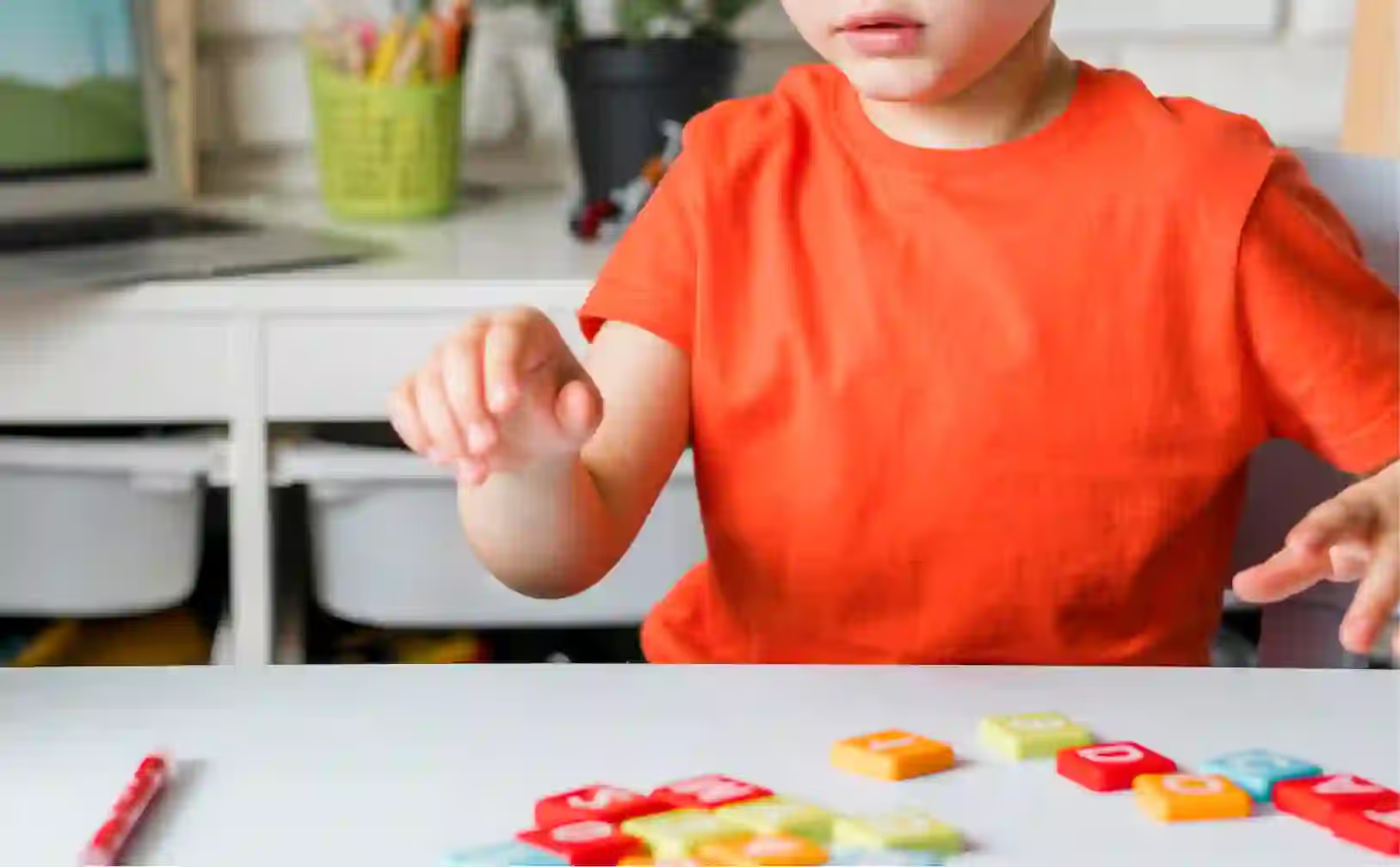
While magnetic tiles are generally safe, specific precautions protect young children.
CPSC toy safety regulations: The Consumer Product Safety Commission oversees toy safety, including magnetic toys. Following widespread injuries from small magnetic balls, regulations now require:
ASTM F963 compliance: This voluntary standard (made mandatory through CPSIA) includes specific magnetic toy requirements. Quality magnetic letter tiles should:
Ideal magnetic tile characteristics for children under 3:
Choking prevention strategies:
What to do if magnet ingestion suspected: If you believe a child swallowed a magnet, especially if multiple magnets or a magnet plus other metal object were ingested:
Multiple magnets can attract through intestinal walls, causing tissue death and perforation—a medical emergency requiring surgery. According to medical research on NCBI, magnet ingestion injuries increased dramatically with magnetic toy popularity, making prevention critical.
Can magnetic tiles help with delayed speech?
Magnetic tiles won't substitute for professional speech therapy if significant delays exist, but they can supplement therapeutic approaches. The multi-sensory nature supports language learning for children with various learning differences. However, if your child isn't meeting CDC early childhood milestones for speech and language, consult with a pediatrician and speech-language pathologist. Magnetic tiles can then be incorporated into the therapy plan the SLP develops.
What language pairs are easiest to teach using magnetic tile games?
Languages sharing the same alphabet (English-Spanish, English-French, English-Italian) are simplest because you can use a single letter set. However, even different-script languages (English-Mandarin, English-Arabic, English-Russian) benefit from magnetic tiles—you'll just need separate letter sets for each writing system. The cognitive benefits of comparing different scripts can actually be valuable, making the different writing systems explicit rather than confusing.
How often should we do bilingual tile activities?
Brief daily sessions (5-15 minutes) provide better results than weekly marathon sessions. Language learning requires consistent exposure and practice. That said, any regular schedule beats no schedule. If daily isn't realistic, aim for 3-4 times weekly. The key is making activities feel playful rather than like homework—if your child resists, sessions are too long or too frequent.
Are letter-only tiles better than tiles with pictures?
It depends on the learning stage. For initial letter recognition (ages 2-4), picture tiles showing objects starting with each letter help children connect abstract symbols to concrete referents. As children progress to reading (ages 5+), plain letter tiles encourage focus on letter shapes and sounds without picture distractions. Ideally, have both available and use appropriately for the skill being taught.
My child only wants to play in English—how do I encourage minority language use?
Make the minority language intrinsically rewarding rather than forced:
Do I need to correct mistakes during magnetic tile play?
Gentle correction maintains accuracy without discouraging effort. When your child builds a word with reversed letters or incorrect spelling, you might say: "Oh, you're building 'dog'! Watch how I build it—D-O-G. See the difference?" Then have them rebuild it correctly. Avoid harsh corrections ("No, that's wrong!") that create anxiety around language learning. The goal is iterative improvement through supportive feedback, not perfection on first attempt.
Can magnetic tiles replace formal language instruction or immersion programs?
No. While magnetic tiles are valuable supplementary tools, they can't replace comprehensive language instruction through immersion programs, bilingual schools, or consistent home language use. They're one component of broader language exposure strategy. Think of them as vocabulary and literacy support tools rather than complete language programs.
What if my partner and I speak different English dialects—which should we use with tiles?
Dialectical variation is linguistic richness, not a problem. Use your authentic dialects—children naturally develop "code-switching" abilities between dialects just as they do between languages. When building words with magnetic tiles, you might discuss how the same word sounds different in different dialects, which builds metalinguistic awareness. For spelling, standard written forms remain consistent across most English dialects.
Your child's bilingual brain is doing remarkable work every single day—juggling phonological systems, grammatical structures, vocabulary sets, and cultural contexts across two languages. That mental juggling builds cognitive flexibility, enhances executive function, and creates cultural bridges that will benefit them throughout life.
Magnetic tiles transform this complex developmental process into something tangible and playful. Instead of abstract language instruction, you're offering hands-on exploration. Instead of worksheets and drills, you're providing open-ended games. Instead of formal lessons that feel like work, you're integrating language learning into the natural play that children already love.
The goal isn't creating perfect bilingual children who never code-switch, never forget words, and speak both languages with native fluency in every context. That's an unrealistic ideal that sets families up for disappointment. The goal is raising children who are comfortable with both languages, who view bilingualism as an asset rather than a burden, and who maintain connection to family heritage while thriving in their broader community.
Magnetic tiles can't guarantee that outcome—language development depends on many factors beyond any single toy or activity. But they can make the journey more playful, more tangible, and more successful. They can transform language learning from something that happens to children into something children actively do.
So pull out those colorful letters, clear a spot on the refrigerator or magnetic board, and start building—in English, en español, 用中文, بالعربية, or whatever languages fill your home. Build words, build sentences, build bridges between languages and cultures. Build literacy skills and cognitive flexibility. Build confidence and linguistic identity.
Most importantly, build memories of language learning that feel like play, connection, and joy rather than obligation and struggle. Because when learning feels like play, children don't just learn—they thrive.
NOVEMBER 21, 2025
NOVEMBER 21, 2025
NOVEMBER 20, 2025
NOVEMBER 20, 2025
NOVEMBER 20, 2025